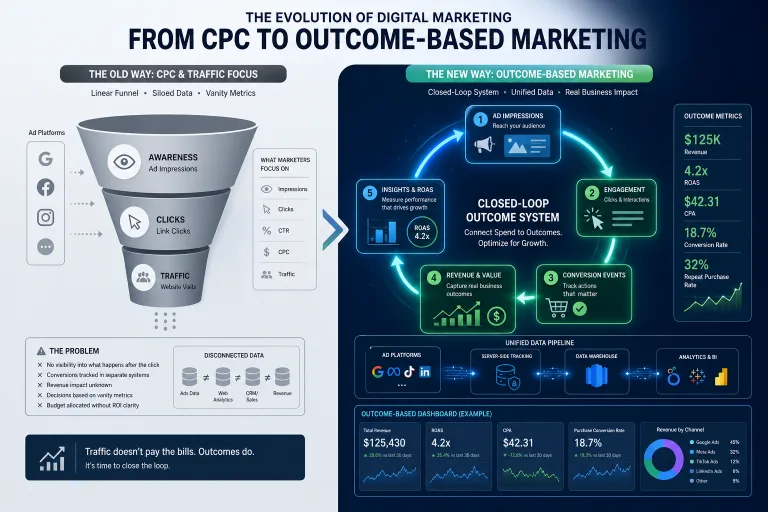
The advertising industry has entered a phase that The Drum dubbed the “outcomes era.” The premise is simple: every dollar invested — whether in a brand campaign or a performance buy — must now prove its commercial impact. The old divide between “image” and “direct response” advertising is fading. For media buyers and arbitrage specialists, this means funnels where the top level isn’t measurably linked to conversions are becoming increasingly expensive and risky.
The drivers of this shift are programmatic buying with real-time bidding, tools like Google Analytics that closed the loop from impression to action, and closed-loop systems like AppLovin that automatically ingest outcome data, model it, and reinvest the budget. The result is a market where the outcome becomes not just a goal, but the very architecture of media buying.
In this article, we’ll break down exactly how the outcome economy works, what it changes for arbitrageurs and media buyers, and how to restructure your purchasing so you don’t lose ROI during the transition.
What Is the “Outcomes Era” and How We Got Here
Outcome-based marketing is an approach where every ad touchpoint is evaluated by the probability of it leading to a measurable commercial result: a purchase, install, lead, or subscription. Not by reach, not by clicks, not by brand lift — but by the outcome itself.
The path to this model took about two decades:
- 2000s — CPC models. Google AdWords made the click the primary currency. Marketers got direct response for the first time.
- 2010s — Programmatic and RTB. Algorithmic buying allowed evaluating every impression in milliseconds and bidding based on conversion probability.
- 2020s — Closed-loop systems. AppLovin, Meta, and Google closed the loop: outcome data automatically flows back into the optimizer, which reallocates budget without human intervention.
Each stage tightened the requirement for measurability. In the CPC era, you could justify spend with “traffic to the site.” Now, the client or buyer must show what revenue that traffic generated.
Closed-Loop Performance: How AppLovin Rewrote the Rules
AppLovin is the most striking example of a closed-loop system in mobile marketing. The platform doesn’t just buy impressions — it ingests postback event data (installs, purchases, retention), builds an outcome probability model, and automatically reinvests budget into the most efficient segments.
For arbitrageurs, this means:
- Budget flows to the algorithm. Manual optimization by CPI/CTR loses to automatic optimization by LTV/purchase.
- Transparency decreases. You don’t see the logic by which the algorithm chose a specific impression — only the result.
- Reaction speed increases. If a creative stops delivering outcomes, the system shuts it down in minutes, not days.
Similar mechanisms are appearing in Google Ads: Smart Bidding with Target ROAS, Performance Max, value-based optimization — all these are elements of a closed-loop approach where the system itself links the impression to the outcome and adjusts bids.
Why Brand Advertising Can No Longer Hide from Accountability
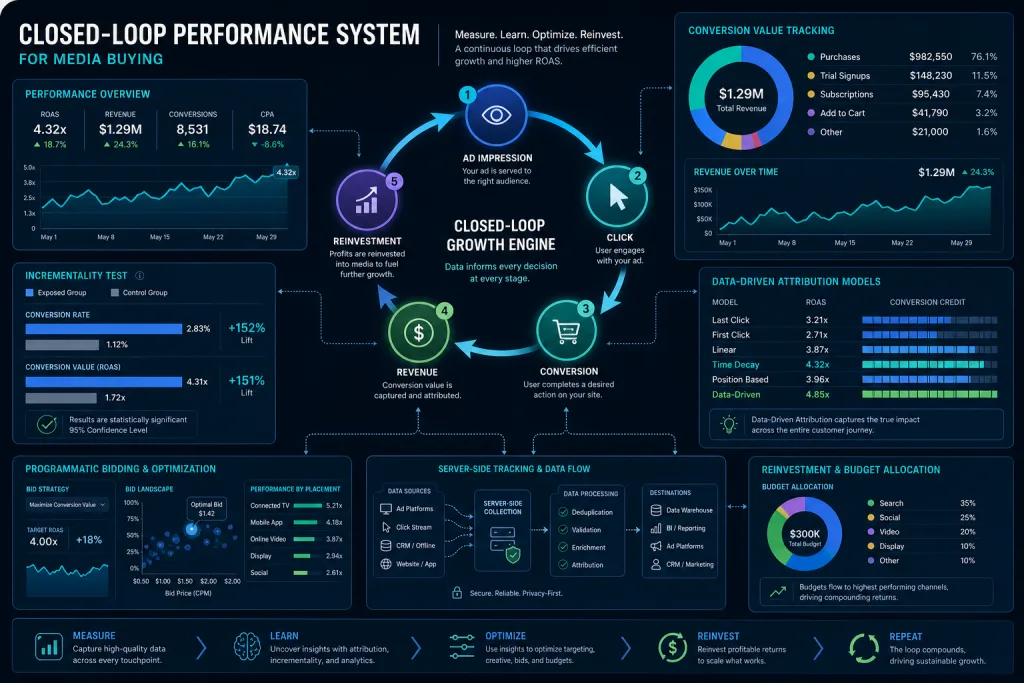
For a long time, brand campaigns lived in an “accountability shelter”: their effect was considered long-term, hard to measure, and not subject to direct attribution. The outcomes era destroys this shelter.
Now, brand investments must also prove commercial impact. This doesn’t mean awareness is no longer needed — it means awareness without a link to conversions doesn’t justify the budget. For media buyers, this creates a specific problem: upper-funnel purchases (Display, YouTube, video in Meta) are increasingly evaluated by incrementality — how much they increased conversions compared to a control group.
Practical implications:
- Brand campaigns without an incrementality test are a risk. If you can’t show that upper-funnel impressions lifted conversions at the lower level, the budget will be cut.
- Attribution becomes multi-touch. A single last click no longer works — you need to distribute value across all touchpoints.
- Impression frequency is optimized for outcome, not reach. Showing an ad 7 times “for memorization” is old logic. The new logic: show it as many times as needed for maximum conversion probability.
How to Redistribute Budgets in the Outcomes Era
For arbitrageurs and media buyers, the transition to an outcome economy requires recalculating the media mix. Here are the key changes:
1. Shift from Reach Formats to Performance Inventory
If previously 30% of the budget could be spent on “warming up,” now every channel must make a measurable contribution. Upper-funnel formats remain, but their share shrinks to 10–15%, and the freed-up funds go to performance channels: Search, Shopping, Performance Max, app-install campaigns.
2. Optimize for Value, Not Volume
CPC and CPA are metrics of the past stage. The outcome economy demands optimization by value: ROAS, LTV, profit per impression. In Google Ads, this means switching to Target ROAS or Maximize Conversion Value. In arbitrage, it means recalculating bundles not by “how much a lead costs” but by “how much a client brings over their lifecycle.”
3. Close the Loop on the Data Side
If you’re pouring traffic and not closing the loop — you’re not in the outcome economy, you’re in the CPC economy. You need to:
- Set up server-side conversion tracking.
- Pass value (order amount) back to the ad platform.
- Use enhanced conversions in Google Ads to recover data after cookie loss.
Google Ads and Outcome-Based Optimization: What to Use
Google Ads offers several tools that directly support the outcome approach:
- Performance Max. Automatically distributes budget across all Google inventory based on conversion probability. Essentially, a closed-loop system within the Google ecosystem.
- Target ROAS. Bids are optimized for a target return on ad spend, not for cost per click or conversion.
- Conversion Value Rules. Allow setting different conversion values depending on audience, location, or device — crucial for precise outcome modeling.
- Data-driven attribution. Distributes conversion value across all touchpoints based on actual data, not a fixed model.
Critical for arbitrageurs: if you don’t pass conversion value to Google Ads, the algorithm optimizes for volume, not revenue. This means you get cheap but low-quality conversions.
Risks and Limitations of the Outcome-Based Approach
The outcome economy isn’t without problems, and media buyers need to understand them:
- Data paralysis. Too many metrics and signals can be confusing. If you track 15 events with different values, the algorithm may not find a pattern. Solution: choose 2–3 key outcome events.
- Short-term thinking. Optimizing for immediate outcomes can kill long-term value. For example, aggressive retargeting boosts conversions today but lowers LTV due to audience burnout.
- Platform dependency. Closed-loop systems like AppLovin or PMax take control away from the buyer. You don’t see exactly where the money goes — only the final ROAS. This is a risk for arbitrageurs working with thin margins.
- Loss of signal. Privacy changes (ATT, the demise of third-party cookies) degrade the data quality on which outcome optimization is built. Server-side tracking becomes not an option, but a necessity.
Strategies for Media Buyers: Practical Steps
To not lose efficiency when transitioning to the outcome economy, media buyers need to act systematically:
Step 1: Audit Current Attribution
Check which conversions you’re tracking and whether you’re passing their value. If Google Ads is set up only for a “purchase” conversion without value — you’re optimizing for volume, not revenue.
Step 2: Implement Conversion Value
Set up dynamic conversion value. For e-commerce — order amount. For affiliate — commission per lead. For mVAS — revenue per subscription. Pass this value to Google Ads via GTM or server-side.
Step 3: Test Incrementality
Run a holdout test: disable the upper-funnel channel on a test group and compare conversions with the control group. If the difference is statistically insignificant — the channel brings no incrementality and the budget needs to be reallocated.
Step 4: Switch to Value-Based Bidding
Switch campaigns from Maximize Conversions to Target ROAS or Maximize Conversion Value. Give the algorithm 2–3 weeks to learn.
Step 5: Monitor Conversion Quality
Outcome is not just quantity, but quality. Track post-conversion metrics: returns, churn, repeat purchases. If ROAS is growing but LTV is falling — the system is optimizing in the wrong direction.
Criteo and New Channels: What Changes for SMBs and Arbitrageurs
Criteo recently expanded its Criteo GO platform, adding full self-service capabilities for small and medium businesses and ChatGPT Ads inventory. About 2,000 brands are already advertising on ChatGPT through Criteo. For media buyers, this means a new channel that:
- Is accessible via a self-service interface (without the minimum budgets of major DSPs).
- Supports cross-channel buying (Meta, video, ChatGPT).
- Works on Criteo’s retargeting data, which is especially valuable for e-commerce affiliate bundles.
However, Criteo as an arbitrage channel requires caution: retargeting inventory depends on cookies and third-party data, which in a privacy-constrained environment reduces reach. Use Criteo as a complement to Google Ads, not a replacement.
YouTube as Part of an Outcome Strategy
YouTube, with estimated revenue of $62 billion, is transforming from a video hosting platform into a full-funnel ecosystem: CTV + social + performance. For media buyers, this means YouTube purchases can now be optimized for conversions, not just reach.
Practical steps:
- Use Video Action Campaigns for conversion optimization.
- Connect conversion value for YouTube campaigns.
- Test Demand Gen in Google Ads as an alternative to Meta for performance video.
Checklist: Transitioning to Outcome-Based Buying
- Is conversion value being passed to Google Ads (not just the conversion event)?
- Is data-driven attribution being used instead of last-click?
- Is there a holdout test for at least one upper-funnel channel?
- Have key campaigns been moved to Target ROAS or Maximize Conversion Value?
- Are post-conversion metrics being tracked (returns, LTV, churn)?
- Is server-side tracking set up to recover data after cookie loss?
What to Expect Next
The outcomes era is not a temporary trend, but a structural shift. Closed-loop systems will expand: Google, Meta, AppLovin, Amazon — all are moving toward automatic optimization by commercial result. The role of the media buyer is shifting from managing bids to managing data: the quality of the signals you feed into the system determines the quality of optimization.
For arbitrageurs, this means that bundles without a closed loop — that is, without feedback on conversions and their value — will increasingly lose. Those who set up a quality data pipeline and switch to value-based optimization will gain an advantage in CPM and conversions because the algorithm will work with the right signals.
FAQ
How is outcome-based marketing different from regular performance marketing?
Performance marketing focuses on the action — a click, conversion, install. Outcome-based marketing goes further: every action is evaluated by its commercial result (revenue, ROAS, LTV). It’s not just about “getting a conversion,” but “getting a conversion that brings profit.”
Do you need to completely abandon brand advertising in the outcomes era?
No. Brand advertising remains important for the top of the funnel, but now it must prove incrementality — a real increase in conversions compared to a control group. If a brand channel doesn’t pass the incrementality test, the budget should be reallocated.
How do you set up conversion value in Google Ads for arbitrage bundles?
Pass the dynamic conversion value via GTM or server-side. For affiliate — commission per lead. For e-commerce — order amount. For mVAS — revenue per subscription. Without conversion value, the Google Ads algorithm optimizes for quantity, not revenue.
What is a closed-loop system and why is it important for arbitrage?
A closed-loop system automatically links an ad impression to an outcome (conversion) and reinvests the budget into the most efficient segments. AppLovin, Performance Max, Smart Bidding are examples. It’s important because manual optimization can’t compete with the speed and accuracy of an algorithm if the data is set up correctly.
What are the risks of switching to outcome-based optimization?
The main risks are: short-term thinking (optimizing for quick conversions at the expense of LTV), dependency on the platform’s algorithm (loss of control over buying), and loss of data quality due to privacy changes. The solution is monitoring post-conversion metrics and server-side tracking.