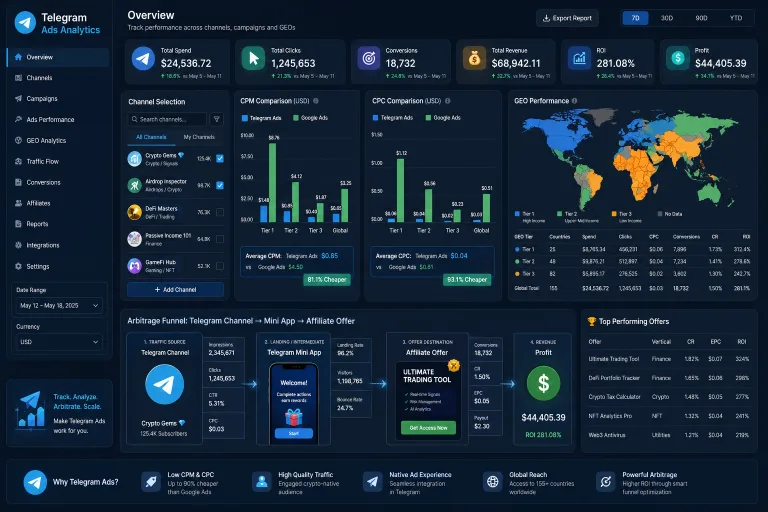
Telegram Ads is rarely considered by media buyers as a full-fledged traffic buying channel — and that’s a mistake. The Telegram Advertising Platform and exchanges like telega.io give media buyers access to 900+ million active users through native placements in channels. For traffic arbitrage, it’s the third-largest source after Google Ads and Meta — with a different intent profile, different CPMs, and a separate set of compliance rules.
The main difference from Google Ads: there is no search intent in Telegram. The user doesn’t enter a query or look for a solution — they read a channel and see a sponsored post. This is a contextual, not a search placement. Conversions will be lower, and CPC higher per action — but CPM is an order of magnitude cheaper, opening up space for funnels with low click prices and wide reach.
In this breakdown — how the Telegram ad ecosystem works, what CPM and CPC are realistic in 2026, how to target, what funnels work for CPS and CPA offers, and how to avoid fake statistics.
How the Telegram Ad Ecosystem Works
Advertising in Telegram works through two models: the official Telegram Ads Platform and third-party exchanges.
Official Telegram Ads — this is a platform from Telegram itself, launched in 2022. The advertiser creates a campaign via the Telegram Ad Platform, selects channels by topic, language, and GEO, and sets a budget. Sponsored posts are shown in channels with a “Sponsored” label. The minimum budget is €1500 per month for direct advertisers, making the platform impractical for small-scale arbitrage.
Third-party exchanges (telega.io, Combot, Telegram Ads Market) — these are intermediaries that aggregate channels, verify statistics, and allow buying ads on a flexible budget. On telega.io, a media buyer can find channels starting at $50 per placement, filtering by subscribers, ER (engagement rate), and CPM. This is a working tool for testing funnels without high entry barriers.
For an arbitrage specialist, the second option is more practical: a lower entry threshold, tools for checking statistics, and the ability to test channels precisely.
Telegram Ads vs Google Ads: Price and Traffic Quality Comparison
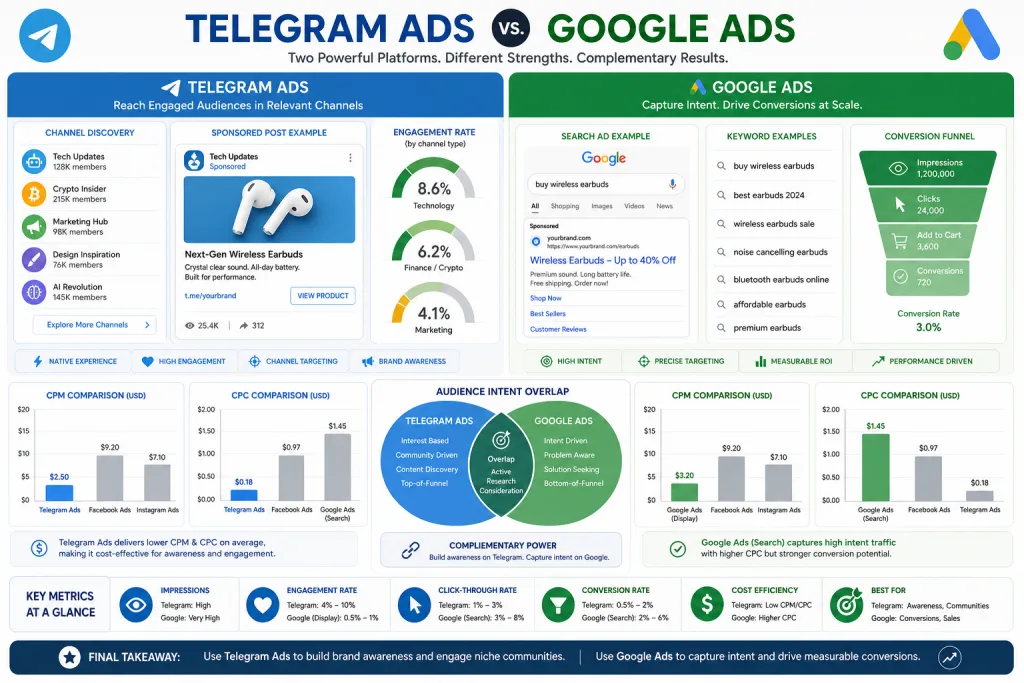
Comparing these two platforms doesn’t favor one over the other — they solve different problems. Google Ads provides search intent with high conversion, Telegram provides contextual reach with low CPM.
| Metric | Google Ads (Search) | Telegram Ads |
|---|---|---|
| Traffic Type | Search Intent | Contextual Placement |
| Avg CPC (tier-1) | $1.50–$8.00 | $0.02–$0.15 |
| Avg CPM (tier-1) | $15–$40 | $1.50–$4.00 |
| Min Budget | $10–$50/day | $50–$500/placement |
| Landing Conversion | 2–12% | 0.3–2% |
| Targeting Control | High (keywords, audiences) | Medium (channels, GEO, language) |
The difference in CPC looks radical, but it doesn’t mean Telegram is cheaper per conversion. Intent traffic from Google Search converts 5–10 times better — and on high-ticket CPS offers, this determines profitability. Telegram provides cheap reach that works for awareness, lead generation, and native funnels, but not for direct sales from a single touch.
Targeting in Telegram Ads: What’s Possible and What’s Not
Telegram Ads Platform and exchanges offer a limited set of targeting options — compared to Google Ads, this is a step backward.
What’s available:
- GEO targeting — by country, in some cases by city
- Language targeting — user’s Telegram interface language
- Topic targeting — selecting channels by category: finance, crypto, tech, news, entertainment
- Channel targeting — manual selection of specific channels via an exchange
What’s missing:
- Retargeting in the usual sense — no pixel on the site, tracking via UTM and server-side
- Lookalike audiences
- Search targeting — no search queries
- Demographics — age and gender are only estimated data from exchanges
- Behavioral targeting based on website actions
For a media buyer, this means funnels are built not on fine segmentation, but on channel selection. The closer the channel’s topic matches the offer, the higher the conversion. A financial offer in a financial channel is the equivalent of broad match in Google Ads: it works, but requires manual review and constant optimization.
Real CPM and CPC: Numbers for Funnel Calculation
CPM in Telegram depends on three factors: GEO, channel topic, and buying format.
Tier-1 (USA, UK, Germany):
- Average CPM: $2.50–$4.00
- CPC: $0.08–$0.15
- Cost per subscriber: $0.50–$2.00
Tier-2 (Poland, Spain, Italy):
- Average CPM: $1.50–$2.50
- CPC: $0.04–$0.08
- Cost per subscriber: $0.20–$0.80
Tier-3 (India, Nigeria, Brazil):
- Average CPM: $0.50–$1.50
- CPC: $0.01–$0.03
- Cost per subscriber: $0.05–$0.30
Channels with financial and crypto topics cost more — CPM can reach $6–$8 in tier-1. Entertainment channels are cheaper, but conversion to monetization is lower.
For funnel calculation: if you buy 10,000 views in a tier-1 financial channel at a $3.50 CPM, the cost is $35. At a 3% CTR, you get 300 clicks, CPC = $0.117. If the landing page converts at 1%, that’s 3 conversions. With a $25 payout per CPS conversion — revenue is $75, ROI 114%. On paper. In practice, the conversion might be 0.3%, and the funnel goes negative. Test with a small budget.
CPS and High-Intent Conversions: Is Telegram a Good Fit?
The CPS (cost per sale) model requires high-intent traffic — a user ready to buy. Google Search provides this intent: the query “buy running shoes” indicates buying readiness.
Telegram intent is contextual. A person reads a finance channel and sees a broker ad. This isn’t search — it’s a distraction. Conversion to a direct sale is low (0.1–0.5%), and only thematic niches with trust in the channel yield acceptable metrics.
What works in Telegram for CPS:
- Financial offers — brokers, crypto exchanges, trading platforms — in financial channels
- Educational courses in educational channels with a trusting audience
- Software and utilities in tech channels
- iGaming in entertainment channels — where compliance allows
What doesn’t work for CPS:
- Cheap e-commerce goods — low price isn’t motivating through a contextual post
- Offers with a long decision-making cycle
- Products requiring comparison or research
For high-intent conversions, Google Ads remains the first choice. Telegram is for CPA leadgen, native formats, and building an audience for retargeting.
Arbitrage Funnels: Telegram → Pre-lander → Offer
The basic funnel for Telegram arbitrage is built in five steps.
- Channel selection — exchange (telega.io or similar) → filter by topic, GEO, ER > 5%
- Stat verification — comparing views with TGStat or telemetr.io data
- Creative creation — a native post fitting the channel’s format, not an ad banner
- Pre-lander — Telegram Mini App or an external landing page
- Offer — CPA network (vCommission, ClickDealer, Afk, etc.)
Telegram Mini App is a key advantage of Telegram. Instead of sending the user to an external site, you open a web app inside Telegram. This reduces friction: no browser transition, no loss of mobile traffic, no context break. A Mini App can be a landing page, a lead form, or even a full-fledged store.
For CPS offers via vCommission: you advertise in a financial channel → Mini App with a registration form → conversion on a CPS model. vCommission works with India, UAE, UK, US — and each GEO needs separate channels and separate creatives.
Compliance and Restrictions: What You Can’t Advertise
Telegram officially bans ads for illegal goods and services, weapons, drugs, doorways, and phishing. However, compliance in Telegram is softer than in Google Ads.
The main difference is no active creative moderation before launch. Checks happen post-factum, based on complaints. This means:
- Travel offers that Google Ads might block for misleading pass in Telegram
- Crypto ads — Google requires certification, Telegram doesn’t, but channel reputation matters
- Leadgen with grey verticals — depends on the specific channel and its owner
Exchanges like telega.io add their own compliance: channels with porn, violence, or illegal content are excluded from the catalog. But this doesn’t guarantee safety — responsibility for the offer lies with you.
For an arbitrage specialist with grey offers, Telegram is a working alternative, but not a safe one. Reputational risks and channel bans are possible, especially when scaling.
Risks: Fake Subscribers and Distorted Statistics
The main risk of Telegram arbitrage is botting. Channels with fake subscribers show normal views (bots watch), but don’t yield conversions. Signs of botting:
- Subscribers grow sharply after buying ads — bots are added after publication
- ER below 3% with a large base — low engagement indicates bots
- Views in posts are noticeably fewer than subscribers — a normal channel shows 20–40% reach
- Subscriber geography doesn’t match the stated GEO — bots are often from tier-3 countries
How to protect yourself:
- Use TGStat or telemetr.io to check subscriber dynamics — a slice for the last 30–90 days
- Compare ER with reference channels in the same niche — a deviation of more than 50% is suspicious
- Buy through an exchange with verified statistics — telega.io shows verified metrics
- Test with a small budget — $50–$100 per channel, measure conversion, then scale
Omnichannel Approach: Telegram + Google Ads
Telegram Ads rarely works alone. In practice, media buyers combine it with Google Ads and Meta.
- Google Ads (Search) — buying search intent, high-converting traffic for direct conversion
- Telegram Ads — reach and channel subscriptions for a warm audience
- Meta Ads — retargeting site visitors from Telegram via a pixel
Working scheme: Google Ads → landing → Meta pixel → Telegram Mini App for a warm audience. Or vice versa: Telegram reach → Google Ads remarketing for users who opened the Mini App — via UTM tagging and Google Analytics.
Integration requires Google Analytics 4 and server-side tracking — because Telegram Mini App doesn’t pass the referrer in the standard way. Without server-side, you’ll lose Telegram traffic attribution and won’t be able to correctly compare CPA across channels.
Checklist: Launching an Arbitrage Funnel in Telegram Ads
- Check the channel via TGStat or telemetr.io: subscriber dynamics, ER, geography
- Compare the channel’s CPM with the niche average — if it’s 50%+ cheaper, botting is likely
- Create a native creative fitting the channel’s format, not an ad banner
- Set up a Telegram Mini App as a pre-lander instead of an external landing page
- Implement server-side tracking (GA4 + Stape) for correct attribution
- Test $50–$100 per channel, measure conversion, then scale
- Compare CPC and CPA with Google Ads on the same offer — complement, don’t replace
FAQ
How much is needed to start arbitrage in Telegram Ads?
The minimum budget via third-party exchanges is $50–$100 per placement. To test 5 channels, you need $250–$500. Via the official Telegram Ads Platform — from €1500 per month, which is impractical for test funnels.
Can I run CPS offers through Telegram?
Yes, but the conversion will be lower than from Google Search. CPS works in niches with channel trust: finance, crypto, education. In other verticals, it’s better to use CPA or leadgen models.
What is the difference between official Telegram Ads and exchanges like telega.io?
Telegram Ads Platform is Telegram’s own product with a minimum budget of €1500 per month and automatic placement in channels. Exchanges are intermediaries with flexible budgets, manual channel selection, and verified statistics. For arbitrage, exchanges are more practical.
How to protect against fake subscribers in Telegram channels?
Check channels via TGStat and telemetr.io for subscriber dynamics, ER, and geography. Test with a small budget. Buy through exchanges with a statistics guarantee. If a channel’s CPM is 50% below the niche average — botting is likely.
Can Telegram and Google Ads be used in the same funnel?
Yes. Telegram provides reach and contextual traffic, Google Ads provides search intent. Scheme: Telegram → Mini App → Google Ads remarketing for visitors. Server-side tracking is needed for correct attribution between platforms.