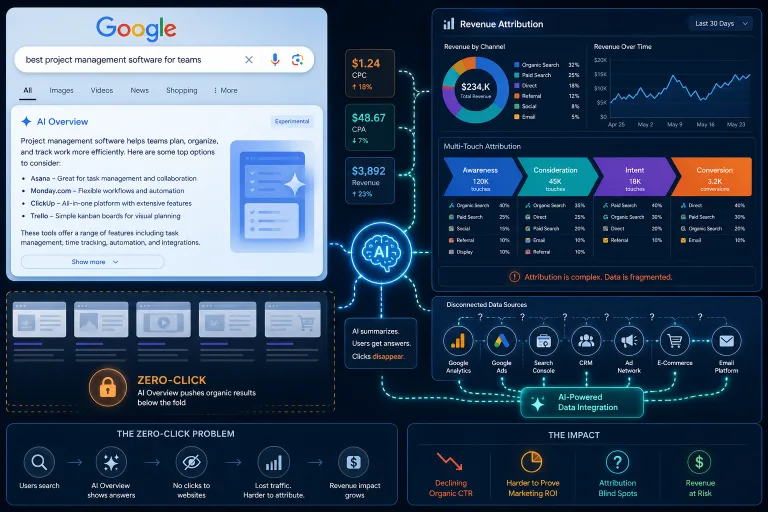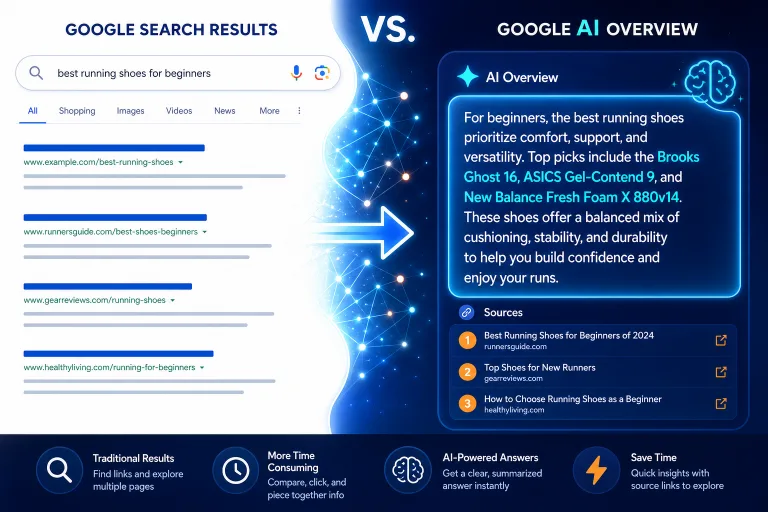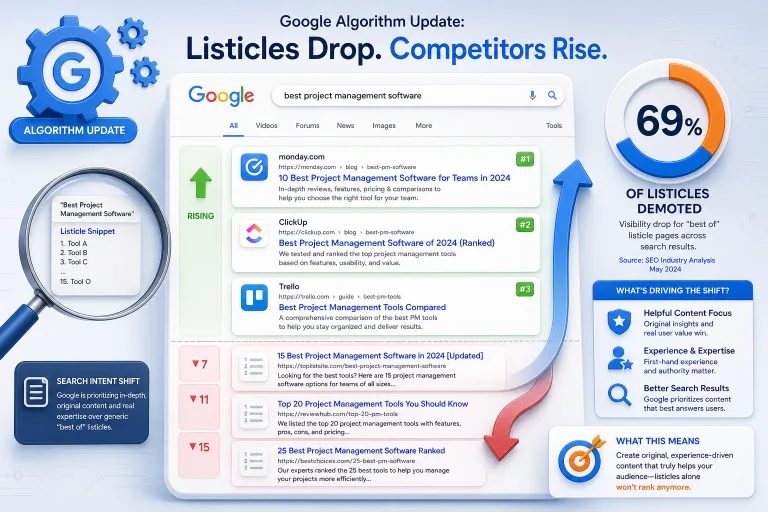
Google has started actively demoting “best of” listicles where brands promote themselves. A new study shows: in 69% of cases, Google recommends competitors instead of the listicle’s author. If you work in affiliate marketing or traffic arbitrage and rely on self-serving lists, your organic traffic is either already dropping or will fall in the coming months. The solution: pivot from self-promotional content to an editorial format, diversify traffic sources through Google Ads, and stop treating listicles as a free ticket to the top of the SERPs.
What Are Self-Serving Listicles and Why Does Google Demote Them
A self-serving listicle is an article formatted as “best VPN services of 2026,” “top 10 casino bonuses,” or “best cashback credit cards,” where the author or brand places their own product at the top without objective comparison. Such articles dominated search results for years because Google couldn’t distinguish editorial recommendations from ads.
Now, Google classifies this content as covert advertising. The algorithm analyzes:
- Publisher domain matching a brand in the list
- Presence of affiliate links to recommended products
- Lack of independent sources and testing
- Templated structure with repetitive blocks
- Ratio of “own” vs. “competitor” products in the list
If an article looks like a storefront for a specific brand, Google lowers its rankings both in classic search results and in AI Overviews.
The 69% Study: What the Data Shows
A new study covering hundreds of “best of” listicles across various niches revealed a pattern: in 69% of cases, Google displays competitors of the brand that wrote the listicle in AI Overviews and top search results. Meaning, if VPN service “X” publishes a “top 10 VPN” list, Google is highly likely to recommend VPN services “Y” and “Z.”
This isn’t a bug, but a deliberate policy. Google treats self-serving listicles as an attempt to manipulate search results. Instead of penalizing the site entirely, the algorithm simply devalues the recommendation and shows alternatives—often from more authoritative sources.
For affiliate marketers, this means: traffic from listicles where your offer ranked first is now going to competitors chosen by Google, not you.
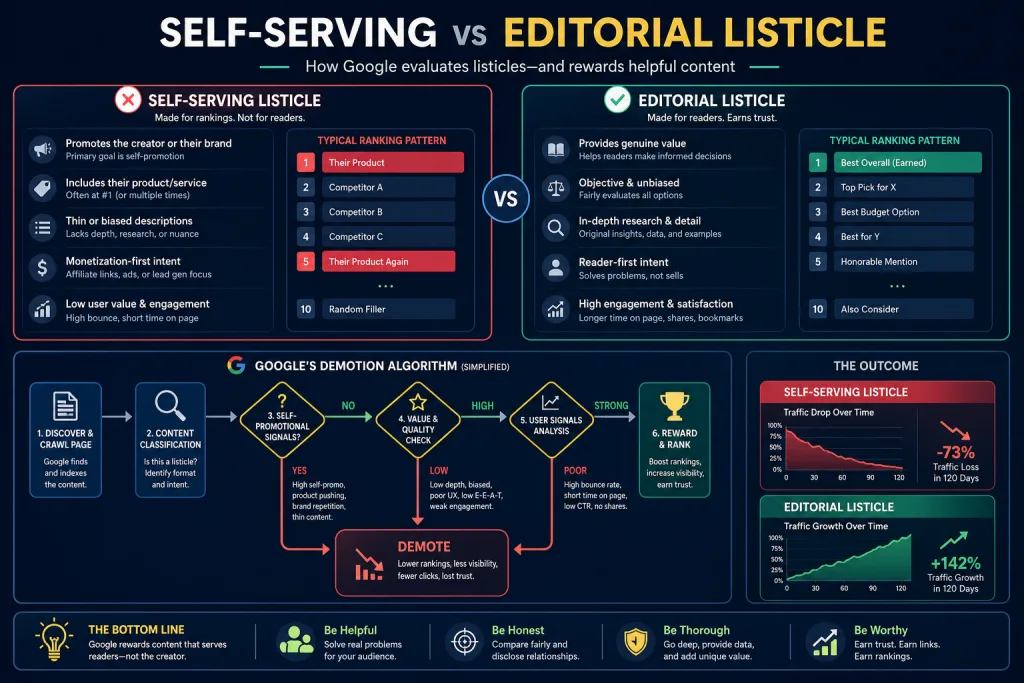
How the Demotion Algorithm Works Technically
Google uses multiple layers of analysis to identify self-serving content:
Entity Analysis
The algorithm extracts entities (brands, products) from the article and compares them with the publisher domain. If the domain belongs to a brand in the list, this is a strong self-serving signal.
Link Profile Analysis
If all affiliate links point to a single product or group of products, Google flags the listicle as promotional. An editorial listicle typically contains links to various independent resources.
Tone and Structure Analysis
Self-serving listicles often use templated positive descriptions without criticism. Editorial ones contain pros and cons, comparison tables, and links to studies and tests.
Behavioral Signals
If users quickly return to search results after clicking a self-serving listicle, it’s a low-quality signal. Editorial listicles hold attention through objective comparison.
Impact on Affiliate Marketing and Traffic Arbitrage
For affiliate marketers, the demotion of self-serving listicles is a structural blow to organic traffic. Let’s look at specific scenarios.
Scenario 1: VPN and Software Offers
VPN offers are a classic niche for self-serving listicles. If you published a “top 10 VPN” list with your offer at the top, expect a 40-70% drop in organic traffic within 2-3 months after demotion.
Scenario 2: Gambling and Casino
Casino listicles like “best sign-up bonuses” are a pure self-serving format. Google is already actively demoting such articles, especially in European GEOs where regulation demands transparency in advertising materials.
Scenario 3: Finance and Credit Cards
Financial listicles like “best credit cards” are among the most competitive niches. Banks and aggregators fought for top rankings for years. Now, Google favors independent reviews and editorial ratings.
Which Niches Suffered the Most
Based on our observations and study data, the demotion has impacted the following verticals in descending order of impact:
- VPN and cybersecurity — highest concentration of self-serving listicles
- Gambling and betting — templated “top casino” articles mass demoted
- Finance and lending — credit cards, microloans, insurance
- Health and supplements — “best vitamins,” “top supplements”
- SaaS and software — CRMs, hosting, website builders
- Travel and booking — “best hotels,” “top airlines”
If you work in one of these niches and your traffic comes through SEO listicles, it’s time to change your strategy.
How to Rebuild Content: The Editorial Format
Rebuilding content from self-serving to an editorial format is the primary way to maintain your search rankings. Here are the specific steps.
Add Real Tests and Measurements
Instead of a templated description like “VPN X is fast and secure,” add test results: speed in Mbps across different servers, security audit results, price comparison with competitors. Google values specific data.
Include Criticism
An editorial listicle contains cons for every product. If you’re writing about a VPN service, mention: “slow speed on Asian servers,” “no split-tunneling,” “expensive for an annual plan.” This is a signal of objectivity.
Use Independent Sources
Link to reviews from third-party publications, studies, and independent lab tests. Google sees that your listicle isn’t just promoting one product, but aggregating information from various sources.
Separate Promotional and Editorial Blocks
If you earn a commission for recommendations, state this explicitly. Google prefers transparency. A “Our Recommendations” section with affiliate links and an “Independent Reviews” section with external links is a working structure.
Update Data Regularly
Listicles dated “2024” lose rankings in 2026. Update the title, publication date, prices, and rates. Google treats fresh data as a sign of relevance.
Diversification: Google Ads as Insurance
If organic traffic from listicles is dropping, Google Ads is the fastest way to compensate for the loss. Here’s how to combine paid and organic traffic.
Search Ads for Brand Queries
Launch campaigns for queries like “best VPN 2026,” “top casino bonuses,” “best credit cards.” While your SEO listicle recovers after a rebuild, paid ads will maintain your presence in search results.
Performance Max for Offer Pages
If you have landing pages for specific offers, Performance Max can drive traffic from various Google sources—Discover, YouTube, Gmail. This reduces dependence on a single channel.
Retargeting Listicle Users
If users came to your listicle from organic search but didn’t convert, set up retargeting. A listicle demotion doesn’t mean you’ve lost these people forever—they’re already in your audience.
Testing New GEOs via Ads
While your SEO strategy is being rebuilt, use Google Ads to test new GEOs. If you only worked in Europe, test Tier-2 and Tier-3 with paid traffic, and then launch SEO for promising markets.
AI Overviews and Listicles: New Dynamics
AI Overviews are a separate problem for self-serving listicles. Google generates its own summaries based on multiple sources, and your listicle might not make it into the summary even if it ranks first organically.
Key difference: AI Overviews don’t just rank sources—they synthesize an answer. If your listicle only contains positive product descriptions, AI Overviews will ignore it in favor of sources with criticism and comparison.
To get into AI Overviews:
- Structure data in tables with clear comparison criteria
- Add an FAQ section with specific questions and answers
- Use Schema.org markup for lists and reviews
- Include quantitative data: prices, speeds, ratings
- Update content at least once a quarter
Risks and Compliance: What Not to Do
When rebuilding content, avoid the following mistakes that could worsen the demotion.
Don’t Create Satellite Networks
Some affiliate marketers try to bypass demotion by creating dozens of micro-sites with listicles linking to each other. Google recognizes such networks and demotes all sites simultaneously.
Don’t Use Hidden Affiliate Links
Redirects through intermediate domains, JavaScript redirects, and hidden affiliate links are all manipulation signals. Use direct links with the rel=”sponsored nofollow” attribute.
Don’t Copy Competitors’ Listicles
Copying the structure and text from other successful listicles is a quick way to get demoted for duplicate content. Create a unique comparison format.
Don’t Ignore E-E-A-T
Experience, Expertise, Authoritativeness, and Trustworthiness are the criteria Google applies to listicles. Specify an author with a real profile, their qualifications, and testing methodology.
Checklist: Audit Your Listicle for Demotion Risk
- Check if the publisher domain matches a brand in the list—if yes, rebuild the format
- Calculate the ratio of “own” vs. “competitor” products in the listicle—aim for 30/70 in favor of competitors
- Add cons for every product in the list—without criticism, Google flags it as self-serving
- Check for links to independent sources and reviews—minimum 3-5 external links
- Update the publication date and all prices/rates in the article—data should be no older than 3 months
- Add Schema.org markup for Review and ItemList—this helps Google understand the structure
- Specify an author with a description of their qualifications and testing methodology—an E-E-A-T signal
A Practical 30-Day Plan
If your listicle has already lost rankings, here is a 30-day recovery plan.
Days 1-7: Audit and Analysis. Check rankings in Google Search Console, identify queries with a drop in CTR. Analyze the competitors who took your positions—what format do they use.
Days 8-14: Content Rebuild. Add tests, criticism, independent sources. Separate promotional and editorial blocks. Update the date and data.
Days 15-21: Technical Optimization. Add Schema.org markup, optimize loading speed, check the mobile version. Set up internal linking from other pages on the site.
Days 22-30: Launch Google Ads. While the SEO listicle recovers, launch Search Ads for target queries. Set up retargeting for users who visited the old version of the listicle.
What to Do if Demotion is Irreversible
In some cases, restoring a listicle is impossible—especially if Google flagged the site as low-quality due to multiple self-serving articles. In this situation:
- Create a new section of the site with editorial reviews, not linked to old listicles
- Redirect traffic via Google Ads directly to offer landing pages, bypassing listicles
- Consider pivoting to YouTube reviews—the video format is less affected by listicle demotion
- Launch content marketing through guest posting on authoritative platforms with a subsequent link to your site
FAQ
Does Google completely remove self-serving listicles from search results?
No, Google doesn’t remove such articles, but demotes their rankings. In 69% of cases, competitors appear in AI Overviews and top results instead of the listicle’s author. The article remains indexed but loses organic traffic.
Can I use affiliate links in listicles after demotion?
Yes, but with transparent markup. Use the rel=”sponsored nofollow” attribute for affiliate links and separate promotional blocks from editorial ones. Google isn’t against affiliate links—it’s against covert self-promotion.
How long does it take to recover after rebuilding content?
Usually 4-8 weeks after publishing the updated version. The speed depends on your site’s crawl frequency, domain authority, and niche competition. In highly competitive verticals like VPN or finance, recovery can take up to 3 months.
Does listicle demotion affect Google Ads campaigns?
Directly—no. Google Ads operates on separate logic. But indirectly: if your landing page was linked to a self-serving listicle and got downgraded due to association with low-quality content, it could affect Quality Score. Keep Ads landing pages separate from SEO listicles.
Does the demotion of self-serving listicles work in all GEOs?
Demotion is most active in the US, UK, and Germany. In Tier-2 and Tier-3 GEOs, the algorithm operates with a 2-6 month delay. If you work in Asian or Latin American markets, you have a window to rebuild content before the algorithm arrives.