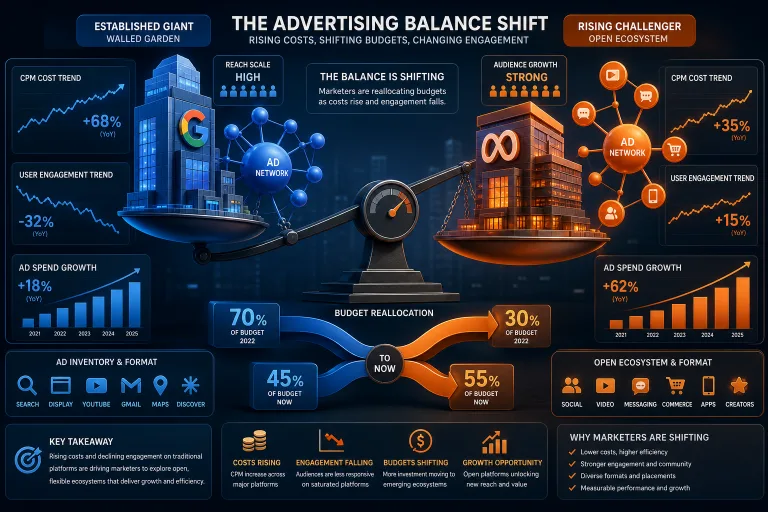
What’s Happening: Meta May Overtake Google in Ad Revenue by End of 2026
According to a report by The Verge citing eMarketer, Meta’s ad revenue grew 27% year-over-year based on the July 2026 report. Forecasts indicate that Meta’s advertising business could surpass Google’s by the end of 2026. This doesn’t mean Google Ads is dying — but a structural shift in ad dollar distribution is already underway, and for arbitrage buyers, this means re-evaluating bundles, recalculating CPMs, and adapting funnels to the new reality.
The problem analysts point out is twofold: ad spend on Meta is growing at double-digit rates, but user engagement in the US isn’t growing. Fewer users are actively posting content, and the younger generation is migrating to other platforms. This creates a classic media buying paradox: more advertisers are fighting for stagnant inventory — CPMs rise, while audience quality may decline.
For traffic arbitrage buyers, this means three things. First, Meta Ads is becoming more expensive in absolute terms. Second, Google Ads remains a key channel for intent traffic, but its share of the overall media mix may shrink. Third, the window for cheap inventory on Meta is closing — and those who don’t recalculate their bundles now risk burning their budgets on inflated auctions.
Why Meta is Growing Faster Than Google in Advertising
Meta’s 27% year-over-year ad revenue growth is no coincidence. Several structural factors explain the acceleration.
Advantage+ and AI Optimization. Meta has invested more heavily in campaign automation than Google has in Performance Max. Advantage+ Shopping Campaigns allow advertisers to launch campaigns with minimal manual setup, and Meta’s algorithm effectively finds converting audiences. For performance marketers and arbitrage buyers, this means a lower barrier to entry and rapid bundle testing.
Reels as New Inventory. Short-form video on Meta has created a massive volume of new ad space. CPMs on Reels are currently lower than on the Feed, creating arbitrage opportunities — especially for bundles with video creatives.
Cross-Platform Attribution. Meta covers Instagram, Facebook, and WhatsApp — three platforms with different usage patterns. This gives advertisers more touchpoints and better data for retargeting.
Brand Budget Shifts. Major brands are moving money from linear TV and display to Meta because measurement and attribution are better there. This drives up auction bids for everyone else.
The Problem: Ad Spend Growth Amid Engagement Stagnation
eMarketer analyst Minda Smiley highlights a key tension: double-digit ad spend growth is not accompanied by double-digit usage growth in the US. This means ad dollars are concentrating on a platform where the number of active users is growing more slowly than the number of advertisers.
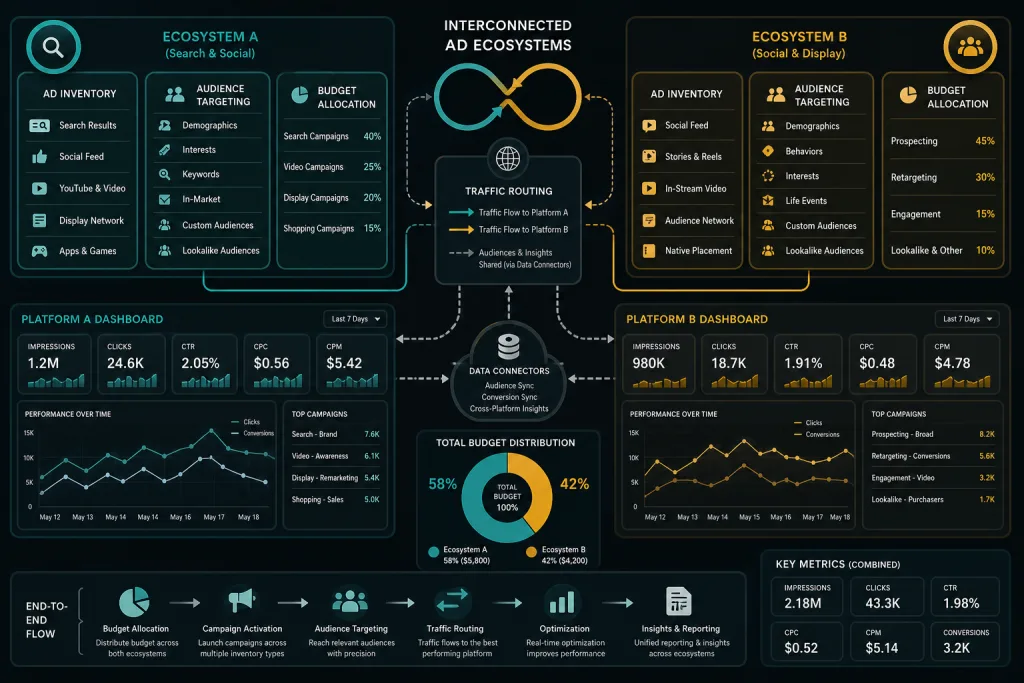
For media buyers, this translates into specific risks:
- Rising CPMs. More advertisers competing for the same inventory = higher bids. Especially in tier-1 GEOs (US, Canada, UK).
- Declining Inventory Quality. Meta shows ads to less engaged users to fill inventory. This can lower CTR and conversion rates.
- Ad Fatigue. Users see more ads per unit of time — creatives burn out faster, and assets need to be refreshed more frequently.
- Oversaturation Risk. In some niches, the auction is already overheated — particularly e-commerce, gambling, nutra, and finance.
What This Means for CPM and CPC on Both Platforms
The budget shift to Meta affects pricing on both platforms. Here’s what it looks like for an arbitrage buyer.
Meta Ads: Rising CPMs, but Still Cheap Inventory in Certain Niches
CPMs on Meta in tier-1 are rising, but unevenly. Reels and Stories still offer relatively cheap inventory — CPMs on Reels can be 30–50% lower than on the Feed. For arbitrage buyers, this means video bundles on Reels remain a viable channel, but the window is narrowing.
In tier-2 and tier-3 GEOs, Meta CPMs are still growing more slowly, but traffic quality and compliance risks are higher. If you’re running nutra or gambling offers in Latin America or Southeast Asia, Meta can still deliver positive ROI — but you need to filter GEOs and creatives more strictly.
Google Ads: A Stable Intent Channel, but Growing Competition on Brand Queries
Google Ads isn’t losing relevance — paid search grew 122% over 15 months, as we analyzed previously. But the auction structure is changing. Brand queries are becoming more expensive because more advertisers are fighting for the same volume of intent traffic.
For arbitrage buyers, this means generic and long-tail queries remain accessible, but you need to work more precisely with match types and negative keywords. Performance Max is also changing the landscape — Google’s algorithm is taking over inventory that was previously available through manual campaigns.
Strategy 1: Diversifying Bundles Between Google and Meta
Redistributing budgets between Meta and Google isn’t an “either-or” question — it’s a matter of balance. Here’s a practical approach.
The 60/30/10 Rule. Split your arbitrage budget: 60% to the channel with the best ROI (usually Google Search for intent offers or Meta for impulse offers), 30% to the second channel for diversification, and 10% to testing new bundles and formats.
Cross-Platform Retargeting. Use Meta for top-of-funnel (awareness, interest) and Google for bottom-of-funnel (search, comparison, conversion). The Meta pixel collects the audience that saw your creatives, while Google Search intercepts those who started searching for the offer by name. This is a classic bundle, but as Meta CPMs rise, it becomes critical for ROI.
Testing Reels Inventory. While Reels CPMs are lower than the Feed, test video bundles with short creatives (5–15 seconds). For arbitrage on nutra, gambling, and dating, this format works — but watch compliance, as Meta is tightening its policies.
Strategy 2: Leveraging the Strengths of Each Platform
Each platform has structural advantages that an arbitrage buyer should exploit.
Google Ads: Intent and Precision
Google Search provides intent traffic — the user is already looking for a solution. This is ideal for offers with a long decision cycle: finance, insurance, B2B, complex products. Use exact and phrase match to control relevance, and don’t forget negative keywords.
Google Display and YouTube offer reach, but with less intent. For arbitrage, this works at the audience warming stage — especially through YouTube video ads followed by retargeting via Search.
Meta Ads: Impulse and Scale
Meta excels at impulse purchases and visual offers. If your offer converts on emotion (nutra, dating, mobile apps), Meta provides scale that Google Search can’t match. Advantage+ automates targeting, but it doesn’t replace creative control.
The key risk on Meta is compliance. Meta’s policies on medical, financial, and gambling offers are stricter than Google’s. If you’re running sensitive verticals, keep backup accounts and test creatives on small budgets before scaling.
Risks and Compliance During Redistribution
Moving budgets between platforms carries not only pricing risks but also compliance risks.
Account Bans. Meta is known for harsh bans without explanation. If you move 30% of your budget from Google to Meta and catch a ban on your main account, you lose both budget and data. Keep at least 2–3 active accounts and use anti-detect browsers for management.
Policy Differences. What passes on Google Ads might not pass on Meta. For example, Google allows cryptocurrency ads with certification, while Meta restricts crypto more heavily. Before moving your budget, check the policy for your offer on both platforms.
Attribution. With cross-platform bundles, attribution becomes more complex. Google Ads and Meta Ads use different attribution models, and last-click may not reflect the true contribution of each channel. Use UTM parameters and server-side attribution to understand which channel actually drives conversions.
Geographic Restrictions. Some GEOs are available on one platform but not the other. For instance, Meta has restrictions in certain countries where Google Ads operates freely. Check inventory availability for your target GEOs before shifting budgets.
Practical Checklist: How to Reallocate Budgets Between Meta and Google
Checklist: Budget Reallocation
- Compare current ROI by channel over the last 30 days — determine which channel offers the best spread between CPM and CPA.
- Check CPMs on Meta Reels vs. Feed in your target GEOs — if Reels are 30%+ cheaper, reallocate part of your budget to video bundles.
- Audit the compliance status of your offer on both platforms — ensure the budget shift doesn’t violate policies.
- Set up server-side attribution and UTM tagging for cross-platform bundles — without this, you won’t see the real contribution of each channel.
- Create backup accounts on Meta and test creative uploads — a ban on your main account shouldn’t halt your campaigns.
- Launch an A/B test of the Meta top-of-funnel → Google Search bottom-of-funnel bundle on 10% of your budget — measure the conversion lift.