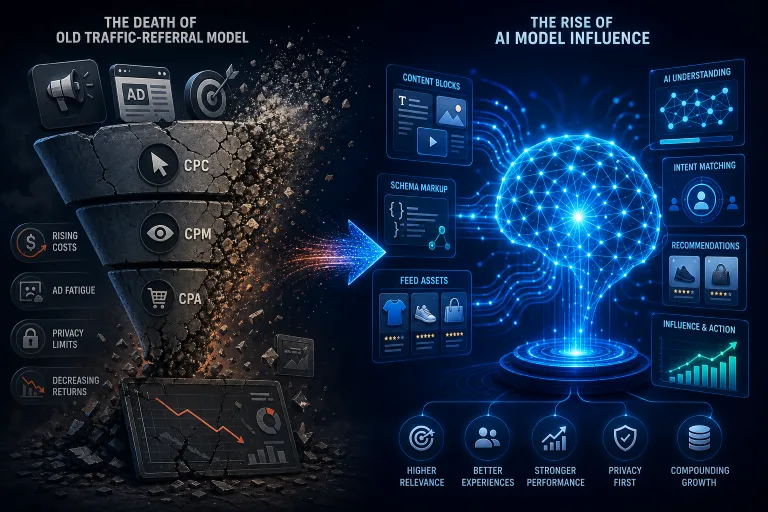
During the Cannes Lions International Festival of Creativity 2026, an event occurred that can only be described as a tectonic shift. The New York Times reported: the old traffic-referral model of the digital advertising market is officially dead. The industry’s focus has shifted from capturing human attention to influencing AI models. Shiva Singh from AI Trailblazers called it “an earthquake no one saw coming.”
For media buyers and arbitrageurs, this isn’t just an abstract conversation on a yacht in Cannes. It’s a direct threat to the familiar funnel: buy a click → send to a landing page → get a conversion → profit from the spread. If AI models become the new “middleman” between the advertiser and the user’s decision, the entire media buying chain is being rebuilt.
In this article: what exactly died, what is replacing it, and how to practically adapt your Google Ads campaigns and arbitrage funnels to the new reality.
What is the Traffic-Referral Model and Why is it Dying
The traffic-referral model is the entire digital marketing ecosystem built on the principle of “advertising generates a click, the click leads to a site, the site converts.” CPC, CPM, CPA, affiliate networks, traffic arbitrage — all of these are extensions of this basic logic. Ads = traffic. Traffic = visit. Visit = conversion opportunity.
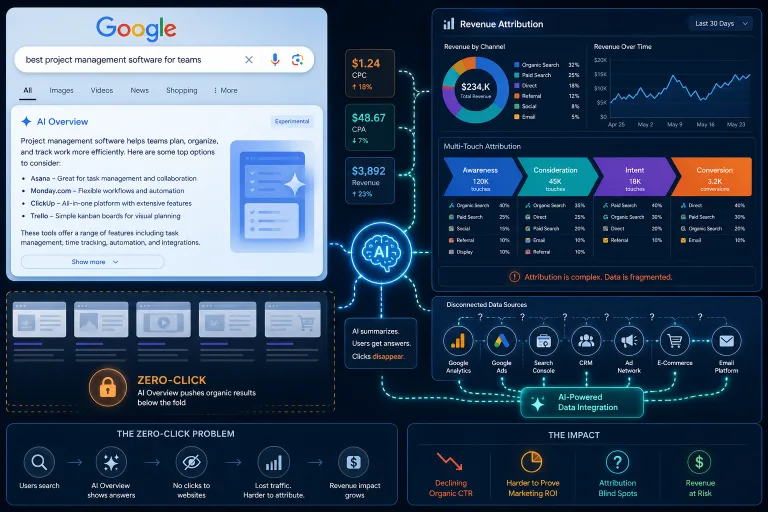
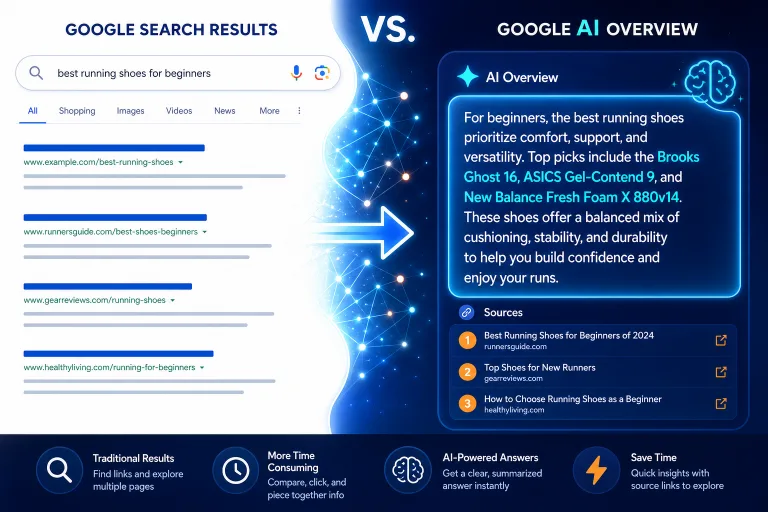
This model has been dying a slow death. First came zero-click searches, when Google started providing answers directly in the SERP. Then came AI Overviews, which reduced clicks even further. Next was advertising within ChatGPT and other LLM platforms, where “visiting a site” became optional. And now, we have official recognition at the industry level.
The key shift: you used to compete for human attention. Now you compete for the “attention” of an AI model that decides what to show the user, which brand to recommend, and which source to cite.
What Comes Next: The AI-Influence Model
The new paradigm — let’s call it AI-influence — is built on a different principle. Your goal is no longer to “get a click,” but to “become the source the AI model chooses for its answer.” This applies not only to Google’s AI Overviews but also to in-platform recommendation systems, chatbots, voice assistants, and even AI agents that make purchases on behalf of users.
In practice, this means three things:
-
Content as a signal for the model, not just for humans. An AI model “reads” structure, semantics, authority, and data consistency. A landing page optimized solely for human conversion might be invisible to the model.
-
Advertising as context, not just a click. Ad creatives now feed AI models data about your brand, offer, and price. Even if there was no click, the model “digested” the information.
-
Attribution is completely blurred. A user might not have clicked your ad, but the AI model mentioned your brand in its answer — and the user went directly to your site. How do you count that conversion? Old attribution models don’t work here.
How This Impacts Google Ads
Google Ads is the #1 platform built on traffic-referral logic. And it’s the one transforming the fastest. Here is what’s changing for a practicing media buyer:
Performance Max and AI-Driven Bidding
Google is increasingly handing campaign management over to its AI models. Performance Max already operates as a “black box”: you provide assets, Google decides where and how to show them. In the new paradigm, this isn’t a bug, it’s a feature — you aren’t buying clicks, you are “feeding” Google’s model data, and it decides how to represent you.
Practical takeaway: the quality of assets (text, images, structured feed data) becomes more important than manual bid optimization. Google’s model determines where your offer is relevant on its own.
Search Ads and Declining Clicks
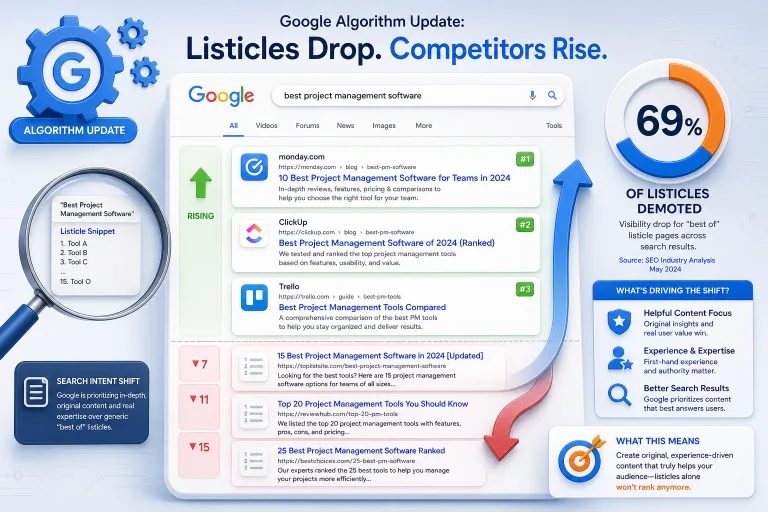
Zero-click searches have already reduced CTR by 15–30% in certain verticals. AI Overviews are accelerating this trend. But this doesn’t mean Search Ads are dying — it means their role is changing. An ad now works not only as a “click button” but also as a signal to the model: this brand is active, paying for this query, therefore it is relevant.
New AI Integration Formats
Google is actively testing ad formats within AI answers. These could be sponsored sources cited by the AI model with a label, or native recommendations within a dialogue. For media buyers, this is a new channel that few are using systematically yet.
What This Means for Traffic Arbitrage
Traffic arbitrage is a business model heavily reliant on traffic-referral. You buy cheaper, convert better, and earn on the difference. If clicks decrease and attribution blurs, margins shrink.
But this isn’t the end of arbitrage. It’s the end of lazy arbitrage — where it was enough to dump cheap traffic onto a primitive landing page. Here is what’s changing:
1. Pre-landers Must Be Optimized for AI
If your pre-lander is text that an AI model cannot structurally “read,” you lose the chance to appear in an AI answer. Add FAQ blocks, structured data (Schema.org), clear headings, and comparison tables. The model must “understand” that you are an authoritative source on the topic.
2. Brand Queries Become More Important Than Direct Offers
In the era of AI answers, users often get a brand recommendation rather than a link. Then they search for the brand directly. This means arbitrageurs need to think not only about first-click conversion but also about creating “brand awareness” that the AI model will pick up.
3. Multi-Channel Approach Instead of a Single Funnel
A single “ad → landing page → offer” funnel is becoming fragile. You need to diversify: SEO content that feeds AI models; YouTube videos that models use as sources; reviews and mentions on authoritative platforms. All of these are signals for AI.
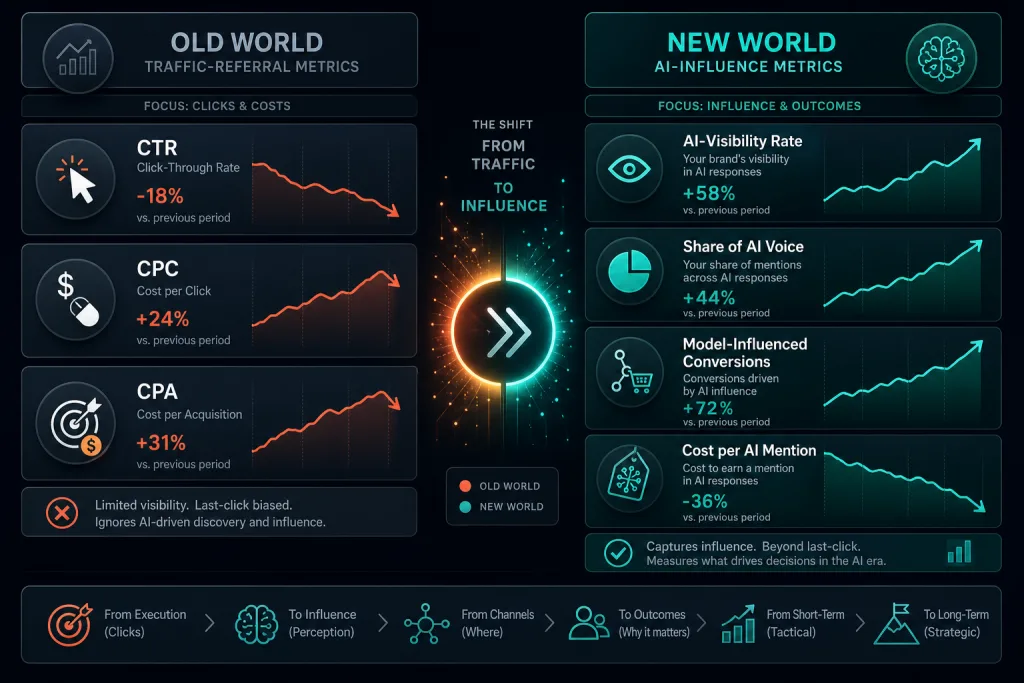
New Metrics: What to Measure Instead of CTR and CPC
If the old model is dying, we need new KPIs. Here is what forward-thinking teams are starting to track:
- AI-visibility rate — how often your brand/offer appears in AI answers for target queries. Tools like Profound, AthenaHQ, and similar platforms already provide this analytics.
- Share of AI voice — the share of your brand mentions among competitors in AI model answers. An analog to share of search, but for AI.
- Model-influenced conversions — conversions that occurred after a mention in an AI answer, even without a direct click. Hard to measure, but possible through brand queries and direct traffic following an AI answer.
- Cost per AI mention — the cost of a single mention in an AI answer. A new analog to CPC, but for the world of AI-influence.
These metrics aren’t standardized yet. But teams that start tracking them now will gain an advantage in 6–12 months when the tools become mainstream.
Practical Steps for Adapting Google Ads Campaigns
Asset Audit for AI Logic
Review your text assets in Search and Performance Max campaigns. Google’s AI model uses them not only for display but also to “understand” your offer. Clear, specific descriptions with key facts (price, terms, geo) work better than abstract “best service for you” claims.
Structured Data on Landing Pages
Add Schema.org markup: Organization, Product, Offer, FAQPage, Review. This isn’t news for SEO, but for arbitrage landing pages, it’s still rare. AI models actively use structured data as a trust signal.
Testing AI Answers as a Channel
Check if your brand/offer appears in AI Overviews for target queries. If not, create content that answers user questions in a format convenient for models to cite: short paragraphs, clear definitions, lists.
Diversification Beyond Google
Google is the main, but not the only, AI middleman. ChatGPT, Perplexity, Copilot, and other LLM platforms also shape recommendations. Expand your presence: content on authoritative platforms, mentions in reviews, video content. Every channel is a signal for some AI model.
Risks and Compliance in the New Paradigm
The new model brings new risks:
- Manipulating AI answers. Services offering to “get you into AI Overviews” for money are already appearing. Google is actively fighting such manipulation. Arbitrageurs need to be careful: techniques that look like spam to an AI model can lead to penalties.
- Loss of message control. An AI model might quote you inaccurately or in an undesirable context. This is especially critical for regulated verticals — gambling, pharma, finance.
- Attribution and payment disputes. If a user converted after an AI answer without a click, the affiliate network might not count the conversion. You need to negotiate new attribution models with partners.
Geo-Differences: Where the Trend is Happening Faster
The shift is happening unevenly. In the US and UK, AI Overviews and ads within AI answers are already scaling. In the EU, the pace is slower due to regulation (AI Act, GDPR). In Tier-2 and Tier-3 geos, it’s even slower, but the direction is the same.
For arbitrageurs, this means a window of opportunity: in geos where AI answers don’t dominate yet, the traffic-referral model lives longer. But you can’t ignore the trend — in 12–18 months, the gap will close.
Checklist: 7 Steps to Adapt for AI-Influence
- Run an audit: does your brand/offer appear in AI Overviews and ChatGPT answers for 10–15 target queries?
- Add structured data (Schema.org: Organization, Product, FAQPage) to all landing pages and pre-landers
- Rewrite text assets in Google Ads: specifics over abstractions, facts over clickbait
- Launch a content strategy for AI: FAQ blocks, definitions, comparison tables on landing pages
- Set up tracking for brand queries and direct traffic as a proxy for AI-influenced conversions
- Diversify channels: YouTube content, reviews on authoritative platforms, media mentions
- Check compliance: ensure your AI content doesn’t violate Google’s policies or regulators in your geo
What Isn’t Changing
Despite all the transformations, fundamental principles remain. Offer quality is still more important than traffic quality. Understanding the audience is still more important than technical optimizations. And margin is still born at the intersection of “bought cheaper — converted better.”
AI models are a new middleman, not a replacement for humans. The user still makes the decision. It’s just that now, their decision is influenced not only by your ad but also by what the AI model told them about you.
Your task is to convince both the model and the human.
FAQ
Does the death of the traffic-referral model mean Google Ads no longer works?
No. Google Ads works and will continue to work. The role is changing: an ad now not only generates a click but also forms a signal for Google’s AI model about your brand and offer. Performance Max is a prime example: you feed the model assets, and it decides how to represent you.
How can an arbitrageur measure conversions if the user didn’t click but got an answer from AI?
There is no direct attribution yet. Use proxies: growth in brand queries, increased direct traffic, conversion spikes after appearing in AI answers. Compare periods before and after. AI-visibility analytics tools (Profound, AthenaHQ) help track mentions.
Should I completely abandon old funnels and switch to AI optimization?
No, an abrupt transition is a mistake. In most geos, the traffic-referral model still makes money. Act in parallel: optimize current funnels while simultaneously investing 15–20% of your time and budget into AI-influence — content, structured data, tracking AI mentions.
Which arbitrage verticals will suffer from this shift the fastest?
The fastest to suffer are those where the user is looking for information, not a specific brand: comparisons, reviews, how-tos. Slower to suffer are verticals with strong brand lore and loyalty (gambling, betting), where the user often goes directly. But even there, AI models are starting to influence the choices of newcomers.
Is there a risk of being banned for trying to manipulate AI answers?
Yes. Google is actively fighting artificial attempts to “push” content into AI Overviews. Use white-hat methods: high-quality structured content, natural mentions, real expertise. Spam techniques for AI models can lead to penalties in both search and Google Ads.