What’s Happening: World Cup 2026 is Breaking Prediction Market Records
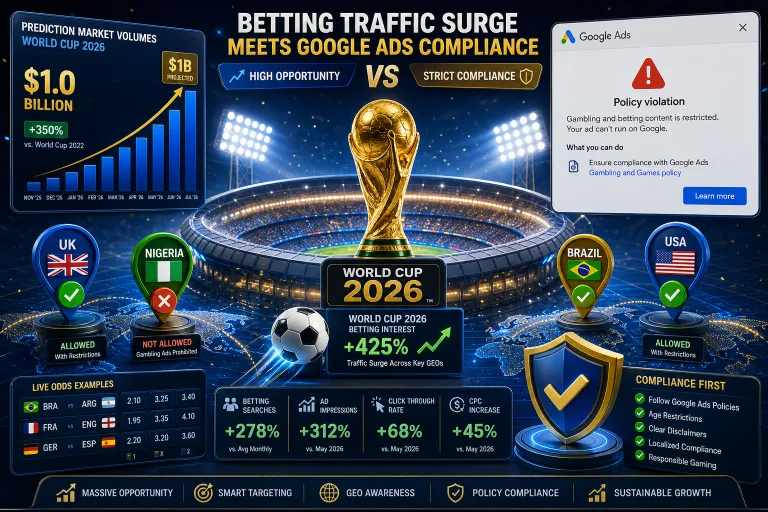
The 2026 FIFA World Cup is sending prediction market platform volumes into the stratosphere. Kalshi reports open positions exceeding $1 billion. Polymarket holds around $400 million in open contracts—and that’s before the tournament reaches its decisive phase. Both platforms are aggressively marketing their products: Polymarket is giving away $2 million for a perfect playoff bracket, while Kalshi is pushing in the App Store under the slogan “Trade the World Cup.”
For traffic arbitrageurs, this looks like a goldmine: huge volume, explosive interest, ready-made landing pages, and high EPC. But this is exactly where the problem begins. Prediction markets are a gray area. They look like bets, smell like bets, and to most ad platforms—including Google Ads—they are bets. The difference between regulated betting and prediction markets exists at the regulatory level, but not at the level of ad policy.
Why Google Ads Blocks Prediction Market Ads
Google Ads categorizes prediction markets under Gambling and games. This means you need a license in every target geo, account verification, and a separate placement request to advertise. Without this, it’s an account ban, often without the right to appeal.
The problem is that Polymarket and Kalshi operate in a legal gray area. Kalshi received CFTC approval as a contract market, but this doesn’t automatically make it legal to advertise in all jurisdictions. Polymarket is completely blocked for US users and operates through an offshore structure. Advertising such platforms via Google Ads means risking your entire account.
Regulated Betting vs. Prediction Markets: Where the Line is Drawn
For a media buyer, it’s critical to understand the difference, because it determines whether you can drive traffic legally.
Regulated Betting
- Licensed by a local regulator (UKGC, MGA, NJ DGE, etc.)
- Require age verification and KYC
- Fall under Google Ads Gambling policy if licensed
- Can be advertised, but with geo and audience restrictions
Prediction Markets
- Regulated as financial derivatives (CFTC in the US) or not regulated at all
- Do not always require KYC (Polymarket didn’t until recently)
- Google Ads makes no distinction—treats them as gambling
- Advertising via Google Ads is almost impossible without a license
How Arbitrageurs Drive Traffic to Sports Events Legally
If you want to monetize World Cup 2026 sports traffic, there are several working paths that won’t lead to an account ban.
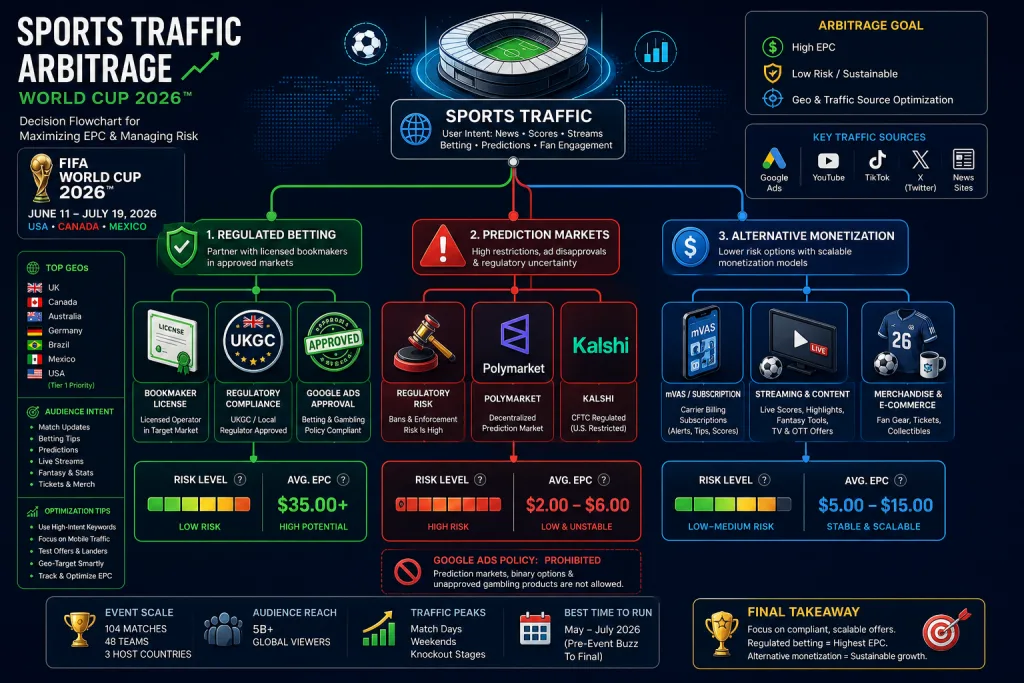
1. Regulated Bookmakers
Affiliate programs of licensed bookmakers are the cleanest path. Bet365, William Hill, DraftKings—all have affiliate programs with CPA and RevShare. Google Ads allows advertising if you have a license in the target geo. You need to apply for account certification, confirm the partnership, and comply with local restrictions.
2. Sports Content and Media
Driving traffic to sports media, news, and analytics is safe. Monetize via AdSense, sports goods affiliates, tickets, or streaming services. CPM is lower, but the traffic volume during the World Cup compensates for the difference.
3. Fantasy Sports
In some geos (US, Canada), fantasy sports are separated into a distinct category that doesn’t fall under gambling policy. DraftKings Fantasy, FanDuel—are easier to advertise than classic betting.
4. Sports Merchandise and Gear
Jerseys, national team gear, tickets—Amazon, Fanatics, UEFA affiliates. Traffic converts worse than betting, but there’s zero ban risk.
Geo-Strategy: Where to Drive Traffic Safely and Where to Avoid
Choosing the right geo determines 80% of success in sports arbitrage. Here is the current picture as of World Cup 2026.
Safe Geos
- UK: UKGC license, Google Ads allows bookmaker ads. High EPC, but high competition and CPM.
- Nigeria, Kenya, Ghana: top geos for football betting. Local bookmakers (Bet9ja, SportyBet) actively work with affiliate partners. Google Ads allows it if you have a local license.
- Brazil, Argentina: a new regulator in Brazil (SPA) has opened the market. High interest in World Cup 2026.
- India: gray area, but some states allow betting on horse racing and lotteries. Cricket traffic converts better, but football works too.
Dangerous Geos
- USA: every state has its own legislation. Google Ads requires separate certification for each state. High risk, high compliance costs.
- China: complete ban on gambling ads. No exceptions.
- Russia: betting is legal, but Google Ads doesn’t work with Russian bookmakers due to sanctions.
Risks of Prediction Markets for Arbitrageurs
Even if you found a way to drive traffic to Polymarket or Kalshi (e.g., via native ads or push notifications), the risks remain critical.
Ad Account Ban
Google Ads, Meta Ads, TikTok Ads—all classify prediction markets as gambling. A ban might not hit immediately, but after the first review. Recovering the account is almost impossible.
Affiliate Payout Freeze
If you work through an affiliate network that sends traffic to prediction markets, the network might freeze payouts during a compliance investigation. This is especially relevant for US geo, where the SEC and CFTC actively check affiliate chains.
Reputational Risk
Advertising unregulated prediction markets can lead to your domain being flagged as a scam in Google Safe Browsing databases. This kills not only the current campaign but all future projects on that domain.
Alternative Strategies for Monetizing Sports Traffic
If gambling and prediction markets are too risky for you, there are working alternatives with good ROI for World Cup 2026.
mVAS and Sports Content Subscriptions
Mobile subscriptions for sports analytics, predictions, and video highlights. Works in LATAM, Africa, and Southeast Asia. High EPC, low CPM, minimal ban risk.
Sports Apps and Games
Football simulators, fantasy apps, quizzes. Monetization through in-app purchases and ads. CPA models work in the App Store and Google Play without gambling policy restrictions.
Sports Streaming Arbitrage
Affiliate programs for streaming services (fuboTV, Sling TV, DAZN) broadcasting World Cup 2026. Subscription commission, safe traffic, good conversion in the US and Canada.
How to Set Up Google Ads for Sports Traffic Without Getting Banned
If you decide to work with licensed bookmakers, here is a step-by-step setup.
Step 1: Account Certification
In Google Ads, go to Account settings → Verification. Apply for certification in the Gambling category. Attach your partner bookmaker’s license and your affiliate agreement.
Step 2: Geo and Targeting Selection
Enable only the geos where your partner has a license. Set age targeting to 21+ (or 18+ depending on the jurisdiction). Exclude geos where betting ads are prohibited.
Step 3: Creatives and Landing Page
Google Ads prohibits creatives that promise winnings or use aggressive wording. The landing page must contain a link to responsible gambling and age restrictions. No “guaranteed predictions” or “100% win.”
Step 4: Compliance Monitoring
Check your account every 48 hours. Google can request additional documents at any time. If a partner loses a license in a geo, immediately exclude it from targeting.
The Economics of Sports Arbitrage at World Cup 2026
Comparison of sports traffic monetization models based on 10,000 clicks.
| Model | CPM (USD) | EPC (USD) | Conversion | Ban Risk |
|---|---|---|---|---|
| Regulated Bookmakers | 8-15 | 0.35-0.80 | 4-7% | Medium |
| Prediction Markets (Polymarket) | 3-6 | 0.20-0.45 | 5-8% | High |
| Sports Streaming | 4-8 | 0.15-0.30 | 3-5% | Low |
| mVAS Subscriptions | 1-3 | 0.08-0.18 | 6-10% | Low |
| Sports Merchandise | 5-10 | 0.10-0.25 | 2-4% | Low |
The numbers are approximate and depend on geo, season, and traffic quality. But the trend is obvious: prediction markets give average EPC with maximum risk. Regulated bookmakers offer the best balance of profitability and safety.
Checklist: Launching World Cup 2026 Sports Traffic Without Bans
- Check the partner’s license in every target geo before launching the campaign
- Apply for Google Ads certification in the Gambling category (if working with bookmakers)
- Set age targeting to 21+ and exclude prohibited geos
- Add a responsible gambling block and a link to the license on the landing page
- Exclude promises of winnings and aggressive wording from creatives
- Set up compliance monitoring every 48 hours after launch
- Prepare a backup domain and account in case of suspension
What’s Next: Prediction Markets After World Cup 2026
World Cup 2026 is not the end, but only the beginning. Polymarket and Kalshi have already announced expansion to other sports events: NFL, NBA, Champions League. Volumes will grow, but Google’s ad policy won’t get softer. On the contrary, after a series of insider trading and unregulated market scandals, a crackdown is expected.
For arbitrageurs, this means one thing: right now, the window of opportunity for legal sports traffic is wide open. Those who set up compliance and partnerships with licensed bookmakers now will take over the market after the tournament. Those who drive traffic to prediction markets via gray schemes will lose their accounts and money.
FAQ
Can I advertise Polymarket via Google Ads?
No. Google Ads classifies prediction markets under the Gambling category. Polymarket doesn’t have a betting license in most geos, so advertising will lead to an account ban. Even if Kalshi has CFTC approval, it’s not enough for Google Ads without a local gambling license in each target region.
Which geos are best for World Cup 2026 betting?
UK (UKGC), Nigeria and Kenya (Bet9ja, SportyBet), Brazil (new SPA regulator), and Canada (provincial licenses). These geos have licensed bookmakers with affiliate programs, and Google Ads allows advertising if you follow the policy.
How do prediction markets differ from betting for ad platforms?
Legally, prediction markets are financial derivatives regulated by the CFTC. But for Google Ads, Meta, and TikTok, there is no difference: if users bet money on the outcome of an event, it’s gambling. Ad platforms make no exceptions for CFTC-approved contracts.
Can I drive traffic to prediction markets via native ads?
Technically possible, but the risks remain. Native networks (Taboola, Outbrain) also have policies against gambling. Moreover, the domain can be flagged in Google Safe Browsing as a scam, which will kill both organic traffic and ads simultaneously.
What is a high-EPC alternative to prediction markets?
mVAS subscriptions for sports content in LATAM and Africa offer an EPC of 0.08-0.18 USD with a 6-10% conversion rate. Sports streaming (DAZN, fuboTV) in the US and Canada offers an EPC of 0.15-0.30 USD. Both options are safe in terms of Google Ads compliance.