What Is Agentic Media Buying and Why It Changes the Game
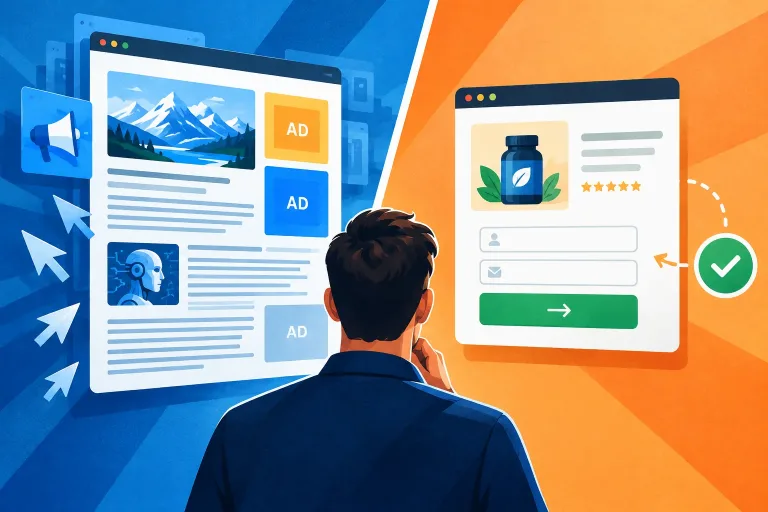
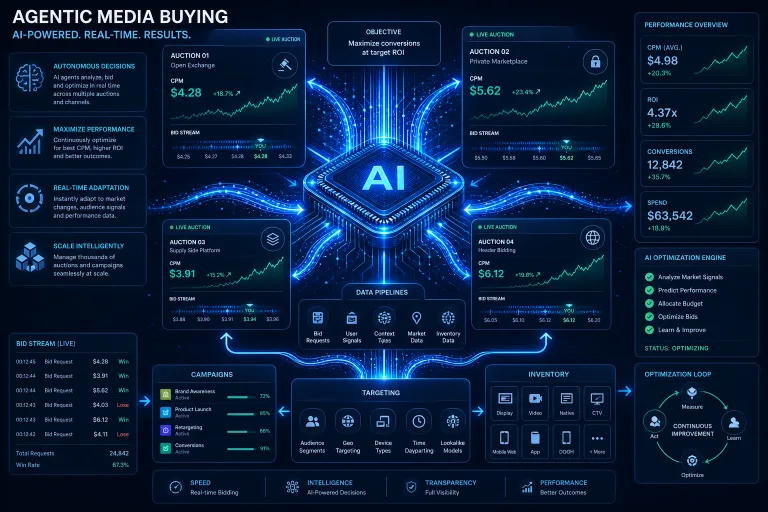
Agentic media buying is the transfer of ad purchasing control to autonomous AI agents that independently make decisions on bidding, targeting, inventory selection, and campaign optimization without constant human intervention. Unlike classical automation, where the algorithm operates within human-defined limits, the agentic approach implies that the AI sets its own sub-goals, tests hypotheses, and adjusts its strategy based on the results.
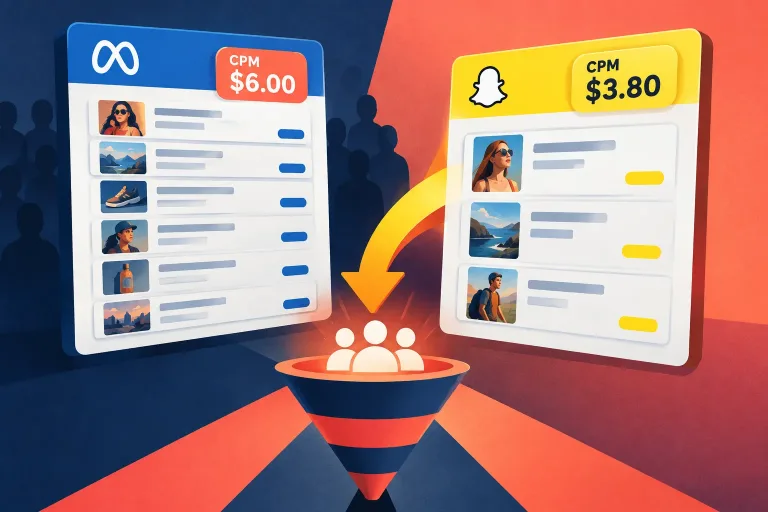
According to MediaPost data from July 2026, the programmatic market shows steady CPM growth: display formats rose by 5.9% month-over-month and 10.6% year-over-year, while video grew by 10.5% and 4.2%, respectively. Overall CPM growth reached 24.2% year-over-year. Against this backdrop, platforms are rapidly adopting agentic systems capable of processing 35 billion impressions per month and working with 200+ bidders simultaneously. For affiliates and media buyers, this means: competing manually on speed and bid accuracy is becoming impossible.
The key difference from familiar Smart Bidding or Performance Max in Google Ads is the degree of autonomy. Smart Bidding optimizes the bid within a set strategy and budget. An agentic AI buyer can independently decide to reallocate part of the budget from search to display, turn off an inefficient ad group, generate new creatives, and launch an A/B test—all without a human pressing a button.
How AI Agents Are Changing Programmatic Buying: Four Key Shifts
1. Decision-Making Speed Exceeds Human Capabilities
AI agents analyze auctions in real time and adjust bids in milliseconds. When DataBeat records 35 billion impressions per month and 200+ bidders, a human physically cannot track even 0.1% of these auctions. Agentic systems aren’t just faster—they see patterns humans miss: for example, that CPM on a specific inventory consistently drops at 2:00 PM EST, and they automatically raise bids in that window.
2. Targeting Shifts from Segments to Intent Prediction
Instead of setting up audiences by interests and demographics, AI agents build models predicting the probability of conversion for each individual impression. This means two affiliates with the exact same offers can get radically different results—one using the agentic approach will show ads to users with a 3% conversion probability, while the other working manually will hit 0.8%.
3. Budget Optimization Becomes Continuous
A human optimizes a budget once a day or once a week. An AI agent does it every few minutes. With a 24% YoY CPM growth, this is critical: the agent can reallocate the budget from expensive inventory to cheap inventory in minutes, while a human hasn’t even opened the dashboard yet.
4. Creatives Are Generated and Tested Automatically
Agentic systems don’t just buy traffic; they create creatives: generate headlines, pick images, test variations. Reddit, for instance, launched a split-testing tool that, while running on AI, still requires human input. Fully agentic systems do this themselves—and at a scale of hundreds of variations.
CPM Trends 2026: What the Data Says and How It Affects Affiliate Marketing
According to DataBeat data from June 2026, monthly revenue exceeded $55 million at 35 billion impressions. CPM growth is uneven: display is growing faster than video year-over-year (10.6% vs. 4.2%), indicating a shift in demand toward banner formats—possibly because AI agents work more effectively with the more structured data of display inventory.
For affiliates, this has direct consequences:
- High-CPM verticals (finance, insurance, B2B) are getting too expensive for manual arbitrage. Without agentic optimization, margins shrink.
- Low-CPM verticals (entertainment, app installs) remain accessible, but even there, competitors’ agentic systems can outbid you.
- Night and off-peak windows are the last zone where manual arbitrage can still compete, as not all agentic systems are optimized for non-standard time slots.
Risks of Agentic Media Buying for Affiliates
Loss of Control Over Spend
An AI agent might decide to increase the budget by 300% because the model predicts a high conversion rate. If an offer has a daily conversion cap or a traffic source cap, the agent won’t know this unless specifically configured. The result: a drained budget and a ban from the affiliate network.
Compliance and Policy Risks
Agentic systems can automatically purchase inventory that violates Google Ads or affiliate network rules. For example, an AI agent might decide that showing ads on a site with banned content yields better ROI and continue buying there until a human notices. For an affiliate, this means account suspension.
The “Black Box” Effect
When an AI agent runs a campaign, the buyer often doesn’t understand why the system made a specific decision. If the affiliate network asks where the traffic came from and why conversions dropped, the buyer can’t give a clear answer. This is especially dangerous when working with mVAS offers and gambling, where network compliance teams demand transparency.
Concentration on a Single Platform
If all competitors use the same agentic systems, a “herd” effect occurs: all agents make similar decisions, creating a bubble on specific inventory. CPMs skyrocket, and ROI drops for everyone simultaneously.
Adaptation Strategies: How an Affiliate Can Survive the Agentic Media Buying Era
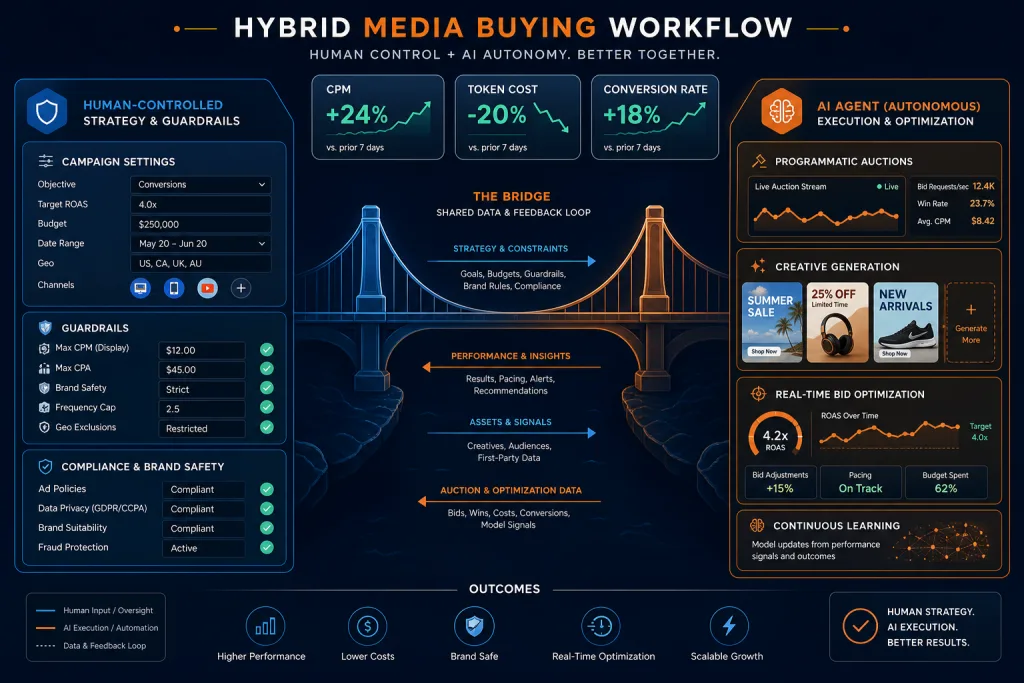
Use a Hybrid Approach
Don’t hand everything over to the AI agent. Divide campaigns into two categories:
- Automated — high-budget, mass offers with predictable conversions. Here, the agentic approach gives maximum effect.
- Manual — new, untested offers, complex GEOs, offers with strict caps. Here, human control is necessary.
Set Guardrails for the AI Agent
Before launching an agentic system, set strict limits:
- Daily budget no more than X% of the total budget per offer
- List of banned sites and inventory categories
- CPM threshold above which the agent cannot buy
- Daily conversion limit matching the offer’s cap
Diversify Traffic Sources
If everyone is going into programmatic display, consider alternatives:
- Native ads — agentic systems still work poorly with native networks due to non-standard formats
- Push and in-app — less automated, leaving room for manual optimization
- TikTok Ads and Pinterest — Pinterest, for example, added tracking tools for overseas campaigns, useful for multi-GEO arbitrage, but agentic automation there is still in its infancy
Monitor Metrics the AI Can’t See
The AI agent optimizes for conversions and ROI, but doesn’t account for:
- Traffic quality (post-click behavior, bounce rate, time on site)
- Chargeback rate and fraud metrics
- Long-term traffic value (LTV vs. upfront conversion)
- The source’s reputation in the eyes of the affiliate network
These metrics are your responsibility. If the AI drives cheap but garbage traffic, the affiliate network will ban you, not the AI.
Falling LLM Token Prices: How It Affects the Cost of Agentic Media Buying
According to Bloomberg, the Silicon Data LLM Token Expenditure Index fell nearly 20% from its May peak. Since the index launched in December, AI token prices have nearly doubled, but are now declining. This means infrastructure costs for running AI agents for media buying will drop, making agentic systems accessible not only to large agencies but also to mid-sized arbitrage teams.
Practical consequence: in the next 6–12 months, expect the emergence of low-cost agentic tools for programmatic buying. This will lower the barrier to entry but also increase competition—more affiliates will be able to use AI agents, leading to further CPM growth on the most efficient inventory.
How to Prepare Your Team for the Transition to Agentic Media Buying
The transition doesn’t mean replacing buyers with AI. It means changing their role. The buyer stops tweaking bids and setting up targeting—they start managing the AI agent: setting goals, defining limits, controlling compliance, and analyzing results.
Key skills for a buyer in the era of agentic media buying:
- Understanding ML models — not at a development level, but at a “how the model makes decisions and where it can go wrong” level
- Working with APIs — agentic systems are managed via APIs, not platform UIs
- Compliance expertise — the AI doesn’t know your affiliate network’s rules; you must
- Analytics and interpretation — the ability to understand why the agent made a decision and correct it
Checklist: Preparing to Launch an AI Agent for Programmatic Buying
- Define which offers and GEOs go to the agent and which stay under manual control
- Set strict guardrails: daily budget, max CPM, list of banned sites
- Set up alerts for anomalies: sharp spend spikes, CR drops, fraud metric spikes
- Verify that purchased inventory complies with affiliate network rules and Google Ads policies
- Set up a dashboard to monitor metrics the AI doesn’t track: chargeback rate, LTV, traffic quality
- Launch the agentic system on 10–15% of the budget and compare results with a control group over 7 days
The Future of Agentic Media Buying: A 12-Month Forecast
The trend toward agentic buying is accelerating. Falling LLM token prices make infrastructure cheaper, rising CPMs make manual optimization unprofitable, and platforms are actively adopting agentic features. Expected changes:
- Google Ads and Meta Ads will add their own agentic modes, expanding Performance Max and Advantage+ to the level of autonomous management. This will reduce the need for third-party agentic tools for basic tasks.
- Affiliate networks will start requiring labels for traffic bought by AI agents for compliance control. Affiliates need to be ready for new transparency rules.
- Competition in agentic media buying will mean the advantage goes not to those with the best AI, but to those with the best guardrails, data, and compliance processes.
FAQ
How is agentic media buying different from Smart Bidding in Google Ads?
Smart Bidding optimizes bids within a set strategy and budget but doesn’t make decisions about campaign structure, targeting, or creatives. An agentic AI buyer autonomously changes strategy, reallocates budget between campaigns, generates and tests creatives, and turns off inefficient elements—without manual intervention.
Can a small-to-mid-sized affiliate use agentic media buying?
Yes, as LLM token prices fall, agentic tools are becoming more accessible. Start with a hybrid approach: give the AI 10–15% of the budget on proven offers, set strict guardrails, and compare results with a control group over 7 days.
What are the main risks of agentic media buying for an affiliate?
Three key risks: loss of spend control (the agent might exceed the offer’s cap), compliance violations (buying banned inventory), and the “black box” effect—the inability to explain to the affiliate network where and why the traffic came.
Do I need to fire buyers when transitioning to agentic media buying?
No, their role changes. The buyer stops manually tweaking bids and starts managing the AI agent: setting goals, defining limits, controlling compliance, and analyzing metrics the AI can’t see—traffic quality, chargeback rate, LTV.
On which verticals does agentic media buying have the maximum effect?
On highly competitive verticals with large data volumes and predictable conversions—finance, e-commerce, insurance. On niche offers with strict caps and complex compliance (gambling, mVAS), it’s better to use manual control or a hybrid approach.