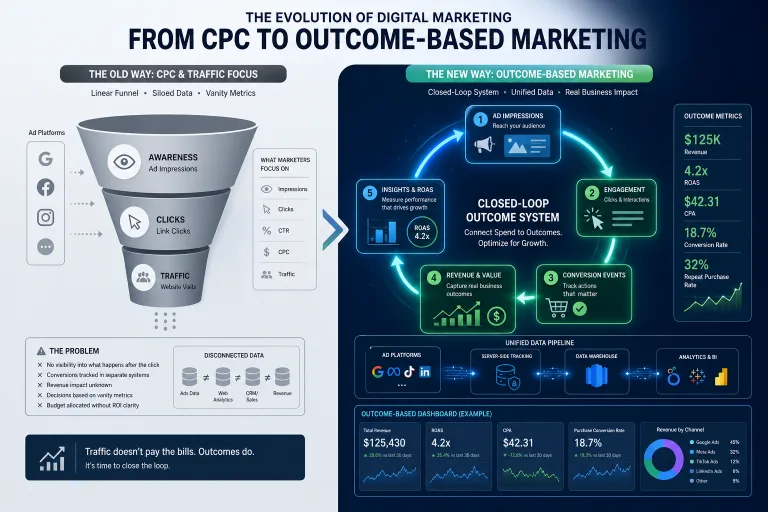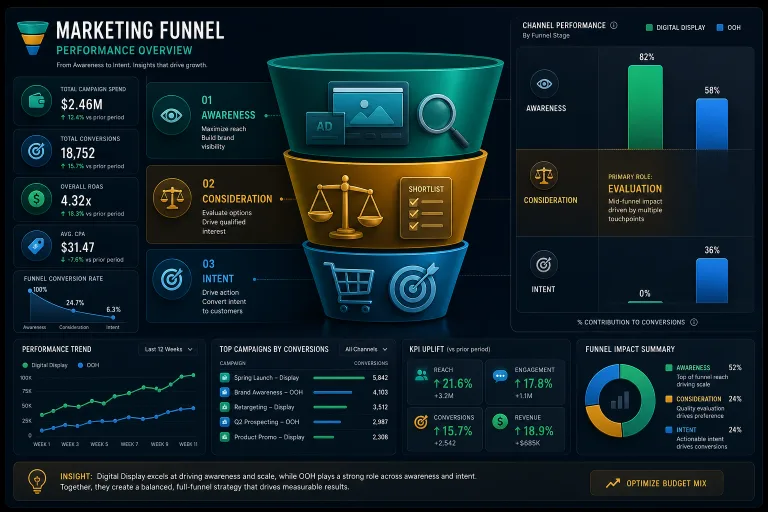
Consideration — the stage between “knowing the brand” and “wanting to buy” — has become the hardest metric to shift in 2026. A new benchmark by On Device Research shows that Digital Display provides the best uplift in awareness (+3.8 pp), but zero effect on intent. OOH (out-of-home) is the only channel that significantly works on both ends of the funnel. None of the measured channels deliver results across the entire funnel. For media buyers and affiliate marketers, this means the “one channel for the whole funnel” model is dead; budgets must be sequenced by stages rather than spread evenly across all platforms at once.
The key problem for traffic arbitrage: classic attribution models (last-click, data-driven in Google Ads) capture the click and conversion, but fail to register the intermediate decision of “the user is considering this offer.” Because of this, teams optimize the wrong metric — chasing CPC and CTR while conversion rates drop, because competitors intercept the user at the consideration stage. Below are the benchmark data, practical channel combinations, and a proxy metric you can implement in a single day.
What the On Device Benchmark Shows
On Device Research published a benchmark measuring the actual impact of advertising channels at different funnel stages. The methodology involves surveying users before and after an ad campaign, measuring shifts in awareness, consideration (inclusion in the shortlist), and intent (purchase intention). The key figures:
- Digital Display: +3.8 pp to awareness — the best result among all channels. But 0 pp to intent — zero shift in intention.
- OOH (out-of-home): +1.7 pp to intent — the best bottom-funnel result. Plus a strong uplift in awareness. The only channel that significantly works on both ends of the funnel.
- Other channels showed fragmented results: one moved awareness but not consideration; another moved intent but not awareness. None provided a significant uplift across all three stages.
The benchmark’s conclusion: advertisers can no longer rely on individual channels for full-funnel performance. The importance of combinations is growing — sequentially using different channels at different funnel stages.
Why Consideration is the Most “Expensive” Metric
Consideration isn’t just “the user saw the ad.” It’s “the user would include your offer in their shortlist of options when buying.” In the context of traffic arbitrage and affiliate marketing, this is a critical stage: the user clicked the banner (awareness), visited the landing page, but left without converting — because at the consideration stage, a competitor intercepted them with a better offer or a better landing page.
The problem is that consideration is poorly measured by standard tools. Last-click attribution assigns the conversion to the last click (usually Search) and zeroes out the contribution of display, native traffic, and retargeting that prepared the user for the choice. Data-driven attribution in Google Ads partially accounts for this, but only works within the Google ecosystem — if you are running traffic on Meta, TikTok, native networks, and Google Ads simultaneously, the data is fragmented.
The result: the media buyer sees that CPC and CTR are stable, but conversions are dropping. The reason isn’t the cost per click, but a gap at the consideration stage. The budget goes to awareness, which doesn’t convert to intent because there is no intermediate touchpoint that specifically shifts consideration.
Digital Display: King of Awareness, Zero on Intent
Digital Display — banners, native ads, programmatic — showed the best uplift in awareness: +3.8 pp. This confirms display’s role as a scalable reach driver. Cheap, broad, and effective for warming up the audience.
But for intent — zero. The user saw the banner, remembered the brand, but the intention to buy wasn’t formed. This doesn’t mean display is useless. It means that display does not close the funnel by itself.
For media buyers, the conclusion is straightforward: pouring display traffic into direct conversion without an intermediate touchpoint is burning budget. Display works for warming up, not for closing the deal. You need to pair it with a channel that drives consideration and intent.
OOH: The Unexpected Leader of the Bottom Funnel
OOH (out-of-home advertising) showed +1.7 pp for intent — the best result among all measured channels. And simultaneously, a strong uplift in awareness. It is the only channel that significantly works on both ends of the funnel.
For media buyers, this is counterintuitive: OOH is traditionally considered a “branding” channel, not a performance tool. But the data shows that physical context creates trust, which specifically drives consideration — the stage where digital channels stall.
Practical application for arbitrage: OOH isn’t available in all GEOs and verticals, but where it is (Tier-1 GEOs, local offers), it’s worth testing as a bundle with digital channels. For affiliate offers with local targeting (finance, insurance, local services), OOH can become an underrated source of cheap intent traffic.
The End of the “One Channel for the Whole Funnel” Model
The main conclusion of the benchmark: no single channel provides a significant uplift across the entire funnel. Previously, you could launch a Search campaign in Google Ads and get results at all stages — from awareness to conversion. Now, you can’t.
The reason: attention fragmentation. The user sees a banner on a website, then a Reel on TikTok, then a search in Google — and each channel works at its own stage. If the entire budget is in one channel, you only cover one stage of the funnel and lose the rest.
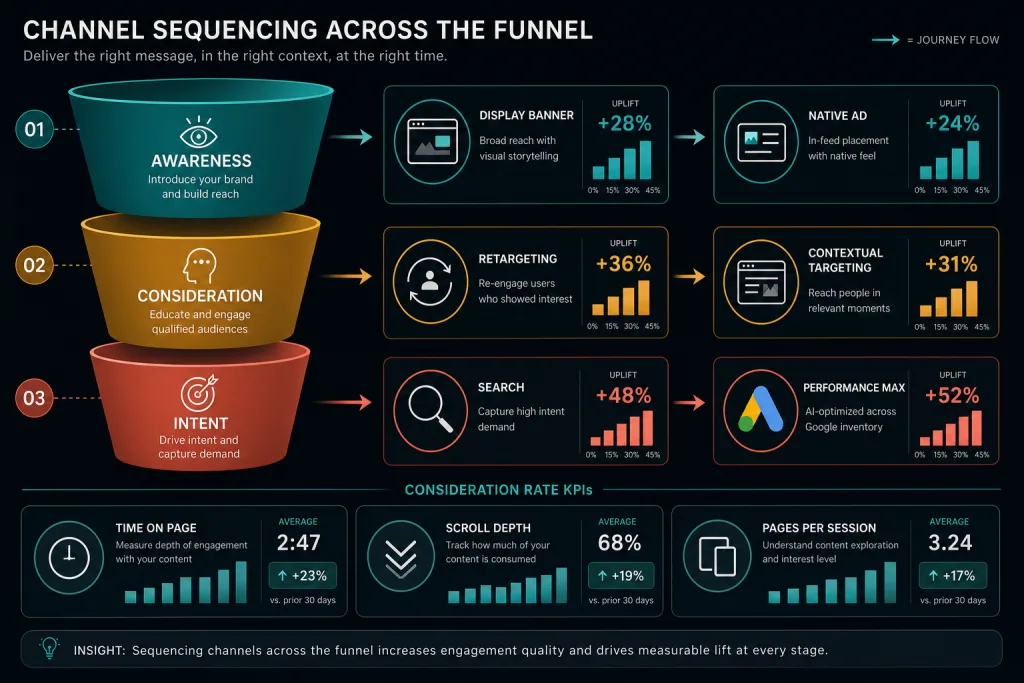
The old budget allocation model: 70% to Search (intent), 30% to Display (awareness). The new model is channel sequencing: Display/native traffic → awareness, retargeting via Meta/Google → consideration, Search + Performance Max → intent and conversion. Each stage is measured separately.
How to Recalculate the Media Mix: Channel Bundles for Media Buyers
For a media buyer with a limited budget, recalculating the media mix starts with dividing the funnel into three stages and selecting a channel for each:
Stage 1: Awareness (Warm-up)
- Channels: Display, native ads (Taboola, Outbrain, MGID), video views in Meta/TikTok
- KPI: Cost per thousand impressions (CPM), reach, frequency (3–5 impressions per user)
- Budget: 20–30% of the total
Stage 2: Consideration (Choice)
- Channels: Retargeting via Meta Pixel and Google Display, contextual targeting, email newsletters to the collected database
- KPI: Consideration rate (percentage of users who, after ad contact, spend >30 seconds on the landing page or scroll below the first screen)
- Budget: 30–40% of the total
Stage 3: Intent and Conversion
- Channels: Google Search Ads (brand and non-brand queries), Performance Max, retargeting for cart/form
- KPI: Cost per conversion (CPA), ROAS
- Budget: 30–40% of the total
The bundle only works if each stage is measured separately. If you merge all metrics into one funnel and look only at the final CPA, you won’t see where the exact break occurs.
The Attribution Problem: Last-click Kills the Truth About Consideration
Last-click attribution assigns the conversion to the last touch — usually Search Ads. This means that display, native traffic, and retargeting that prepared the user get zero credit. As a result, the media buyer cuts the budget for upper-funnel channels because they “don’t bring conversions,” and pours everything into Search. After 2–3 weeks, Search drops too, because the top of the funnel is no longer being filled.
This is a classic mistake that On Device data confirms quantitatively: Digital Display gives +3.8 pp to awareness, but if you only measure conversions, display looks useless. In reality, it works — just at a different stage of the funnel.
What to Do
- Enable data-driven attribution in Google Ads (if you haven’t already) — it considers intermediate touches within Google.
- For cross-platform bundles, use MMM (marketing mix modeling) or at least post-purchase surveys (“how did you hear about us?”).
- Implement consideration rate as a separate KPI — described below.
Consideration Rate: A Proxy Metric You Can Implement in One Day
Consideration rate is the percentage of users who, after contact with an ad, demonstrate behavior indicating the inclusion of the offer in a shortlist. Full measurement of consideration requires surveys (brand lift studies), but there are proxy metrics available in Google Analytics 4 and Google Ads:
- Time on landing page >30 seconds — the user is reading, not immediately leaving.
- Scroll below the first screen — the user is studying the offer details.
- Visiting >2 pages — the user is comparing options within the site.
- Clicking on an element with detailed info (FAQ, pricing, reviews) — the user is diving deeper.
Set up these events in GA4 as micro-conversions and pass them to Google Ads to optimize campaigns at the consideration stage. This will allow you to measure not only the final conversion but also the intermediate shift — and understand which channel drives consideration, and which only drives awareness.
Risks and Limitations: Where the Data Might Not Work
The On Device benchmark is based on surveys — this is user self-reporting, not behavioral data. Limitations:
- GEO specificity: the data is aggregated, not broken down by country. For Tier-2/Tier-3 GEOs, results may differ — OOH might not work where there is no outdoor advertising infrastructure.
- Vertical specificity: affiliate offers (iGaming, finance, e-commerce) may show different patterns. iGaming traffic often converts faster — the consideration stage is shorter.
- Sample size: the benchmark does not provide statistical significance for every channel in every segment.
For media buyers, the conclusion is: use On Device data as a hypothesis for testing, not as dogma. Launch an A/B test splitting the budget by funnel stages and compare it with the baseline model over 2–3 weeks.
Checklist: Implementing Consideration Rate in an Affiliate Bundle
- Divide the budget into three pools: awareness (20–30%), consideration (30–40%), intent (30–40%) — don’t spread it evenly.
- Set up micro-conversions in GA4: time >30 sec, scroll below the first screen, >2 pages, click on FAQ/pricing.
- Pass micro-conversions to Google Ads and optimize consideration campaigns on them, not on the final conversion.
- Switch the attribution model in Google Ads from last-click to data-driven — to see the contribution of intermediate touches.
- Add retargeting as a separate campaign between display and search — this is the stage that drives consideration.
- Launch an A/B test for 2–3 weeks: old model (all budget in Search) vs. sequenced model (budget by funnel stages).
- Compare not only CPA, but also consideration rate — if consideration is growing but conversion isn’t yet, wait: the funnel will fill up.
FAQ
What is consideration in advertising in simple terms?
Consideration is the funnel stage where the user already knows about your offer and includes it in their shortlist of options to buy. It’s not a click (awareness) and not a purchase (intent), but an intermediate decision of “I am considering this option.”
Why doesn’t Digital Display provide intent if it provides awareness?
Banners and native ads are effective for reach — the user sees the brand and remembers it. But a banner by itself doesn’t form an intention to buy: for that, additional touchpoints (retargeting, search, context) are needed, which work at the consideration stage. On Device data confirms: display gives +3.8 pp awareness and 0 on intent.
How to measure consideration without surveys and brand lift?
Use proxy metrics in GA4: time on landing page >30 seconds, scroll below the first screen, visiting >2 pages, clicks on blocks with detailed information (FAQ, pricing, reviews). Set them up as micro-conversions and optimize campaigns on them.
Should media buyers test OOH?
If you work with local offers in Tier-1 GEOs (finance, insurance, local services) — yes. OOH showed the best uplift in intent (+1.7 pp) in the On Device benchmark. For global affiliate traffic and iGaming, OOH might be unavailable or unprofitable.
How does channel sequencing affect CPA?
At the start, CPA may rise — the budget is distributed across stages, and conversions arrive with a delay. After 2–3 weeks, when the funnel fills up, CPA stabilizes and often ends up lower than in the “all in Search” model, because users come to Search already warmed up and convert cheaper.