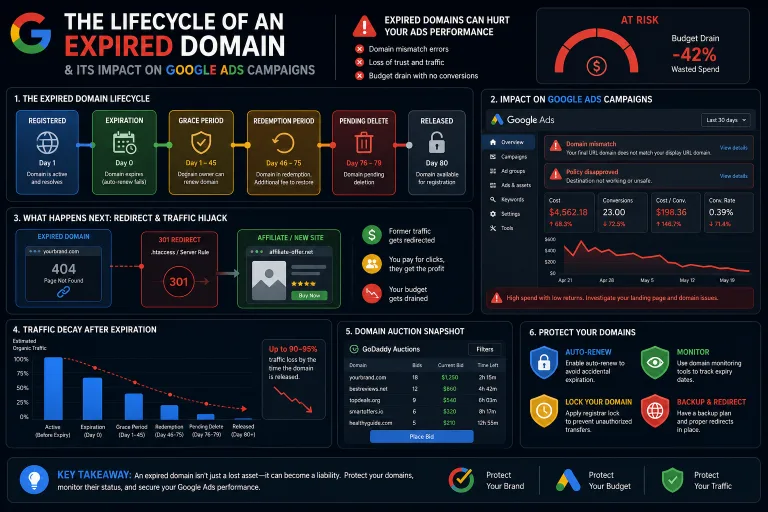
In 2015, former Google employee Sanmay Ved bought the Google.com domain for $12. The company simply forgot to renew the registration. The incident lasted a minute — Google quickly got the domain back — but it illustrates a fundamental vulnerability: even the largest advertisers lose control over domains, and with them, over traffic, brand queries, and advertising budgets in Google Ads. For arbitrageurs, expired domains are not a funny story, but a working tool for generating cheap traffic through redirect arbitrage and intercepting competitors’ brand traffic. In this article, we will break down how domain arbitrage works in 2026, what risks it poses to advertisers, and how media buyers can protect their campaigns.
What is expired domain arbitrage
Expired domain arbitrage is the practice of buying domains with expired registration to redirect their organic and referral traffic to the arbitrageur’s landing pages. When a domain is not renewed, it enters the deletion cycle: grace period (1–45 days), redemption period (30 days), and final release. At each stage, the traffic that continued to flow to the domain — from bookmarks, old links, search results, email newsletters — can be intercepted.
For media buyers, this means three things:
- Cheap traffic without buying ads. A domain with 10,000–50,000 visits per month can be bought for $50–500 at auctions like GoDaddy, NameJet, or Dynadot.
- Redirect to offers. Traffic is redirected via a 301 or 302 redirect to affiliate landings, prelanding pages, or direct offers.
- SEO legacy. Many expired domains retain backlinks and some search traffic for weeks after release.
How expired domains hit Google Ads campaigns
When an advertiser’s domain expires, the consequences for Google Ads go far beyond “just the site doesn’t work.” Here is what happens at the campaign level:
1. Budget is drained on irrelevant traffic
If the domain has expired but the Google Ads campaign is still running, clicks lead to the registrar’s placeholder page or the new owner’s redirect. The advertiser pays for clicks that bring no conversions. With a budget of $500/day and a 3% CTR, that’s $15–25 a day of pure waste.
2. Ads are rejected for landing page irrelevance
Google Ads checks landing pages during moderation and retargeting. If the domain has passed to a new owner with different content, the Quality Score drops, and ads may be rejected for a mismatch between the landing page and the ad text. Recovery takes days.
3. Competitors’ brand bidding on the expired domain
Arbitrageurs regularly monitor brands’ expired domains and buy them for brand campaigns. If your domain lapses, a competitor can buy it and set up a redirect to their landing page. Users who type your URL directly end up with the competitor.
Redirect arbitrage: mechanics and risks
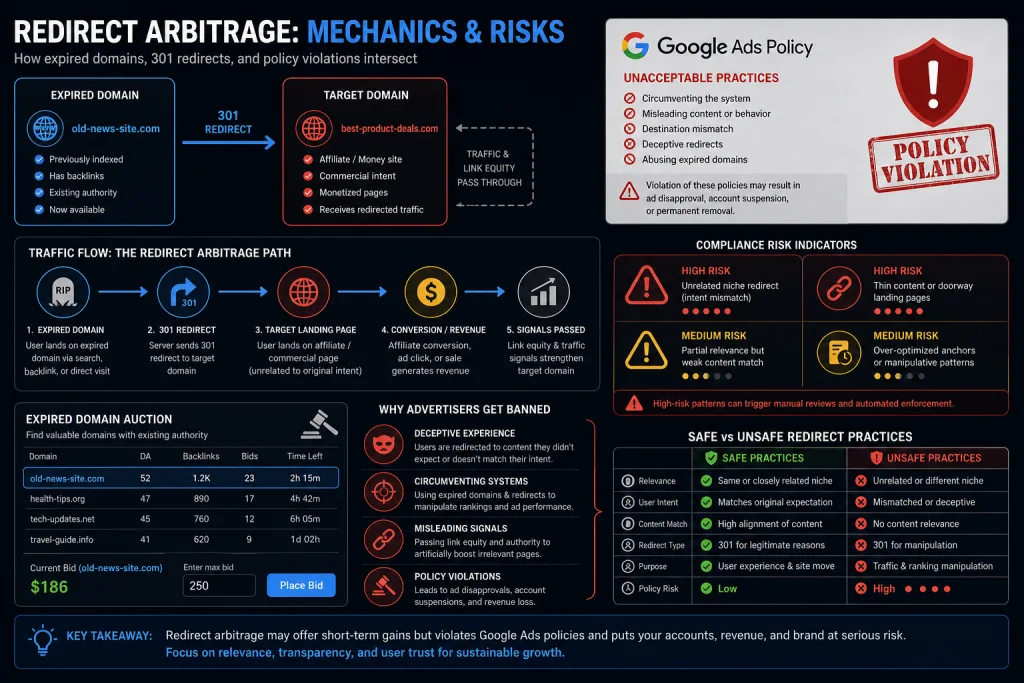
Redirect arbitrage is a sub-type of domain arbitrage where traffic from an expired domain is redirected to pages with ads or affiliate offers. The scheme looks like this:
- The arbitrageur finds a domain with expired registration that has traffic (via Wayback Machine, Ahrefs, SEMrush).
- Buys the domain at auction or after release.
- Sets up a 301 redirect of all pages to the target page — an offer landing, preland, or a page with AdSense/Taboola.
- The traffic that went to the old pages is automatically redirected.
Risks of redirect arbitrage in Google Ads
Google Ads explicitly prohibits the use of redirect pages that do not provide users with relevant content. The “Destination requirements” policy requires the target URL to match the domain in the ad, and redirects to be only for technical purposes (HTTPS, domain migration).
Violations:
- Domain mismatch. The ad leads to domain-a.com, but the redirect sends to domain-b.com — account ban.
- Sneaky redirects. Redirect to a page with different content — violation of the “Misleading content” policy.
- Arbitrary redirects. Redirect without warning to an irrelevant page — violation of “Destination requirements”.
How arbitrageurs find expired domains with traffic
The expired domains market in 2026 is an industry with tools, auctions, and automation. The main methods:
Registrar auctions
GoDaddy Auctions, NameJet, Dynadot, and DropCatch hold auctions for domains that have not been renewed. Prices start at $12 and go up to thousands of dollars for domains with high DA (Domain Authority) and traffic.
Services for finding expired domains
- Expireddomains.net — a free database with filters by TLD, traffic, Alexa rank.
- SpamZilla — a paid service that analyzes the domain’s spam factor, link profile, and history.
- DomCop — shows DA, PA, trust, traffic, and auction price.
Traffic analysis via Wayback Machine and Ahrefs
Before buying, arbitrageurs check:
- What content was on the domain (Wayback Machine).
- How many backlinks and from which sites (Ahrefs, Majestic).
- What organic traffic there was before expiration (SEMrush, SimilarWeb).
- Whether there are any Google penalties (manual or algorithmic).
Brand bidding on competitors’ expired domains
One of the most aggressive tactics is buying a competitor’s expired domain to intercept their brand traffic. This is not just redirect arbitrage, but targeted conquesting through domain infrastructure.
How it works
- A competitor forgets to renew a domain (for example, a regional landing page or microsite domain).
- The arbitrageur buys the domain at auction.
- Sets up a redirect to their landing page or affiliate offer.
- Users who type the old URL or click on old links end up with the arbitrageur.
Legality and risks
Brand bidding on expired domains is a gray area. Google Ads does not prohibit domain ownership, but:
- If the domain contains a trademark, the rights holder can file a UDRP complaint (Uniform Domain-Name Dispute-Resolution Policy) and recover the domain through WIPO.
- If the redirect misleads users, it is a violation of Google Ads policies.
- If the arbitrageur uses the domain to imitate a brand, it may qualify as cybersquatting under the ACPA (Anticybersquatting Consumer Protection Act) in the US.
Protection: how media buyers can avoid losing domains and budgets
For advertisers and agencies, domain protection is part of operational security, no less important than protecting Google Ads accounts.
Registration and renewal
- Enable auto-renew at the registrar for all domains used in Google Ads campaigns.
- Register domains for 5–10 years in advance — this reduces the risk of accidental expiration and provides an SEO bonus.
- Use a corporate registrar (MarkMonitor, CSC, GoDaddy Corporate) for brand domains — they provide monitoring and automatic renewal.
Expiration monitoring
- Set up alerts 90, 60, and 30 days before a domain expires.
- Use services like DomainTools or WhoisXML API to monitor domain status.
- Check notarized expiry dates — sometimes the grace period is shorter than expected.
Protection against brand bidding
- Register domain variations (.com, .net, .org, .co, common typos).
- File UDRP complaints against arbitrageurs who bought your domain.
- Set up Google Ads brand exclusions so competitors cannot use your brand as a keyword (via Trademark complaint).
Practical strategies for arbitrageurs
If you are considering expired domain arbitrage as a traffic source, here are working approaches:
1. PBN redirects for SEO arbitrage
Instead of a direct redirect to an offer, build a PBN (Private Blog Network) from expired domains with high DA and relevant backlinks. Use them for link building to your money sites. This is slower but safer — no risks with Google Ads policies.
2. 301 redirect to a preland
Buy a domain with traffic in the right niche (finance, health, e-commerce) and set up a 301 redirect to a prelanding page. The preland should be relevant to the original domain content — this reduces the risk of rejection in Google Ads.
3. Domain parking with monetization
For domains with generic traffic (for example, former informational sites), use domain parking via Sedo, Bodis, or Dan. This brings in $1–10 RPM without the need to build landing pages.
4. Restoring content via Wayback Machine
Restore the original content of the domain from the Wayback Machine, add affiliate links and banners. This preserves SEO traffic and creates an organic source of conversions without buying ads.
Checklist: protecting domains and campaigns from expired domain arbitrage
- Enable auto-renew for all domains used in Google Ads campaigns
- Register brand domain variations (.com, .net, .co, common typos)
- Set up alerts 90, 60, and 30 days before each domain expires
- Check all active Google Ads campaigns for domain and landing page match
- Use a corporate registrar for brand domains with monitoring
- File UDRP complaints via WIPO if a domain is intercepted by arbitrageurs
- Set up Google Ads trademark complaints to protect brand queries
Compliance and ban risks
Expired domain arbitrage is not only a technical possibility but also a compliance risk. Google Ads in 2026 has strengthened the automatic checking of landing pages, and redirect schemes are detected faster than in 2023–2024.
What leads to a ban
- Redirect from domain-a.com to domain-b.com without technical necessity.
- A landing page with content that does not match the ad.
- Using an expired brand domain to imitate the original site.
- Mass registration of domains with the same redirect — a pattern detected by algorithms.
What reduces risks
- Redirect only within the same domain (www → non-www, HTTP → HTTPS).
- Restoring relevant content on the expired domain instead of a direct redirect.
- Using the domain as a full-fledged site with affiliate links, rather than as a redirect pad.
- Spreading redirects across different accounts and IP addresses.
The expired domains market in 2026: trends
The expired domains market has gone from a niche hobby to an industry with automation. Key trends:
- AI scanners. Services like SpamZilla and DomCop use AI to assess a domain’s potential — traffic, spam factor, penalty history.
- Programmatic bidders. Large players use API bidding at auctions, buying domains milliseconds after release (drop catching).
- Price increase. Domains with DA 30+ and traffic of 5,000+ visits/month cost $200–2000, which is higher than in 2022–2023.
- Stricter compliance. Google and registrars are more actively pursuing cybersquatting and misleading redirects.
FAQ
Is it legal to buy competitors’ expired domains for redirect arbitrage?
Buying an expired domain is technically legal, but if the domain contains someone else’s trademark, the rights holder can recover it through a UDRP complaint with WIPO. Redirecting to your landing page with brand imitation may qualify as cybersquatting under the ACPA in the US.
How does Google Ads detect redirect arbitrage?
Google Ads uses automatic landing page scanners that check the match between the domain in the ad and the final URL after redirects. If domain-a.com redirects to domain-b.com without technical necessity, the campaign is flagged as a violation of “Destination requirements”.
How much does a domain with traffic for arbitrage cost?
Prices range from $12 (a domain after release without auction) to $2000+ (a domain with DA 30+ and organic traffic of 5000+ visits/month). The average price of a working domain for redirect arbitrage is $100–500.
Can expired domains be used for Google Ads campaigns directly?
Yes, if you restore relevant content on the domain and use it as a full-fledged landing page. A direct redirect to another domain violates Google Ads policies. Restoring content via the Wayback Machine with the addition of affiliate links is a safer approach.
How to protect your domain from being intercepted by arbitrageurs?
Enable auto-renew, register the domain for 5–10 years in advance, use a corporate registrar with monitoring, set up alerts 90/60/30 days before expiration, and register domain variations (.com, .net, .co, typos).