Google Ads has officially announced the cancellation of language targeting starting September 2026 — nine months later than the original deadline. For media buyers and affiliate marketers, this means one of the fundamental levers for controlling traffic quality is disappearing. Campaigns that relied on language targeting to filter out irrelevant traffic in multilingual GEOs will now show ads to users regardless of their browser’s interface language. The risk of wasting budget on users who don’t understand the landing page’s language increases manifold — especially in regions like Canada (English/French), Belgium (Flemish/French), Switzerland (German/French/Italian), and CIS countries (Russian/local languages). This article covers exactly what is changing, how to restructure your targeting, and which strategies work under the new conditions. The cancellation of language targeting is not a cosmetic change. Language targeting was one of the three basic filters in Google Ads (along with GEO and device) that allowed media buyers to narrow the audience down to users whose browser interface language matched the language of the creative and landing page. Without this filter, a campaign targeting Switzerland with a German landing page will be shown to both French-speaking and Italian-speaking Swiss users. For affiliates working with thin margins and CPA offers, this could mean a 15–30% drop in conversion rates in multilingual GEOs.
What exactly is being canceled and when
Google Ads is removing the ability to select targeting language at the campaign level. Previously, you could select up to 41 languages in the campaign settings: Google matched the user’s browser interface language and only showed ads to those whose language matched the selection. As of September 2026, this parameter stops working. Google justifies this by saying that users’ language preferences have become less predictable: people use VPNs, change their interface language, and work in multilingual environments. According to Google, up to 23% of users in the EU regularly use a browser in a language other than their native one. However, for media buyers, this means a loss of control over traffic quality.
Why this is critical for affiliate traffic
Affiliates use language targeting in three key scenarios: Scenario 1: Multilingual GEOs. Canada, Belgium, Switzerland, Finland, India — countries where several languages have official status. Language targeting allowed you to drive traffic only to English-speaking Canadians or only to French-speaking Belgians. Without it, reach expands, but quality drops. Scenario 2: Filtering out junk traffic. In CIS and Eastern European countries, language targeting based on Russian filtered out users with localized browsers (Kazakh, Ukrainian, Belarusian) who often don’t convert on Russian-language offers. Scenario 3: Creative localization. Campaigns with creatives in the local language (German for Germany, French for France) used language targeting as a guarantee that the user would understand the creative. Without it, a portion of impressions goes to users with a different interface language.
How Google will determine language without targeting
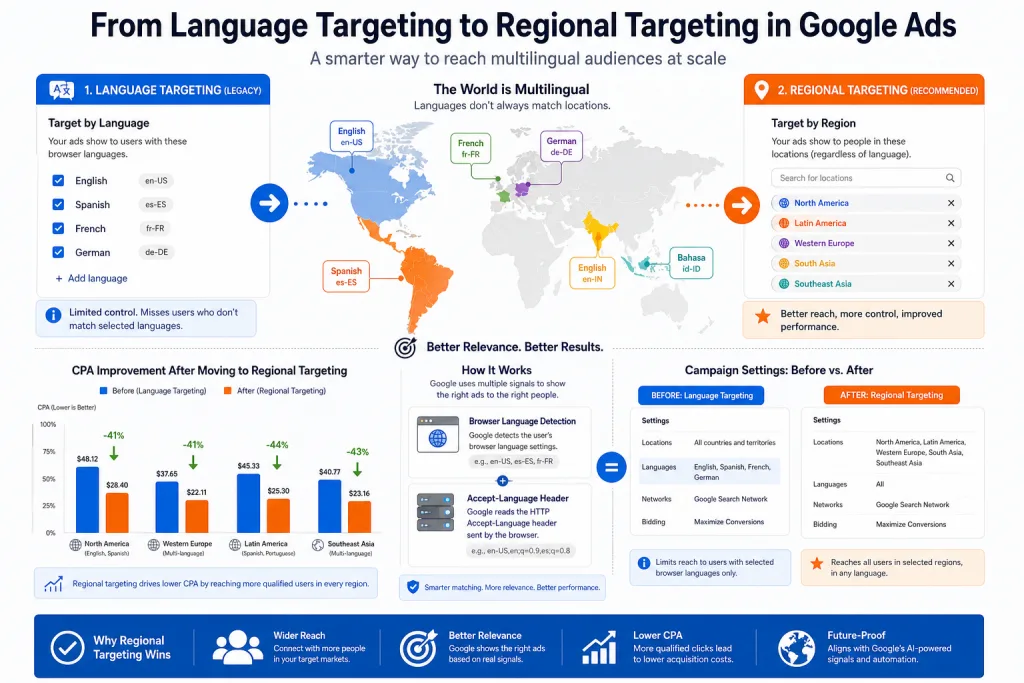
Google has stated that instead of explicit language targeting, the system will use “automatic language detection” based on signals: search query language, page content language (for Display), user search history, and Google account language settings. The problem is that these signals are less reliable than direct browser interface language. A user who searches in English but uses a French browser might now see an English ad — even if the landing page is in French. For Performance Max campaigns, the situation is even more complex: PMax already operates with minimal targeting control, and losing the language filter means even fewer levers to pull.
Adaptation strategies: what to replace language targeting with
1. Geographic targeting at the regional level
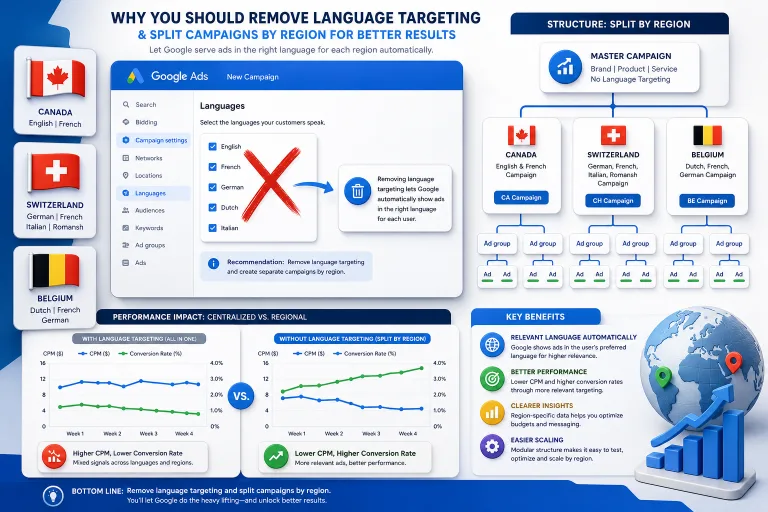
Instead of language targeting by country, use regional targeting. For example, for Canada, create two separate campaigns: one targeting the provinces of Ontario, British Columbia, Alberta (English-speaking), and the second targeting Quebec (French-speaking). For Belgium, split into Flanders (Flemish) and Wallonia (French). This requires more campaigns but gives control over the language audience through geography.
2. Keywords in the desired language
For Search campaigns, language targeting is partially replaced by the keywords themselves. If you are buying keywords in German, you automatically filter users who search in German. Problem: broad match and Performance Max can show ads for translated or mixed queries. Solution: use exact match and phrase match, add negative keywords in other languages.
3. Landing page localization with auto-detection
Configure your landing page to automatically detect the browser’s language and redirect to the correct language version. This doesn’t solve the problem of showing the creative in the wrong language, but it reduces the bounce rate risk. For affiliates using a TDS (traffic distribution system), this is standard practice — add an Accept-Language header check.
4. Audience signals in Performance Max
In PMax, use audience signals with language segments. Google allows you to create audiences based on language preferences — this isn’t a perfect replacement, but it gives the algorithm a signal about which segment to target.
5. Separating campaigns by creative language
Create separate campaigns for each creative language. This increases management overhead but allows you to control which creative is seen by which user. In Display and Demand Gen, this works through separate campaigns with different language versions of banners.
Impact on different campaign types
Search Ads
Lowest risk: keywords in the desired language already act as a filter. However, broad match can lead to impressions for related queries in other languages. Recommendation: switch broad match to phrase match in multilingual GEOs.
Performance Max
Highest risk: PMax gives no control over the language of impressions. The only lever is audience signals and asset localization (asset groups by language). If you are running PMax in a multilingual GEO, split it into separate campaigns by region.
Display & Demand Gen
Medium risk: targeting by topics and placements partially compensates for the loss of the language filter. Add site exclusions in unwanted languages via placement exclusions.
YouTube Ads
The language of the video creative acts as a natural filter — users who don’t understand the language simply skip the ad. But that doesn’t mean they won’t click. Add subtitles and localized CTAs.
Risks for affiliates: what could go wrong
Risk 1: CPM increase with a drop in conversion. Reach increases (more impressions), but conversion drops. As a result, CPA rises, and ROAS falls. For affiliates with a fixed payout, this can make a campaign unprofitable. Risk 2: Bans for irrelevant traffic. Affiliate networks and programs might ban an account for “junk” traffic — showing a landing page to users who don’t understand the language is often regarded as fraud. Risk 3: Compliance issues. In some verticals (finance, medicine, gambling), advertising in the wrong language can violate local laws. For example, advertising financial services in English in Quebec without French localization is a violation of Bill 101. Risk 4: Lower Quality Score. If a creative in one language is shown to users with another language, CTR drops, Quality Score decreases, and CPC rises. This creates a vicious circle.
Practical migration plan before September
You have until September 2026 to prepare your campaigns. Here is a step-by-step plan: 1. Audit current campaigns. Identify all campaigns that use language targeting. Check which GEOs are multilingual. 2. Segmentation by regions. Split campaigns in multilingual GEOs by regions/provinces. 3. Creative localization. Ensure that each creative matches the language of the target region. 4. TDS setup. Add an Accept-Language check to your traffic distribution system to redirect to the correct landing page. 5. Monitor the first two weeks. After the cancellation, track CTR, conversion, and CPA by segment. Be prepared to adjust bids promptly.
What Google says about compensation
Google claims that automatic language detection based on ML signals will be “more accurate” than explicit language targeting. However, there is no independent data to confirm this yet. Media buyers should treat this claim with skepticism: Google is interested in expanding reach (more impressions = more revenue), not in improving traffic quality for advertisers.
Checklist: preparing campaigns for the end of language targeting
- Identify all campaigns with language targeting and multilingual GEOs in your account
- Split campaigns into regional segments instead of language-based ones
- Switch broad match to phrase match in multilingual Search campaigns
- Add negative keywords in unwanted languages
- Set up auto-detection of language in TDS via the Accept-Language header
- Create separate asset groups in PMax for each creative language
- Set up alerts for CPA growth in the first two weeks after the cancellation
Forecast: who will suffer the most
The cancellation of language targeting will hit affiliates working with: — Canada (English/French): need to split campaigns by provinces — Switzerland (three official languages): complex segmentation — Belgium (Flemish/French): regional division — India (Hindi/English/regional languages): huge reach, low quality — CIS GEOs (Russian/local languages): increase in junk traffic Affiliates working with monolingual GEOs (Germany, France, Japan, South Korea) will suffer the least, where the browser interface language matches the state language in 95%+ of cases.
FAQ
What exactly is being canceled in Google Ads in September 2026?
Google Ads is removing the ability to select targeting language at the campaign level. Previously, you could select up to 41 languages, and ads were only shown to users with a matching browser interface language. Now, Google will determine the language automatically based on search queries, history, and other signals.
Do I need to create separate campaigns for each language?
For multilingual GEOs — yes, this is the recommended strategy. Splitting by regions (provinces, cantons) allows you to indirectly control the language audience. For monolingual countries, separate campaigns are not needed.
How will this affect Performance Max campaigns?
PMax will suffer the most, as it already provides minimal targeting control. It is recommended to create separate PMax campaigns for each language segment with localized asset groups and audience signals.
Can keywords be used as a replacement for language targeting?
Partially, yes. Keywords in the desired language in Search campaigns act as a natural filter. But broad match can lead to impressions for related queries in other languages. Use phrase match and add negative keywords in unwanted languages.
What to do if an affiliate network bans for irrelevant traffic after the cancellation?
Set up a TDS with an Accept-Language header check and a redirect to the correct language version of the landing page. This will reduce the risk of bounce rates and bans. Also, warn your affiliate network manager about the change in Google Ads and ask them to temporarily soften KPIs for traffic quality.