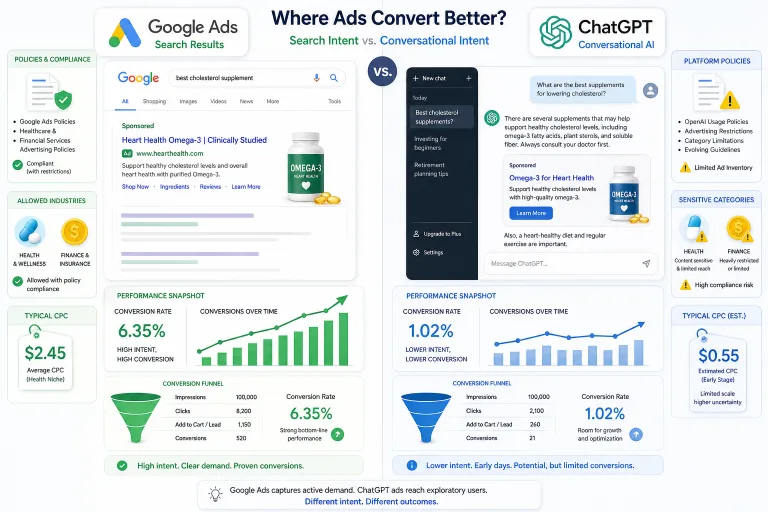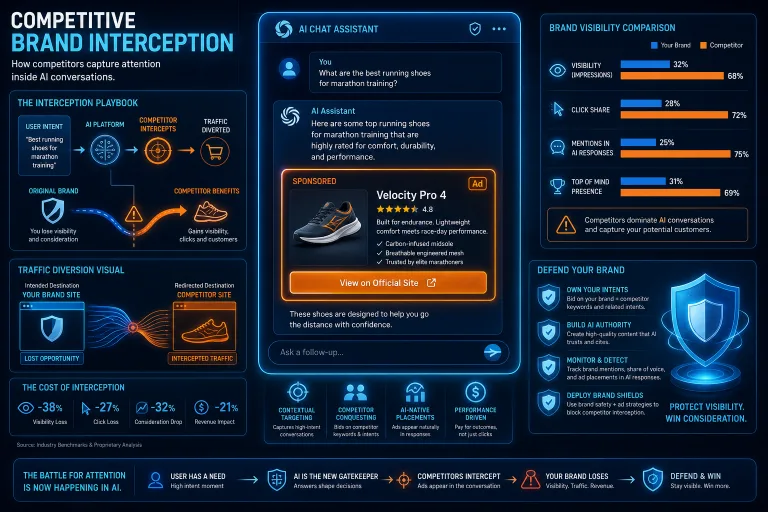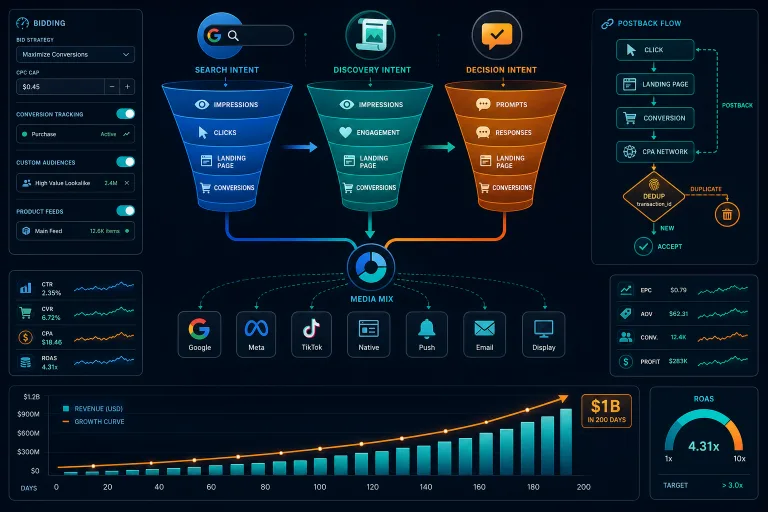
ChatGPT Ads reached a $1 billion annual run rate in 200 days — a pace that neither Google Ads nor Meta Ads showed at the start. For media buyers and affiliates, this isn’t just another “AI advertising” news story: OpenAI has simultaneously expanded its global rollout and added CPC bidding, conversion tracking, custom audiences, product feeds, and outcome-based optimization. The ChatGPT ad infrastructure finally has the same levers that affiliates use to manage economics in Google and Meta.
The key shift is not the volume of revenue, but the type of intent ChatGPT intercepts. Google catches a person at the moment of search, Meta — at the moment of scrolling, ChatGPT — at the moment of decision-making. The user asks “what should I buy”, “which company to choose”, “which software is better” — this is the intent that lives between search and conversion in a classic funnel. And it is this layer that is being monetized for the first time.
What exactly happened: $1B run rate in 200 days
According to data cited by Manny Rodriguez, ChatGPT Ads reached an annualized revenue run rate of $1 billion in less than 200 days since the launch of paid advertising. For context: Google Ads took several years to reach $1 billion in revenue, Meta was faster, but also not in half a year. ChatGPT’s pace is explained not by inventory volume, but by the density of intent sessions: the user comes with a task already, not just a behavioral session.
In parallel, OpenAI announced a global expansion of the ad product with a full set of buying tools:
- CPC bidding — pay per click, like in Google Search;
- conversion tracking — server-side and client-side tracking of target actions;
- custom audiences — uploading your own segments;
- product feeds — product feeds for e-commerce and nutra;
- outcome-based optimization — optimization for a target conversion, not for a click.
For a media buyer, this means that ChatGPT Ads has ceased to be an experiment with prefetch traffic and has become a full-fledged channel with the familiar logic of auction, attribution, and optimization.
Decision intent: the third type of intent after search and scroll
In traffic arbitrage, there are two established types of intent that funnels are tailored for. Search intent — the user is actively looking for a solution, Google Ads intercepts them at the query level. Discovery intent — the user is not searching, but is receptive to context, Meta and TikTok catch them in the feed. ChatGPT creates a third layer: decision intent.
Decision intent arises when the user has already formulated the problem but has not yet chosen a provider. In ChatGPT, this looks like “which CRM is best for small business”, “which VPN to choose”, “where to open an account for nutra”. In Google Ads, this query would go to organic and zero-click AI Overview; in Meta — to scrolling without explicit intent. In ChatGPT, it stays within the session and is brought to an ad with a high probability of conversion.
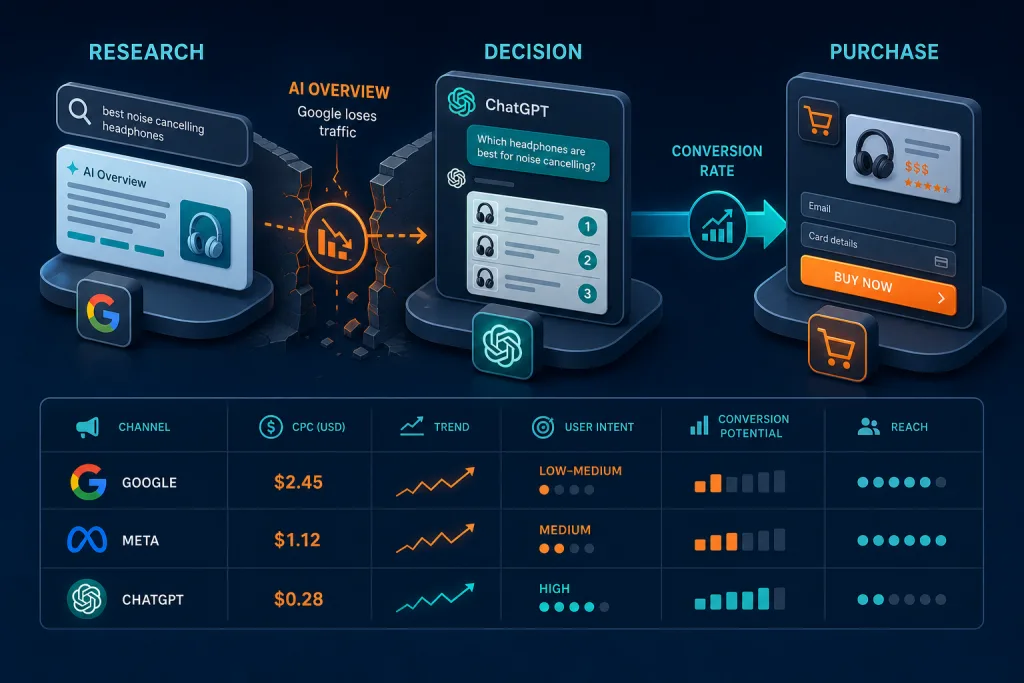
For an affiliate, this changes the funnel calculation: ChatGPT Ads is not a replacement for search, but a layer between research and purchase, where the most “expensive” part of the traffic is usually lost.
CPC bidding and auction logic: how to calculate economics
The launch of CPC bidding in ChatGPT Ads brings it closer to Google Search in terms of buying mechanics, but not in auction density. At the start of the global expansion, the number of advertisers is limited, and the inventory — sessions with decision intent — is relatively small. This creates two effects for an affiliate.
First, the CPC can be lower than in heated Google Ads verticals, where the auction is bought out by large brands. Second, the volume of clicks is limited by the upper limit of intent sessions: you can’t “spin up” reach like in Meta because the impression is tied to a question, not to behavior. This means that funnels on ChatGPT Ads should be tested as an addition to the main channel, not as a replacement.
Funnel economics calculation:
Acceptable CPA in ChatGPT Ads = (click conversion × average offer payout) − (cost per click / click conversion).
If the conversion rate from a click is higher than in Google Search (due to decision intent), the acceptable CPC grows even with a lower payout — because the user is already at the choice stage.
Conversion tracking and postback: what an affiliate needs to set up
Conversion tracking in ChatGPT Ads now supports server-side events, which is critical for arbitrage: the client-side pixel in nutra and gambling often loses data due to consent blocks and blockers. For an affiliate, this is an opportunity to raise the postback to a level comparable with Google Ads Enhanced Conversions and Meta CAPI.
What needs to be set up before launching the funnel:
- server endpoint for receiving conversion events;
- event mapping for the offer funnel (lead, FTD, sale, repeat);
- postback to the CPA network with the click_id from ChatGPT Ads;
- deduplication by transaction_id to avoid duplicating conversions.
Without a correct postback, outcome-based optimization will not receive a signal and will optimize for clicks — this is the most common reason for “burning” budget on new platforms.
Custom audiences and product feeds: where this works in arbitrage
Custom audiences allow you to upload your own segments — email bases, website user lists, lookalike sources. For arbitrage, this opens up two scenarios: retargeting “non-converted” users from Google Ads and buying by lookalike from those converted in Meta.
Product feeds work for e-commerce and nutra, where there is a catalog. For gambling and betting, feeds are less applicable, but for nutra (vitamins, supplements, cosmetics) this is a direct channel: the user asks “what remedy for X”, and ChatGPT shows a product from the feed with a price and an offer.
Outcome-based optimization: how it differs from Google PMax
Outcome-based optimization in ChatGPT Ads is an analog of Target CPA and Maximize Conversions in Google Ads, but with an important difference: the optimization is for a target action within a session, not for behavior on the site after a click. Since the intent is already “inside” ChatGPT, the model does not have to guess the user’s interest — it gets it from the text of the query.
For an affiliate, this means that funnels with outcome-based optimization should be launched only after accumulating a sufficient number of conversions to train the model. On a cold start, it’s better to use CPC bidding with manual control and switch to outcome-based when 30-50 conversions have accumulated for the funnel.
Risks and compliance: what changes for arbitrage
ChatGPT Ads is a new platform, and compliance here is unstable. OpenAI’s policy on sensitive verticals has changed several times since March: health and finance were sometimes allowed, sometimes closed. For an affiliate, this means three risks.
First — sudden policy change: an offer can be disabled without notice. Second — brand safety: an ad is shown next to an AI answer, and if the creative contradicts the content of the answer, OpenAI can block the account. Third — attribution gap: ChatGPT does not give a full behavioral graph, and attribution between click and conversion can be lost if the postback is not fully configured.
Strategy: run buying in ChatGPT Ads as a supplementary channel, no more than 15-20% of the budget on a test funnel, with an explicit stop-loss and weekly compliance audit.
Funnels and scenarios for testing
Practical scenarios in which ChatGPT Ads already makes sense for an affiliate:
-
Nutra with a product feed: the user asks about a remedy — a product with a price is shown. Intent is high, auction competition is lower than in Google Shopping.
-
B2B SaaS and fintech: “which platform to choose” — conversion to a lead form, payout is higher than in consumer verticals.
-
VPN and privacy software: queries about “safe internet” convert to a trial subscription, install intent is high.
-
Retargeting funnel: Google Ads drives to a landing page, ChatGPT Ads pushes a custom audience of visitors who did not convert at the first touch.
-
Conquesting adaptation: if a competitor advertises in ChatGPT on a brand query, you can set up a counter-campaign for adjacent queries with decision intent.
Channel comparison: Google vs Meta vs ChatGPT
A summary of the three channels for an affiliate’s media mix:
- Google Ads Search: search intent, high CPC in hot verticals, dense auction, predictable volume.
- Meta Ads: discovery intent, medium CPC, behavioral targeting, large reach.
- ChatGPT Ads: decision intent, low-medium CPC at the start, intent from text, limited volume, high click conversion rate.
For an affiliate’s media mix, ChatGPT Ads is not a replacement, but a layer that captures traffic between research and purchase, where Google loses it in AI Overviews, and Meta lacks explicit intent.
Checklist: launching a funnel in ChatGPT Ads
- Check that the vertical is allowed by the current OpenAI policy on the launch date
- Set up server-side conversion tracking and postback to the CPA network
- Deduplicate events by transaction_id
- Launch CPC bidding with a small budget and a stop-loss of 20% of the daily limit
- Accumulate 30-50 conversions before switching to outcome-based optimization
- Allocate no more than 15-20% of the total budget to ChatGPT Ads as a supplementary channel
FAQ
How do ChatGPT Ads differ from Google Ads for an affiliate?
ChatGPT Ads intercept decision intent — a user who is already formulating a choice, whereas Google Ads catches search intent at the query level. In ChatGPT, the CPC can be lower at the start, but the volume is limited by the number of intent sessions, so the channel works as an addition, not a replacement.
Can you run gambling and betting through ChatGPT Ads?
OpenAI’s policy on sensitive verticals is unstable and has changed several times since March 2026. Before launching, you need to check the current policy and factor in the risk of a sudden ban. At the start, it’s safer to test nutra with a product feed and B2B SaaS, where compliance is softer.
Why do you need a product feed in ChatGPT Ads?
A product feed allows you to show product cards with a price right in the answer to a user’s question. For nutra and e-commerce, this is a direct path from an intent query to conversion, without an intermediate landing page. For gambling and betting, feeds are currently poorly applicable.
What budget should be allocated for a ChatGPT Ads test?
It’s recommended to allocate no more than 15-20% of the total affiliate budget to ChatGPT Ads as a supplementary channel. For testing one funnel, a daily limit comparable to a Google Ads Search test is enough, along with a stop-loss of 20% of the limit before evaluating the first intent signal.
When should you switch from CPC to outcome-based optimization?
Outcome-based optimization requires data to train the model. You should switch after accumulating 30-50 conversions for the funnel: switching earlier will lead to optimization for clicks, not for the target conversion, and the budget will go to non-target traffic.