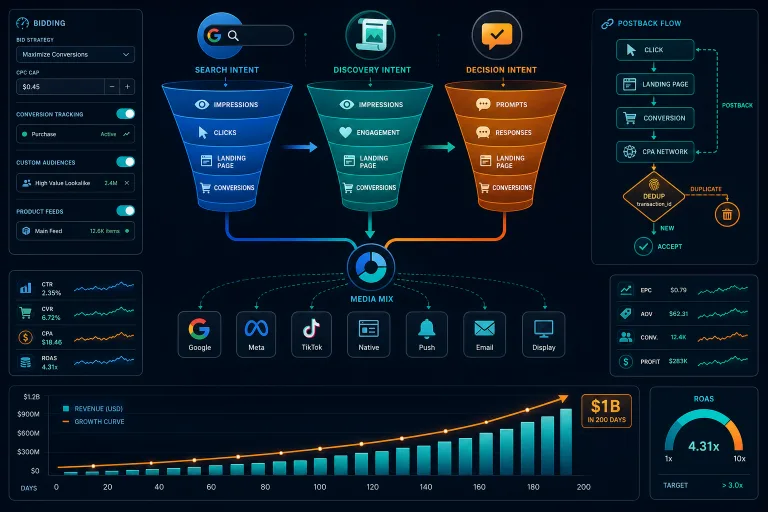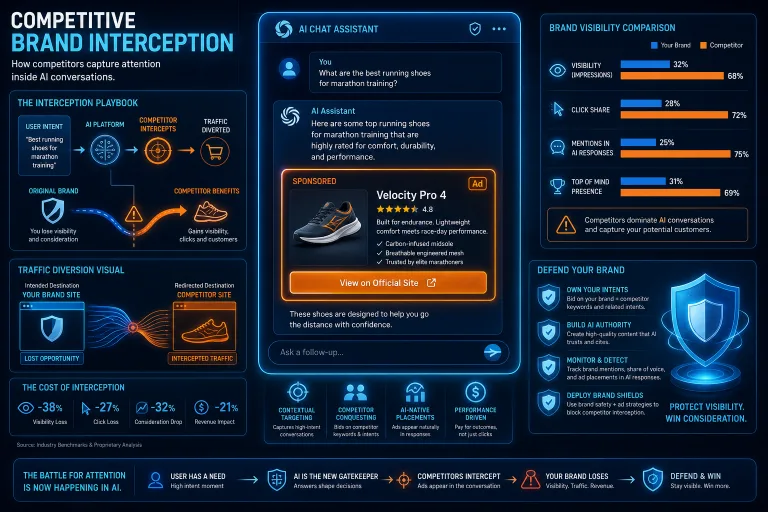
OpenAI has officially opened advertising in the health and finance categories within ChatGPT. This means that affiliates and media buyers now have access to the two most marginal verticals on a new platform with potentially cheap traffic. But there’s a catch: OpenAI’s advertising policy has changed four times since March 2026, and each revision closed or opened entire offer categories without warning.
According to SE Ranking, the frequency of ads in commercial ChatGPT prompts is growing, but the distribution across verticals is uneven. Health and finance are categories with the highest ban risk and the fastest-changing rules. If you’re running nutra, crypto, insurance, or credit offers through ChatGPT Ads, you need a strategy that accounts for policy volatility, not just CPC and conversion.
This article breaks down OpenAI’s current rules for sensitive verticals, SE Ranking’s data on ad frequency, compliance risks for affiliates, and practical strategies for buying traffic on health/finance offers through ChatGPT without getting blocked.
What OpenAI Allowed: Current Policy on Health and Finance
As of August 2026, OpenAI allows advertising in two broad categories:
- Health — ads for OTC drugs, vitamins, telemedicine, wellness products, and fitness apps. Prescription drugs, psychiatry, and addiction treatment remain prohibited.
- Finance — ads for banking products, credit cards, investment platforms, insurance, and crypto exchanges. ICOs, token sales, and binary options are banned.
The key issue: OpenAI doesn’t publish a detailed public policy like Google Ads does. The rules are built into the ad interfaces of partner platforms (StackAdapt, Microsoft Advertising) and updated without a public changelog. According to Search Engine Journal, the policy changed four times since March — each change affected either the list of allowed subcategories or landing page requirements.
SE Ranking Data: How Often Ads Appear in Commercial Prompts
SE Ranking analyzed the frequency of ads in ChatGPT responses to commercial queries. Key findings:
- Ads appear in about 18–23% of commercial prompts, depending on the query category.
- Finance queries (“how to invest,” “best credit card,” “auto insurance”) show ads 31% of the time — the most monetized category.
- Health queries (“symptoms,” “treatment,” “vitamins”) show ads 14% of the time — lower, but growing faster than other categories.
- Average CPC in the finance vertical on ChatGPT is $2.5–$4.1, in health — $1.8–$3.2.
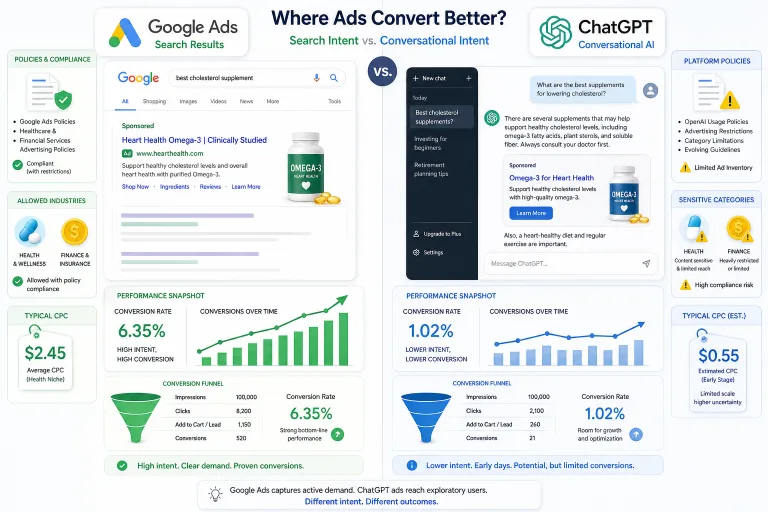
For comparison: in one published case study, ChatGPT Ads traffic converted at 0.21% versus 3.71% for Google Ads on the same site. The low conversion is because ChatGPT users are in “answer-seeking” mode, not “product-seeking” mode. But for health/finance offers with long decision cycles and high CPA, this can be an advantage — cheap top-of-funnel traffic.
Why OpenAI’s Policy Changes So Often
OpenAI is under pressure from two sides. On one hand, advertisers and partner networks (Microsoft, StackAdapt) demand expanded inventory for monetization. On the other, regulators (FTC in the US, MHRA in the UK) are watching to ensure AI platforms don’t become channels for spreading medical misinformation and fraudulent financial schemes.
The four policy revisions since March 2026 break down as follows:
- March — initial ad launch with a limited list of categories. Health and finance completely banned.
- April — partial opening of finance: banks and insurance allowed, investments and crypto banned.
- June — opening of health for wellness and telemedicine. Simultaneously, stricter requirements for finance ad landing pages: mandatory license link and disclosure.
- July–August — opening of investment ads with restrictions (licensed brokers only), tightening of health creative moderation.
Every revision is a risk for affiliates. A campaign that worked yesterday can be blocked today without notice.
Compliance Risks for Affiliates: What Gets Blocked Most
Based on an analysis of bans and policy changes, four main risk zones emerge:
1. Medical Claims in Creatives
OpenAI prohibits ads containing medical claims without clinical evidence. This kills classic nutra funnels: “lowers blood sugar by 40%,” “relieves joint pain in 7 days.” ChatGPT’s moderation is stricter than Google Ads because the AI platform analyzes not only the creative’s text but also the context of the prompt where the ad is shown.
2. Financial Offers Without a License
Advertising credit products, investments, and insurance requires a link to a license or registration. For affiliates working through networks with white-label landing pages, this means the landing page must contain legal info about the partner’s license, not just an offer description.
3. Crypto Offers
Crypto exchanges are allowed but with restrictions: mandatory KYC status, no yield promises, and a ban on advertising fixed-price tokens. ICOs and token sales are completely prohibited. For affiliates running crypto offers via mVAS and app-install funnels, this narrows the inventory.
4. Retargeting and Data Usage
OpenAI restricts the use of prompt data for retargeting. You cannot show ads based on a user’s specific prompt — only based on broad categories. This kills the classic affiliate funnel “prompt → retargeting → landing page.”
Buying Strategies: How to Run Health/Finance via ChatGPT Ads
Strategy 1: Top of Funnel for Long Decision Cycles
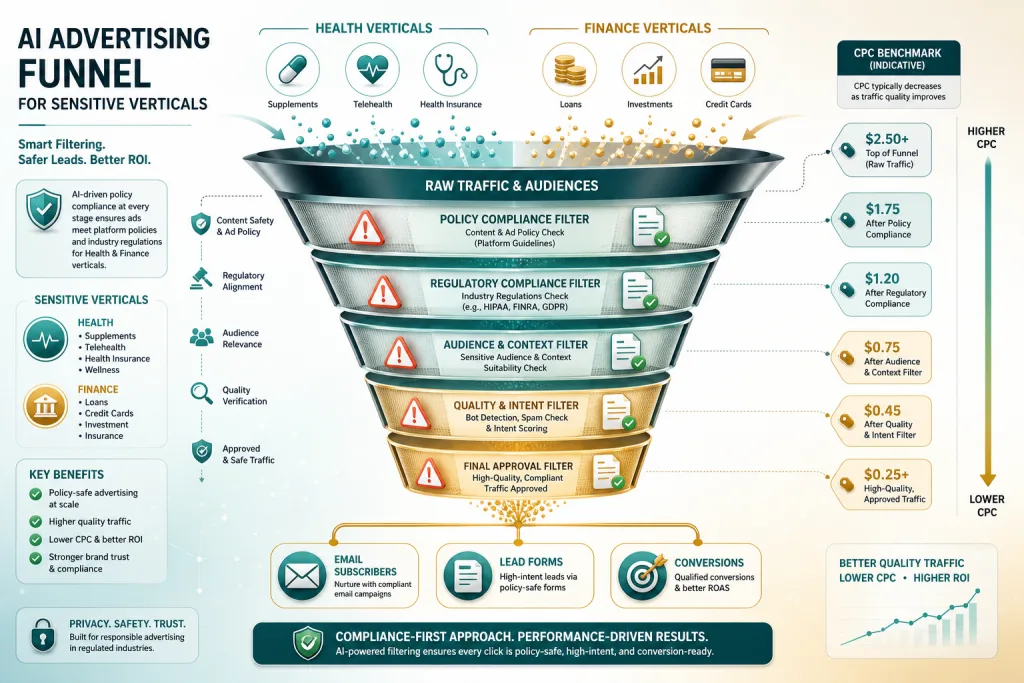
ChatGPT Ads works as an awareness channel, not as a direct-response tool. For health/finance offers with a CPA of $50–$300, this means: run ads on informational queries, collect emails/leads, and nurture them through email sequences and retargeting on Meta/Google.
Funnel: ChatGPT Ads (informational prompt) → landing page with lead form → email funnel → conversion on offer.
Strategy 2: Geo-Arbitrage on Regulated Markets
OpenAI doesn’t allow health/finance ads in all countries. The US, UK, Canada, and Australia are open markets with strict compliance. Eastern Europe, Latin America, and Southeast Asia are gray areas where rules are still forming. Buy traffic for regulated offers in GEOs with soft compliance, but verify that the partner platform (StackAdapt, Microsoft) supports targeting for these regions.
Strategy 3: White-Label Landing Pages with Disclosure
Create a landing page that passes OpenAI moderation: legal disclosure in the footer, link to the partner’s license, and no medical/financial guarantees in the text. The creative should be informational (“learn about insurance options”), not promotional (“best insurance for $9.99”).
Strategy 4: A/B Testing Offers with Different Risk Levels
Divide your offer portfolio into three risk levels:
- Low risk — telemedicine, wellness, bank cards, insurance. Run the main budget here.
- Medium risk — vitamins with medical claims, investment platforms. Test with a small budget.
- High risk — nutra with aggressive claims, crypto tokens. Avoid or use a pre-lander.
Conversion Comparison: ChatGPT Ads vs Google Ads on Sensitive Verticals
| Metric | ChatGPT Ads | Google Ads |
|---|---|---|
| Avg CPC (finance) | $2.5–$4.1 | $4.8–$12.0 |
| Avg CPC (health) | $1.8–$3.2 | $3.5–$8.0 |
| Conversion (case study) | 0.21% | 3.71% |
| CPA (estimated) | $850–$1950 | $129–$323 |
| Ban risk | High (policy changes) | Medium (stable policy) |
The low conversion of ChatGPT Ads makes direct response unprofitable for most offers. But cheap CPC and low competition make the channel interesting for lead generation and upper-funnel strategies.
How to Set Up a Health/Finance Campaign via Partner Platforms
Direct access to ChatGPT Ads is still limited. Most affiliates work through partner platforms:
- StackAdapt — OpenAI’s main partner for programmatic buying. Supports health/finance categories with moderation pre-check.
- Microsoft Advertising — integrated with ChatGPT through the existing Microsoft-OpenAI partnership. Available for accounts with a history of ad campaigns.
- Adcomms — a niche platform for the health vertical with pre-approved inventory.
When setting up a campaign:
- Set vertical = Health or Finance at the campaign level.
- Upload the landing page for moderation pre-check 3–5 days before launch.
- Use broad topic targeting, not keywords — ChatGPT doesn’t support keyword-level targeting.
- Set a daily budget of $50–$100 for testing and track CTR and cost-per-lead, not conversion.
What to Do If Your Campaign Gets Blocked
Blocking in ChatGPT Ads happens faster than in Google Ads, and appeals are harder. Steps to take:
- Check if the policy changed in the last 48 hours — this is the most common cause.
- Compare the blocked creative with the latest policy version via the partner platform’s support ticket.
- Remove all medical/financial claims from the creative and landing page.
- Restart the campaign with a new creative and a pre-checked landing page.
- If the block recurs — switch the budget to Google Ads or Meta with the same offer.
Checklist: Launching a Health/Finance Campaign in ChatGPT Ads
- Check the current version of OpenAI’s policy via the partner platform’s support ticket before launch
- Create a white-label landing page with legal disclosure and a link to the partner’s license
- Remove all medical and financial guarantees from the creative and landing page text
- Set up broad topic targeting, not keyword targeting
- Set a daily budget of $50–$100 and track cost-per-lead, not conversion
- Prepare a backup campaign in Google Ads for the same offer in case of a ban
Forecast: What to Expect from OpenAI Ads in the Coming Months
OpenAI’s policy volatility is not a bug, but a feature of the transition period. The platform is actively forming rules under pressure from regulators and advertisers. Expected changes by the end of 2026:
- Stricter moderation of health creatives — automated checking via GPT models for medical claims.
- Expansion of finance categories — possible opening of ads for robo-advisors and DeFi protocols with KYC.
- Direct access for large advertisers — bypassing partner platforms, which will lower CPC due to competition.
- Public policy center — OpenAI might publish a detailed policy similar to Google Ads Policies.
For affiliates, this means: test now while competition is low and CPC is cheaper than Google Ads, but don’t invest your main budget in a channel that could close a category with a single policy update.
FAQ
Can you run nutra offers via ChatGPT Ads?
Partially. OpenAI allows ads for wellness, vitamins, and telemedicine, but bans medical claims without clinical evidence. Classic nutra funnels with result promises (“lowers blood sugar by 40%”) won’t pass moderation. Use informational creatives and a pre-lander without medical guarantees.
What is the conversion rate of ChatGPT Ads compared to Google Ads?
According to published case studies — 0.21% vs 3.71% for Google Ads on the same site. The low conversion is because ChatGPT users are looking for answers, not products. For direct-response this is expensive, but for lead gen and upper-funnel — CPC is 2–3 times lower than Google Ads.
What to do if a campaign is blocked due to a policy change?
Check changes via the partner platform’s support, remove all claims that fail the new policy version, re-upload the landing page through moderation pre-check, and restart with a new creative. If the block recurs — switch the budget to Google Ads or Meta.
Which partner platforms provide access to ChatGPT Ads?
The main platforms are StackAdapt (programmatic access with moderation pre-check) and Microsoft Advertising (through the existing Microsoft-OpenAI partnership). Direct access to ChatGPT Ads is still limited to large advertisers.
Should you shift your budget from Google Ads to health/finance on ChatGPT?
Not entirely. ChatGPT Ads works as an additional upper-funnel channel with low CPC, but low conversion. It’s recommended to split the budget: 70–80% in Google Ads (direct-response), 20–30% in ChatGPT Ads (lead gen and awareness). Test for 2–3 weeks before scaling.