What are MFA sites and why they are being talked about again in 2026
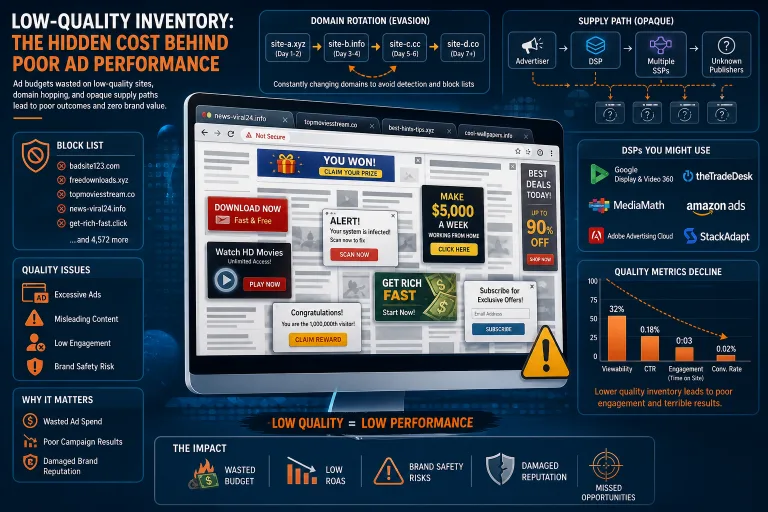
Made-for-advertising (MFA) sites are websites created solely to display ads and generate revenue from impressions or clicks, rather than to provide valuable content to the user. In March 2026, Adalytics published an updated report showing that ads from major brands are still being transacted on MFA sites through Google, Amazon DSP, Magnite, PubMatic, and TripleLift, despite public promises to block such inventory.
For media buyers and traffic arbitrage specialists, this means a direct loss of money: MFA inventory generates impressions, but not conversions. If you buy traffic through programmatic or Google Display Network without strict filtering, part of your budget goes to sites where the content is merely a wrapper for ad blocks.
The key issue identified by Adalytics: MFA domains are constantly rotating. Static blocklists that DSPs upload once lag behind reality. A domain blocked today reappears tomorrow under a new name with the same template and the same AdSense publisher ID.
MFA ≠ traffic arbitrage: why media buyers confuse the concepts
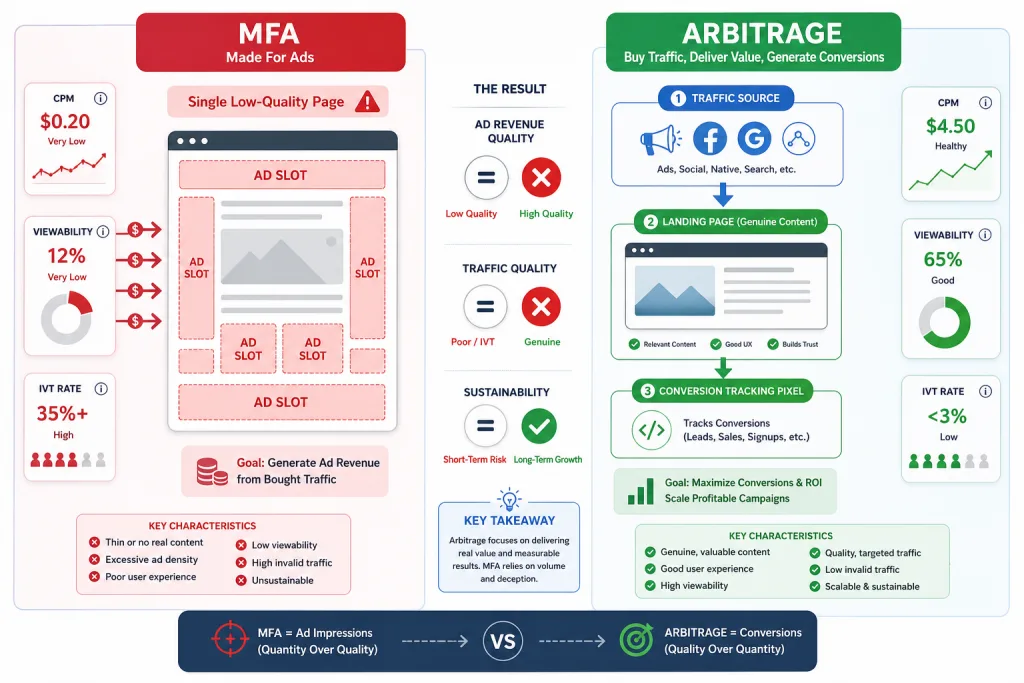
The most common mistake in the industry is equating MFA sites with traffic arbitrage. PPC Land, in its analysis, clearly separates these concepts: MFA is a property of a website, while arbitrage is a trading strategy.
Traffic arbitrage is buying traffic from one source and directing it to another resource for monetization. An arbitrageur can direct traffic to a legitimate publisher with high-quality content. An MFA site is a web resource that exists solely to display ads, with minimal or generated content.
The difference is critical in practice:
- An arbitrageur buys clicks in Google Ads, Meta, or native networks and directs them to a landing page with a real offer, article, or service. Conversion is the goal.
- An MFA publisher creates a site with thin content, clutters it with ad blocks, and drives cheap traffic to earn on impressions. An impression is the goal.
- The overlap occurs when an arbitrageur directs traffic to an MFA site. This is the gray area that Google is trying to regulate.
Evolution of the term: from Made for AdSense to Made for Advertising
The MFA abbreviation predates programmatic. In the 2000s, it stood for Made for AdSense — sites created specifically to earn money on Google AdSense. Publishers generated SEO content, drove cheap traffic, and earned from clicks on Google ads.
With the advent of programmatic trading and header bidding, the model evolved. Today, MFA sites are monetized not only through AdSense but also through dozens of DSPs and SSPs simultaneously. A single MFA domain can sell inventory through Magnite, PubMatic, TripleLift, and Amazon DSP in parallel, creating the illusion of diverse sources.
This complicates filtering: even if you block an MFA domain in one DSP, the same inventory is available through another. For arbitrageurs buying across multiple platforms, this means filtering must be end-to-end.
Why Google and DSP blocks don’t work
The Adalytics report revealed a systemic problem: public promises to block MFA inventory do not match reality. Here is why enforcement lags behind:
1. Domain rotation. MFA operators register new domains daily. A static blocklist loaded into a DSP becomes outdated in 24–48 hours. By the time the brand safety team updates the list, new domains are already generating impressions.
2. Template structure. MFA sites use the same templates but different domains. Google claims it prohibits publishers from using “disorienting or deceptive ad serving,” but automated checks don’t always recognize the pattern on a new domain.
3. Blurred definitions. There is no universally accepted, formalized criterion for MFA. Google, Amazon DSP, and TripleLift use different definitions, allowing each to interpret “MFA” in its own way.
4. Economic conflict of interest. SSPs and DSPs earn from transaction volume. Aggressively blocking MFA inventory reduces available inventory and platform revenue. This creates a structural incentive for soft enforcement.
How MFA inventory affects arbitrageurs’ budgets
For arbitrageurs and media buyers, MFA inventory is a direct financial drain. Let’s break it down by metrics:
Viewability. MFA sites often show high viewability according to formal metrics (the ad is in the visible area), but the actual user attention is minimal. The user came for a clickbait headline, scrolled through a page with 8–12 ad blocks, and left.
CTR and conversion. A click on an ad on an MFA site is often accidental or induced (misleading ad placement). The conversion rate from such traffic is 3–7 times lower than from quality publisher inventory.
CPM inflation. MFA inventory creates a false sense of cheap inventory availability. A media buyer sees a low CPM and thinks they’ve found a profitable channel, but the actual cost per conversion turns out to be higher due to low traffic quality.
Brand safety. For brand campaigns, appearing on MFA sites is a reputational risk. Adalytics recorded ads from Fortune 500 brands on MFA domains, which damages their image when publicly exposed.
Practical steps: how to filter MFA inventory
1. Use dynamic blocklists, not static ones
Static domain lists are an outdated approach. Use services that update MFA lists in real-time: Adalytics, Confiant, DoubleVerify, and GeoEdge. If your DSP supports integration with dynamic blocklist feeds, set up automatic updates every 6–12 hours.
2. Analyze patterns, not just domains
MFA sites have characteristic features:
- High ad density (more than 5 ad units per page)
- Thin or AI-generated content (500–800 words without unique value)
- High percentage of traffic from paid sources (over 70%)
- Low session duration (under 15 seconds)
- Template structure with a repetitive layout
Set up scripts or use verification tools that analyze these patterns automatically.
3. Set up exclusion lists in Google Ads
In Google Display Campaigns and Performance Max, add MFA domains to exclusion lists. Use placement reports to identify sites with abnormally high impression counts and low CTR — this is the first sign of MFA inventory.
4. Demand MFA filtering from your DSP
When working through programmatic directly, demand that the DSP enables MFA filtering at the pre-bid level. Amazon DSP claims to proactively block MFA, but the Adalytics report shows this doesn’t always work. Demand reports on blocked inventory and verify them with independent tools.
5. Monitor IVT and viewability together
High viewability with high IVT (invalid traffic) is a red flag. MFA sites often generate impressions using bots or induced clicks. Use combined scoring: if viewability is above 80% but IVT is above 5%, check the domain manually.
MFA and arbitrage: where the line is drawn for media buyers
For traffic arbitrageurs, it is critical to understand where legitimate arbitrage ends and the MFA model begins. Here is a practical test:
Legitimate arbitrage. You buy traffic in Google Ads for the keyword “best VPN 2026”, direct it to a landing page with a real comparison of VPN services, the user reads the review, clicks the affiliate link, and subscribes. You earned a commission, the user received value, the advertiser got a customer.
MFA model. You buy traffic for a clickbait headline “Shock! You won’t believe what happened to…”, direct it to a page with 300 words of a news summary and 10 ad blocks. The user scrolled, saw the ad, accidentally clicked, and you earned on the impression. The user received no value, the advertiser paid for a junk click.
Gray area. An arbitrageur directs traffic to a site with moderate content and 3–4 ad blocks. This is not pure MFA, but it’s not a high-quality publisher either. Google and DSPs classify such sites differently, creating a risk of blocking.
Risks for arbitrageurs: what to do if your site is classified as MFA
If Google or a DSP has flagged your landing page as MFA, the consequences are severe: AdSense suspension, blocking in Google Display, exclusion from programmatic inventory. Actions to take:
- Check ad density. If there are more than 5 ad blocks on the page — reduce it to 2–3.
- Increase the volume of unique content. A minimum of 1500–2000 words of original text, not AI-generated without editing.
- Reduce the share of paid traffic. If more than 70% of traffic comes from Google Ads, diversify your sources: SEO, email, social networks.
- Improve engagement metrics. A session duration under 15 seconds is a red flag. Add interactive elements, videos, infographics.
- Submit an appeal. Google allows you to appeal the classification through the AdSense Help Center, but the process can take 2–4 weeks.
What to expect next: MFA regulation in 2026–2027
The market is moving towards stricter regulation. Adalytics and other researchers continue to publish reports that force DSPs and SSPs to react. Expected changes:
- Standardization of the MFA definition. IAB and TAG are working on a common criterion that will allow unified blocking.
- Pre-bid filtering at the SSP level. Instead of post-bid blocking, SSPs will filter MFA inventory before the auction, reducing losses for buyers.
- AI pattern detection. Google and Amazon DSP are implementing machine learning to recognize MFA templates on new domains, which should outpace rotation.
For media buyers, this means that filtering MFA will become easier, but until the end of 2026, you cannot rely solely on automated platform mechanisms — manual control and independent verification are needed.
Checklist: Protection against MFA inventory in programmatic and Google Ads
- Connect a dynamic MFA blocklist with updates every 6–12 hours via Adalytics, Confiant, or DoubleVerify
- Check placement reports in Google Ads for sites with abnormally high impressions and CTR below 0.1%
- Set up pre-bid filtering in your DSP: demand MFA exclusion at the auction level, not post-bid
- Monitor combined scoring: viewability above 80% with IVT above 5% is a reason for manual domain check
- Check your own landing pages: ad density no more than 3 blocks, unique content from 1500 words, session duration over 30 seconds
- Demand a monthly report from your DSP on blocked MFA inventory and cross-reference it with independent data
FAQ
How does an MFA site differ from a traffic arbitrageur’s site?
An MFA site is created solely to display ads: the content is a wrapper, the goal is revenue from impressions or clicks. An arbitrageur directs traffic to a resource with real value for the user (offer, article, service), where conversion is the main goal. MFA is a property of a site, arbitrage is a trading strategy.
Why can’t Google and DSPs completely block MFA inventory?
MFA domains rotate daily: static lists become outdated in 24–48 hours. There is no universally accepted formalized definition of MFA, allowing platforms to interpret criteria differently. In addition, SSPs and DSPs are economically interested in transaction volume, creating a structural incentive for soft enforcement.
How to identify an MFA site in Google Ads placement reports?
Look for domains with abnormally high impressions, CTR below 0.1%, session duration under 15 seconds, and ad density of more than 5 blocks per page. Also check the share of paid traffic: if more than 70% of a domain’s traffic comes from paid sources, this is a likely MFA sign.
Can a legitimate arbitrageur suffer from MFA blocks?
Yes. If an arbitrageur’s landing page has high ad density, thin content, and a high share of paid traffic, Google or a DSP may classify it as MFA. To avoid this, keep ad density at 2–3 blocks, provide unique content of at least 1500 words, and diversify traffic sources.
What tools help filter MFA inventory?
Adalytics, Confiant, DoubleVerify, GeoEdge — services that provide dynamic MFA lists and pattern detection. For Google Ads, use built-in exclusion lists and placement reports. For programmatic, demand pre-bid filtering and independent verification from your DSP.