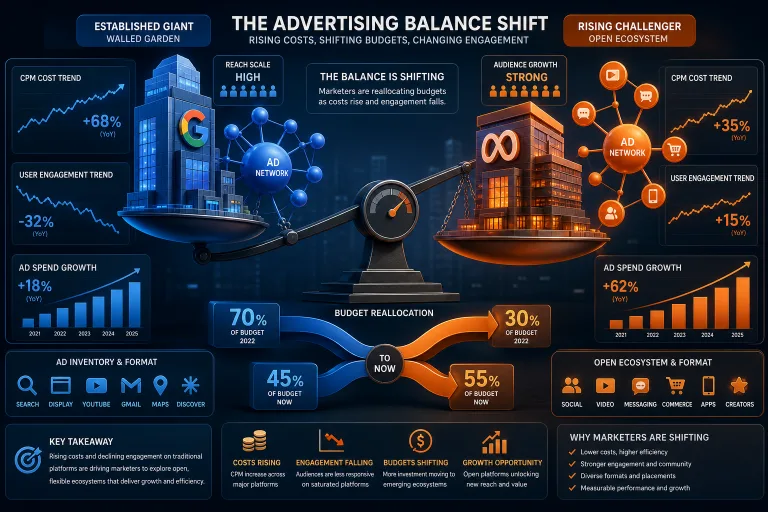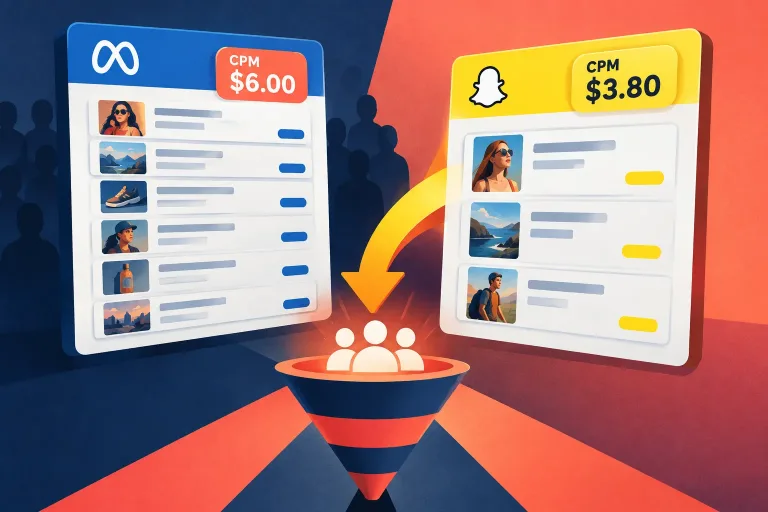
In 2026, the media mix for performance teams has shifted: back in 2022, Meta and Google were enough, but now it’s Meta, TikTok, Google, and Snapchat. Teams that ignore any of these four platforms lose auction efficiency. Snapchat is the most underrated of the four: its median CPM for comparable audiences is 30–40% lower than equivalent Meta inventory. This spread isn’t shrinking — it’s widening. For arbitrage teams, this means Snapchat remains one of the last sources of cheap arbitrage traffic in tier-1 GEOs.
In this article, we’ll break down why Snapchat offers CPM arbitrage, who lives on the platform, which formats and targeting options are available, how to integrate it into a four-platform workflow, and what risks come with buying traffic on Snapchat in 2026.
Why Snapchat Remains an Underrated Channel in 2026
Most arbitrage teams and media buyers in the Russian-speaking space ignore Snapchat for three reasons: the stereotype of a “teen-only” audience, the lack of a familiar Meta Ads Manager-style interface, and the difficulty of creating accounts for teams from CIS countries. All three arguments are outdated in 2026.
Snapchat stopped being a teen-only platform a long time ago. The 25–34 age group is now the largest demographic in the US and Europe. The platform maintains strong positions in Arab countries, India, and Latin America — GEOs that are traditionally interesting to arbitrage teams. The Snapchat Ads Manager interface received updates in 2025–2026 and now supports batch creative uploads, conversion-optimized pricing, and CAPI (Conversions API) integration for server-side attribution.
The main reason it’s underrated is low auction competition. There are significantly fewer advertisers on Snapchat than on Meta and Google. Fewer competitors means lower CPMs. This is basic auction economics, and it’s exactly what creates the arbitrage opportunity.
CPM Arbitrage: 30–40% Lower Than Meta — What This Means in Practice
Data from client datasets shows: the median CPM on Snapchat for matched audiences — audiences with comparable demographics and interests — runs 30–40% below equivalent Meta inventory. This isn’t a one-off anomaly but a stable 2026 trend. The spread between Snapchat and Meta isn’t shrinking — it’s widening.
What this means for an arbitrage specialist in numbers. Let’s say you’re running an offer with a target CPA of $8. On Meta, your CPM is $6, CTR is 1.5%, and you’re paying $0.40 per click. With a 5% landing page conversion rate, your CPA is $8. On Snapchat, with the same CTR and conversion rate, a CPM of $3.60–4.20 gives you a CPC of $0.24–0.28 and a CPA of $4.80–5.60. You either get the same volume of conversions 30–40% cheaper, or scale 1.5–2x more at the same budget.
It’s important to understand: the CPM spread doesn’t guarantee a proportional CPA reduction. Snapchat’s audience differs from Meta’s in behavior, trust in advertising, and conversion intent. Creatives that work on Meta often show 20–50% lower CTR on Snapchat if they aren’t adapted for vertical format and the platform’s native style. Real CPM arbitrage only works when you account for the difference in creative performance, not just the difference in bids.
Snapchat Audience: Who Lives There in 2026
Snapchat in 2026 has 850+ million monthly active users with strong positions in several key arbitrage regions:
- US and Canada — 200+ million MAU, the most monetizable audience. ARPU is higher than on TikTok. The core group is 25–34 years old.
- Europe — 150+ million MAU. The UK, France, Germany, and the Netherlands are strong. The audience is older than in the US.
- Middle East — 100+ million MAU. Saudi Arabia and the UAE are top GEOs for mVAS, dating offers, and gambling.
- India — 200+ million MAU, but low ARPU. Suitable for volume offers with low CPA.
- Latin America — Mexico, Brazil, Argentina. A growing market with cheap traffic.
The key takeaway for arbitrage teams: Snapchat covers tier-1 GEOs (US, UK, UAE) with CPMs lower than Meta, and tier-2/tier-3 (India, Latin America) with even lower CPMs. This gives you two strategies: expensive conversions in tier-1 with high payouts, or mass volume in tier-2/tier-3 with low CPA.
Targeting and Formats: What’s Available to Media Buyers
Snapchat Ads Manager in 2026 supports three main types of targeting:
-
Audience targeting — demographics, geo, interests, behavior. Custom Audiences from customer lists, lookalike audiences based on seed data. Lookalike on Snapchat works similarly to Meta, but with a smaller minimum seed size — starting from 1,000 users.
-
Contextual targeting — targeting by content categories the audience is engaged with. Useful for brand-safe buying and bypassing restrictions on sensitive verticals.
-
Snap Select — reserving inventory in premium placements at a fixed price. Usually not interesting for arbitrage, but useful for testing creatives on a guaranteed impression volume.
Snapchat ad formats:
- Snap Ads — vertical videos up to 3 minutes, full-screen. The main format for performance buying. CTR heavily depends on the first 2 seconds — the audience swipes fast.
- Collection Ads — a series of product cards within a Snap Ad. Suitable for e-commerce offers and native funnels.
- Story Ads — ads between friends’ and publishers’ stories. A native format that’s perceived as content, not advertising.
- Commercials — 6-second non-skippable videos in Shows and Spotlight. For brand objectives, not for arbitrage.
For traffic arbitrage, Snap Ads with conversion optimization via CAPI are the most effective. Without server-side attribution, Snapchat optimizes for proxy events, which reduces bidding accuracy.
How to Integrate Snapchat into a Four-Platform Workflow
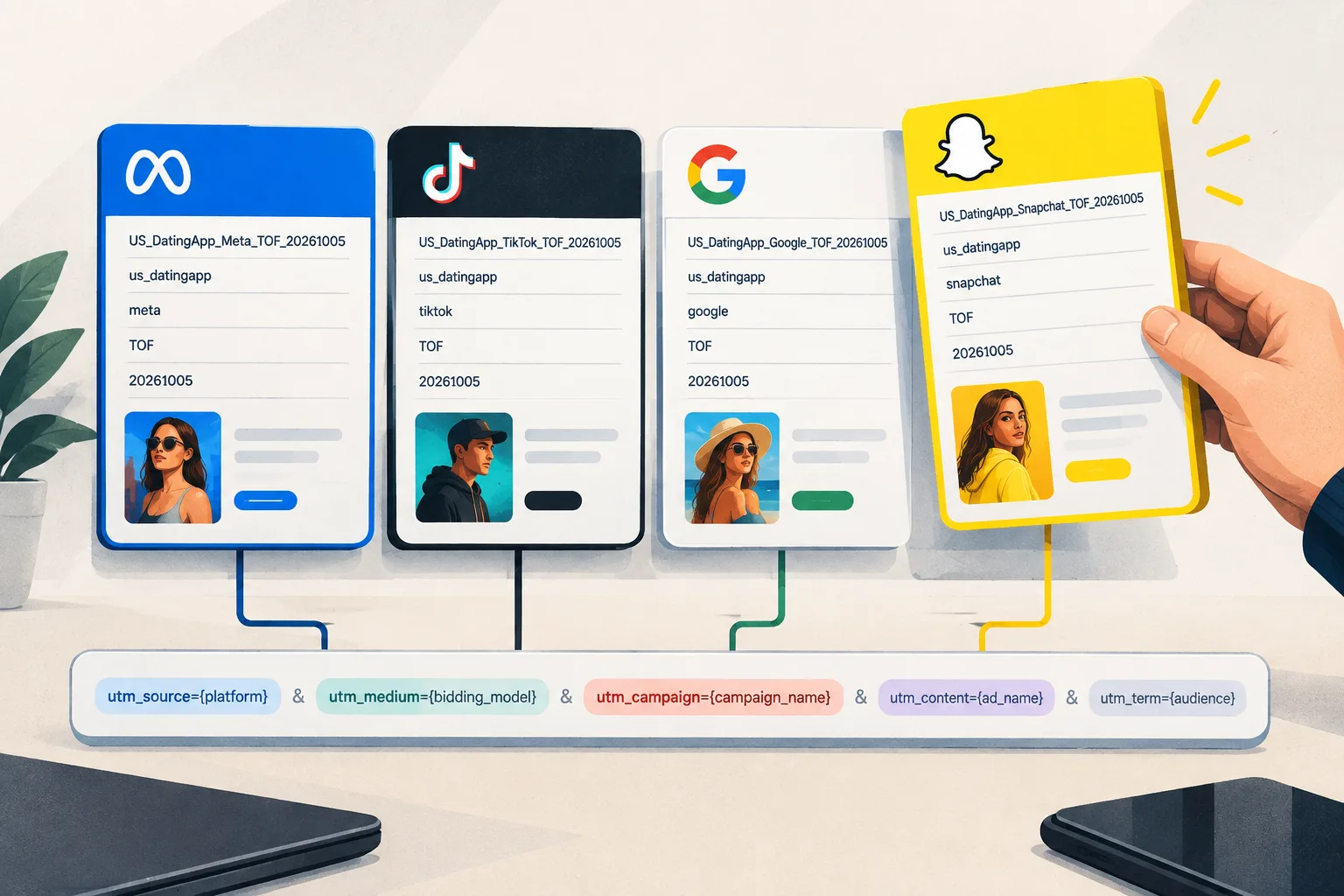
In 2026, the operational workflow for launching campaigns must cover all four platforms — Meta, TikTok, Google, and Snapchat — with unified naming conventions and UTM templates. Without this, cross-platform attribution breaks down, and you can’t compare channel performance.
Basic workflow for an arbitrage team:
-
Creative preparation — one master creative is adapted for each platform’s format. Snapchat needs vertical 9:16, Google Demand Gen needs horizontal 16:9 and square 1:1, Meta needs all three. Don’t use identical creatives without adaptation — it kills CTR.
-
Campaign naming — a unified pattern for all platforms. Format:
[GEO]_[Offer]_[Platform]_[Funnel_Stage]_[Date]. Example:US_DatingApp_Snapchat_TOF_20261005. This lets you filter data in your BI system by any dimension. -
UTM templates — standardized UTMs for all platforms. Snapchat supports dynamic URL macros:
{campaign_id},{ad_id},{adset_id}. Template:utm_source=snapchat&utm_medium=cpc&utm_campaign={campaign_id}&utm_content={ad_id}. Similar macros are set up for Meta ({{campaign.id}}), TikTok (__CAMPAIGN_ID__), and Google ({campaignid}). -
Attribution — server-side attribution via CAPI for Snapchat, Conversions API for Meta, Events API for TikTok, and Google Ads Conversion Tracking for Google. Client-side attribution via pixel works, but loses 15–30% of data due to blockers and iOS ATT.
-
Budget allocation — starting split for testing: 40% Meta, 30% Google, 20% TikTok, 10% Snapchat. After 7 days of testing, reallocate by ROI. Snapchat often gets an increased budget in the second week if creatives are adapted.
UTM Templates and Naming for Cross-Platform Attribution
The biggest mistake when adding Snapchat to the mix is using different UTM patterns across platforms. This makes it impossible to compare channels in Google Analytics 4 or a third-party BI system.
Unified UTM template for all four platforms:
utm_source={platform}&utm_medium={bidding_model}&utm_campaign={campaign_name}&utm_content={ad_name}&utm_term={audience}
Where {platform} is snapchat, meta, tiktok, or google. {bidding_model} is cpc, cpm, ocpm, or tcpa. The remaining parameters are filled with each platform’s macros.
Ad set and ad naming must be identical in structure across all platforms. If you name an audience US_W2534_Interest_Dating on Meta, it should be named the same on Snapchat — US_W2534_Interest_Dating. This lets you aggregate data by audience regardless of platform.
Pairing with Google Ads: How Snapchat Works at the Top of the Funnel
Google Ads remains the most important channel for bottom-funnel intent capture in most B2C verticals. But in 2026, Google Demand Gen absorbed YouTube Shorts as a performance placement — not just a brand channel. This creates a natural pairing: Snapchat and TikTok work at the top of the funnel (awareness, consideration), Google Demand Gen in the middle (consideration, intent), and Google Search at the bottom (conversion).
For arbitrage teams, this means: don’t expect direct conversions from Snapchat on complex offers. Snapchat can warm up an audience that later converts through Google Search or retargeting. Set up Snapchat audiences for retargeting in Google Ads via Customer Match or list imports. This is especially effective for dating and gambling offers, where the decision cycle is longer than a single click.
Alternative pairing: Snapchat → landing page → pixel → retargeting on Meta. Snapchat drives cheap traffic to the landing page, Meta catches those who didn’t convert. CPM on Snapchat is lower, CPM on Meta retargeting is higher, but conversion rate is also higher. The overall CPA is often lower than buying only on Meta.
Risks and Compliance: What Gets Accounts Banned on Snapchat
Snapchat is a platform with strict moderation. The 2026 policies prohibit or restrict:
- Gambling — only allowed with licenses. Running unlicensed offers leads to a permanent account ban. GEOs with legal gambling: UK (UKGC), New Jersey (DGE).
- Pharma — prescription drugs are banned. Supplements and nutra pass, but with restrictions on claims. “Cures,” “100% results” — ban.
- Dating — allowed, but with landing page verification. White dating passes, adult dating doesn’t.
- Crypto — requires registration proof and compliance review. ICOs and tokens — ban.
The ban appeal process on Snapchat is slower than on Meta. Average support response time is 5–7 days. For an arbitrage team, this means a week of campaign downtime. Keep backup accounts and don’t pour your entire budget into one account.
Testing Snapchat: When to Stop a Campaign
Criteria for stopping a test campaign on Snapchat:
- Fewer than 1,000 impressions in 24 hours — the auction hasn’t ramped up, check your bid and audience.
- CTR below 0.5% after 5,000 impressions — the creative isn’t working. Snapchat’s audience swipes faster than Meta’s. The first 2 seconds decide everything.
- CPA above target by 50% after 20 conversions — the optimizer hasn’t found a pattern. Check that CAPI events are set up correctly.
- Zero conversions after 10,000 impressions — attribution gap or the landing page doesn’t convert Snapchat traffic. Check your pixel and server-side events.
Minimum test budget — $50–100 per day per ad set. Less than that, and the optimizer won’t collect enough data. Test for 5–7 days, don’t stop earlier — Snapchat’s learning phase takes 3–4 days.
Checklist: Launching Snapchat in a Four-Platform Workflow
- Create a Snapchat Ads business account with a verified domain and set up CAPI for server-side attribution.
- Adapt your master creative for vertical 9:16 format — the first 2 seconds must hold attention, with no logo at the start.
- Set up a unified UTM template for all four platforms with each platform’s macros: Snapchat, Meta, TikTok, Google.
- Use a unified naming pattern: [GEO]_[Offer]_[Platform]_[Funnel_Stage]_[Date] for campaigns, ad sets, and ads.
- Launch a test with a budget of $50–100 per day per ad set, for a minimum of 5–7 days, and don’t stop during the learning phase.
- Check offer compliance with Snapchat policies before launching — especially for gambling, pharma, and dating.
- Compare Snapchat CPA with Meta after 20 conversions — if CPA is 20%+ lower, scale; if 50%+ higher, stop and revisit your creative.
FAQ
Is Snapchat suitable for arbitrage in tier-3 GEOs?
Yes, but with caveats. India and Latin America offer very low CPMs, but ARPU is also low. For volume offers with low CPA (mVAS, simple dating), Snapchat works in tier-3. For high-payout offers with a long conversion cycle, tier-3 isn’t suitable — the audience doesn’t convert.
Do I need to use cloaking on Snapchat?
Cloaking on Snapchat is riskier than on Meta. Snapchat moderation uses more manual reviews, and bans for cloaking are permanent. If an offer passes Snapchat policies without cloaking — run it directly. If it doesn’t pass, it’s better to choose another platform than risk your account.
How does Snapchat compare to TikTok in terms of CPM?
In 2026, TikTok and Snapchat are comparable in CPM in the US and Europe, but Snapchat is cheaper in the Middle East and India. TikTok is stronger in reach for audiences under 30, Snapchat for the 25–34 audience. For arbitrage teams, it’s optimal to test both platforms in parallel and keep the one that delivers lower CPA on a specific offer.
Can I import campaigns from Google Ads to Snapchat?
There’s no direct import, unlike with Microsoft Advertising. But creatives and audiences can be transferred manually. Google Demand Gen creatives (16:9 and 1:1) need to be re-encoded to 9:16 for Snapchat. Customer Match audiences from Google Ads can be exported and uploaded as Custom Audiences in Snapchat.
What’s the minimum budget for testing Snapchat?
$50–100 per day per ad set, for a minimum of 5–7 days. Snapchat’s learning phase takes 3–4 days, and you shouldn’t stop a campaign before that — the optimizer won’t have collected enough data. The overall minimum test budget is $350–700 per offer.