Google Discover is one of the most underrated traffic sources for media buyers in 2026. While most affiliates fight over inventory in Google Search and Meta, the Discover feed generates billions of monthly impressions — and ad networks like RichAds already support GEO-targeting down to the city level. That means you can buy USA traffic with precision down to a specific state or city, and collect behavioral signals that indirectly boost your landing page’s SEO rankings.
In this article, we’ll break down how Google Discover works as an arbitrage channel, why city-level targeting changes the economics of media buying, which formats to test first, and how to avoid bot traffic when buying through ad networks.
What Is Google Discover and Why Media Buyers Underestimate It
Google Discover is a personalized content feed on mobile devices that appears on the Chrome browser homepage and in the Google app. Unlike Search, the user doesn’t enter a query — Google curates content based on interests, search history, and behavioral patterns.
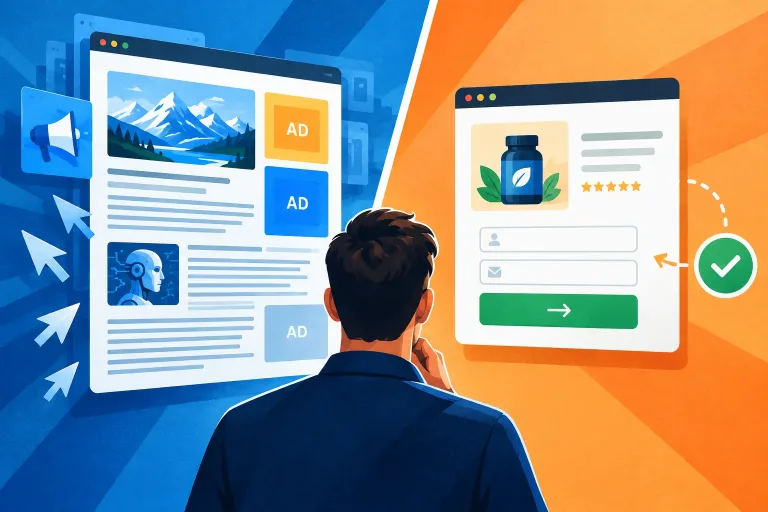
For media buyers, this means a fundamentally different type of traffic: not intent-based, but interest-based. The user isn’t searching for your offer — they’re scrolling the feed and clicking on whatever catches their eye. CTR depends on your creative and headline, not on your bid in a keyword auction.
Most media buyers ignore Discover for two reasons: first, organic Discover traffic is hard to control — it depends on Google’s algorithms. Second, you can’t buy Discover traffic directly through Google Ads — you need ad networks that access the inventory through programmatic or direct integrations.
This is where networks like RichAds come in, offering access to Discover inventory with flexible GEO-targeting.
City-Level GEO-Targeting: How Narrow Targeting Changes the Economics
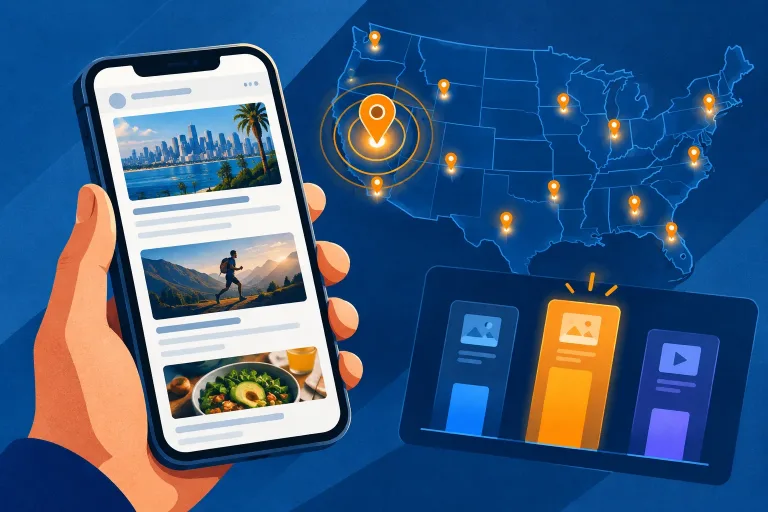
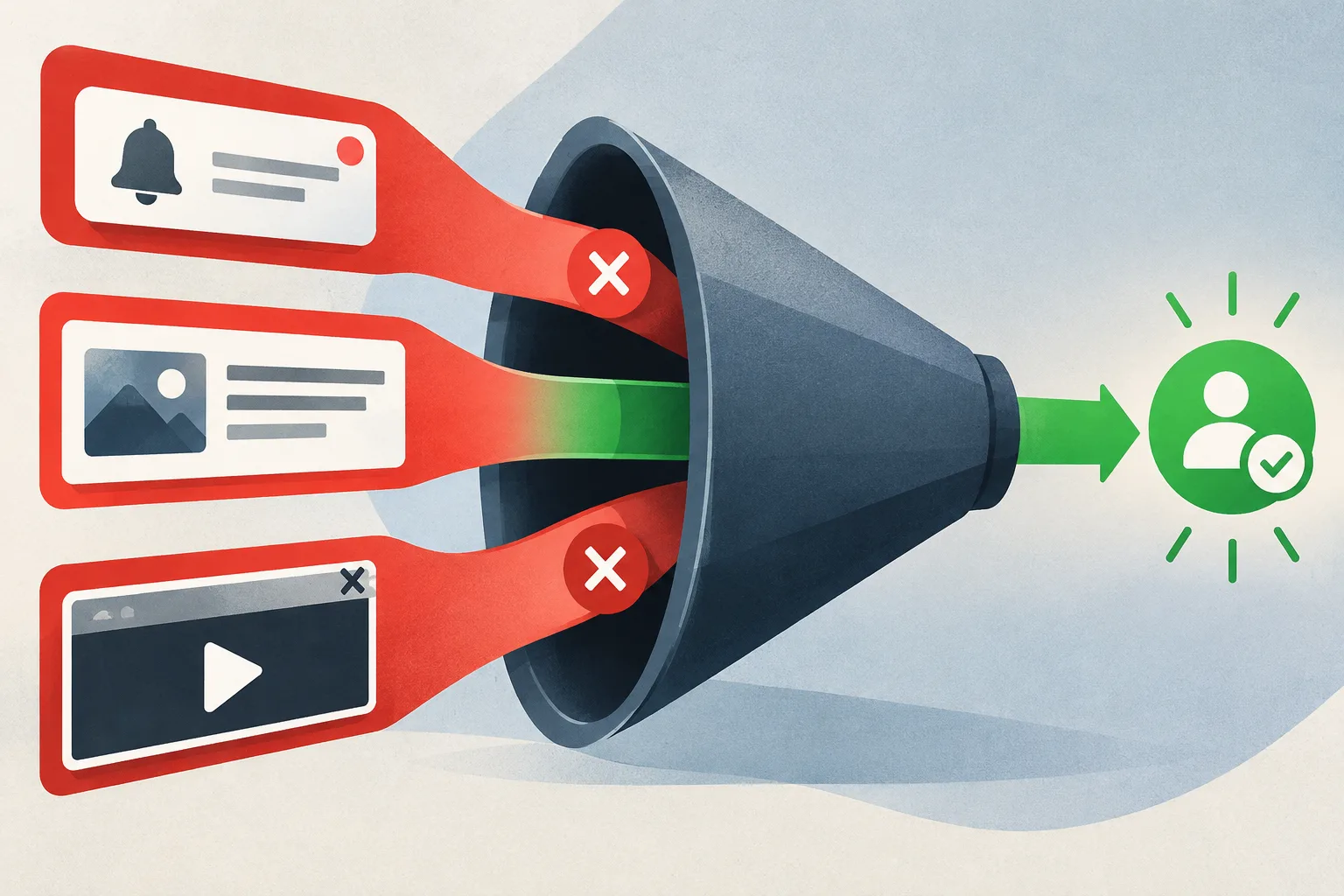
The RichAds team explicitly recommends using GEO-targeting down to the city level in their Google Discover guide. The platform supports targeting an entire country, an individual state, or a specific city. But this approach has a flip side.
What Narrow GEO Targeting Gives You
Narrowing your targeting down to a city allows you to:
- Cut down on junk traffic from regions that don’t convert.
- Fine-tune creatives for local context (for example, mentioning the city in the headline can boost CTR by 15-25%).
- Control spend on expensive markets — for instance, buying traffic only from New York, Los Angeles, and Chicago instead of the entire country.
- Better segment audiences for retargeting.
What You Lose When Narrowing Down
Narrow targeting shrinks the available inventory pool. That means:
- Fewer impressions — the auction becomes less liquid.
- Higher CPM — less competition, but also less volume, which can paradoxically drive up the price.
- Risk of audience burnout — in a small city, the Discover user pool gets exhausted quickly.
Rule of thumb: start with state-level targeting (e.g., California, Texas, Florida), collect conversion data, then narrow down to 3-5 cities with the best ROAS.
Format Testing: Why 2-3 Is the Optimal Number
RichAds recommends testing two to three formats simultaneously to get real performance data and make decisions based on numbers, not intuition. That’s the right approach — but you need to understand which formats are available for Discover traffic.
Push Notifications
The push format works in Discover through partner networks: the user subscribes to notifications, and your creative lands directly on their device. For arbitrage, push delivers high CTR (2-5% in the US), but traffic quality heavily depends on the subscription source.
Native Banners
Native formats blend into the content feed and look like editorial material. In the Discover feed, native banners show high CTR because the user is already in content-consumption mode. But compliance risks are higher — Google can block a creative if it violates policy.
Popunder and Interstitial
These formats are more aggressive but underperform in the US due to high UX sensitivity. CPM is lower, but conversion into high-payout offers (finance, insurance) often doesn’t pay off.
Practical Approach
Test push + native + one aggressive format (popunder). Split the budget 40/40/20. After 500-1,000 clicks per format, pause any format whose CPA exceeds your target by more than 50%.
Behavioral Factors: How Paid Traffic Indirectly Helps SEO
Google has repeatedly stated that buying ads doesn’t directly affect organic rankings. That’s true — there’s no mechanism that boosts a site’s ranking just because you spend money on Google Ads or ad networks.
But there’s an indirect effect: high-quality paid traffic improves behavioral metrics that Google does factor into rankings.
Which Metrics Shift
- Time on site: quality USA traffic from Discover stays on the page longer than bot clicks from tier-3 GEOs.
- Pages per session: if the landing page matches the creative, users visit 2-3 pages.
- Return visits: Discover users more often come back via search, strengthening brand signals.
- Bounce rate: targeted traffic lowers the bounce rate, which Google interprets as a quality signal.
How It Works in Practice
A media buyer runs Discover traffic through RichAds to a landing page with AdSense or an affiliate offer. Some users convert directly (generating revenue). Others leave but leave behavioral traces that, over 4-8 weeks, lift organic rankings for related queries.
This isn’t a guarantee — but with the right setup of quality traffic + relevant content, the effect is real. The key condition: the traffic must be human, not bot clicks.
How to Tell Quality USA Traffic from Bots
The bot traffic problem in the US is less severe than in tier-3 GEOs, but it still exists. Here are the signals to watch for when buying through ad networks.
Signs of Quality Traffic
- Low bounce rate (40-60% for US inventory).
- Diverse devices and browsers (not just Chrome on Windows).
- Hourly distribution — real traffic follows the time zones of your target cities.
- Conversions — even micro-conversions (link clicks, scrolling) confirm human behavior.
Red Flags
- 100% of traffic from one city in a single hour.
- Identical User-Agent strings across all clicks.
- Zero page depth — all sessions are one page and 0 seconds.
- CTR above 15% on push format in the US — unrealistic for quality inventory.
Verification Tools
Use Google Analytics 4 for source analysis, Voluum or RedTrack for click and conversion tracking, and Cloudflare Bot Management for DNS-level filtering. If an ad network won’t give you access to raw click data — that’s already a reason to be suspicious.
Campaign Economics: A USA Discover Breakdown
Let’s walk through a realistic calculation for an arbitrage campaign running USA traffic through Discover inventory.
Say you’re buying native traffic through RichAds targeting California. CPM is $3.50, CTR is 1.8%. That gives you a CPC of $0.19. At a 2% conversion rate into an offer paying $8, you earn $16 per 100 clicks. Your spend is $19. That’s a $3 loss per 100 clicks.
That’s a losing campaign. But if you narrow targeting to San Francisco and Los Angeles, where conversion climbs to 3.5% thanks to a more relevant audience, revenue becomes $28 against $19 in spend. That’s $9 profit per 100 clicks.
Key takeaway: narrow GEO-targeting raises CPC, but conversion grows faster than click cost — provided you pick the right cities.
Risks and Compliance When Working with Discover Traffic
Google Discover is part of the Google ecosystem, and policies here are stricter than in native networks outside Google.
Policy Risks
- Content violating Google’s policies (adult, weapons, drugs) will be blocked at the Discover level, even if the ad network allowed it.
- Brand bidding on third-party trademarks in Discover creatives can lead to complaints and account suspension within the ad network.
- Misleading headlines — Google actively filters clickbait in Discover. A creative with a headline like “You won’t believe what happened…” will get zero impressions.
Technical Risks
- Multi-domain redirect chains — RichAds and other networks may block such setups.
- Cloaking — showing different content to bots vs. users. Google Detect and similar tools catch this quickly.
- Expired SSL certificates on landing pages — a common cause of zero conversions on an otherwise working campaign.
Comparing Google Discover to Other Arbitrage Channels
| Channel | CPM (USA) | Intent | Volume | Control |
|---|---|---|---|---|
| Google Search Ads | $8-25 | High | Limited | Full |
| Google Discover (via ad networks) | $2-6 | Interest-based | High | Partial |
| Meta Feed | $5-15 | Interest-based | Very high | Full |
| Native (Taboola/Outbrain) | $1.5-4 | Interest-based | Medium | Full |
| Push (via ad networks) | $0.5-2 | Low-intent | High | Full |
Discover occupies the niche between Search and Native: more expensive than native, but cheaper than Search, with higher volume than Search and better intent quality than push.
Launch Strategy: Step-by-Step Plan
- Select 3-5 high-income states (California, Texas, New York, Florida, Illinois).
- Launch 2-3 formats (push, native, popunder) with a $50-100 budget each.
- Collect 500+ clicks per format.
- Pause formats with CPA exceeding your target by more than 50%.
- Narrow GEO to 3-5 cities with the best conversion rates.
- Scale the remaining format by increasing the budget 30% per day.
- Monitor behavioral metrics in GA4 — if time on site drops below 30 seconds, pause the campaign.
Checklist: Launching Google Discover Arbitrage Through Ad Networks
- Choose an ad network with city-level GEO-targeting support (RichAds, PropellerAds, EvaDav)
- Prepare 3 creative variants for different formats (push, native, popunder)
- Set up tracking in Voluum or RedTrack with subid passthrough for optimization
- Launch targeting on 3-5 states, not the entire country
- Collect at least 500 clicks per format before making decisions
- Check bounce rate and time on site in GA4 after the first 1,000 clicks
- Narrow GEO to cities with ROAS above 120% and scale
FAQ
FAQ
Can you buy Google Discover traffic directly through Google Ads?
No, Google Ads doesn’t offer a separate format for Discover. Buying happens through ad networks that access Discover inventory via programmatic integrations or publisher partnerships.
How is Google Discover traffic different from regular native traffic?
Discover traffic is shown in the Google feed on mobile devices, where the user is already primed for content consumption. Regular native traffic is shown on publisher sites. Discover delivers better intent quality, but costs more and has less volume.
What’s the minimum budget for testing Discover arbitrage in the USA?
The minimum budget for testing 2-3 formats across 3-5 states is $300-500. That’s enough to collect 800-1,500 clicks and make a scaling decision.
Does paid Discover traffic help SEO rankings?
Indirectly, yes. Quality human traffic improves behavioral metrics (time on site, page depth, return visits) that Google factors into rankings. But this only works with relevant content on the landing page.
Which offers convert best with Discover traffic in the US?
Finance (credit cards, insurance), health (supplements, telemedicine), software subscriptions, and e-commerce with impulse-buy appeal. The Discover audience tends to make quick decisions, so long B2B funnels underperform.