
What is AI slop and why ad verification is failing
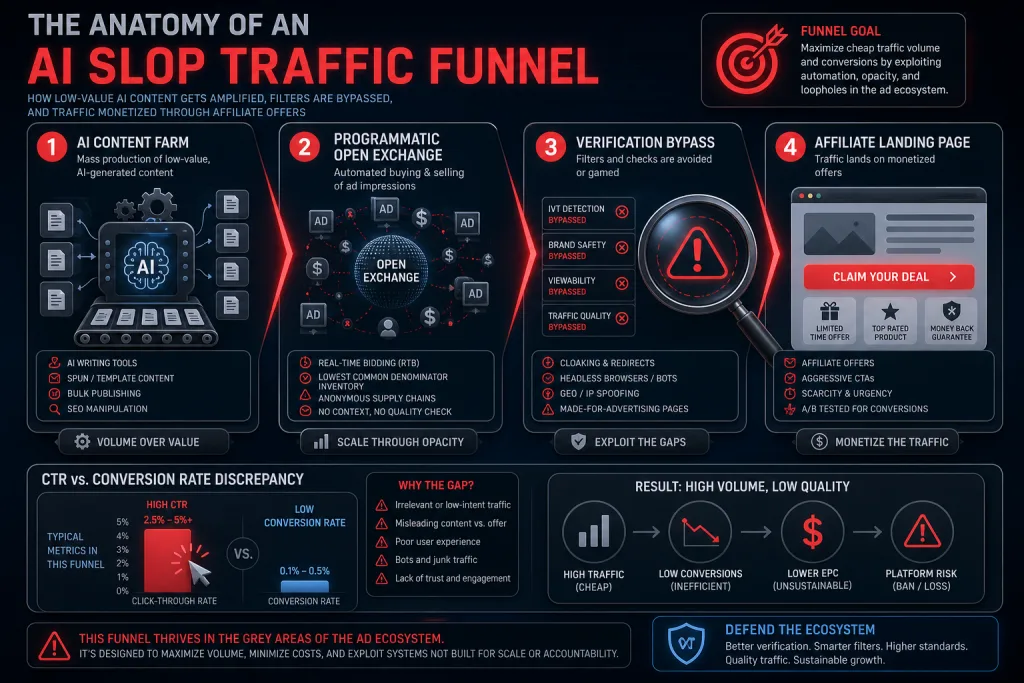
AI slop is mass-generated content created by language models to fill web pages for ad monetization. In 2026, the issue shifted from theoretical to practical: ad verification tools meant to protect media buyers’ budgets systematically let this junk inventory through. According to ADWEEK, in some cases, advertisers pay more for impressions next to AI-generated garbage than for placements in legitimate publications.
For traffic arbitrage specialists and media buyers, this poses a direct threat to campaign economics. You buy traffic that looks legitimate based on basic metrics—clicks are happening, impressions are rolling, but conversions are zero. The budget is burned on inventory generated by bots or AI content farms.
How AI slop bypasses verification systems
Traditional brand safety and verification systems were built to fight policy-violating content—violence, adult content, extremism. They analyzed text and images for compliance with lists of banned topics. AI slop works differently: it is technically clean, violates no explicit policies, but provides no value to the user.
The bypass mechanism
Verification systems use content classifiers. AI generators create texts that pass these classifiers because:
- The text is grammatically correct and structured.
- The topic formally falls into allowed categories (e.g., “technology” or “finance”).
- Images are generated without explicit violation markers.
- Domains have a short but clean history.
As a result, the inventory gets a green light from verification and enters programmatic auctions. A media buyer using standard targeting settings buys this traffic, unaware that the impressions are driven not by real users, but by scripts interacting with AI content.
Impact on traffic arbitrage economics
For a traffic arbitrage specialist, AI slop creates a three-layer problem. First, direct budget loss on fake inventory. Second, skewed data for optimization. Third, the risk of account suspension in Google Ads and other networks.
Skewed data for optimization
Google Ads and other platforms use machine learning for bid optimization. When traffic from AI slop sites enters the training set, the algorithm begins to consider the “high CTR—zero conversion” pattern normal. This breaks attribution and forecasting models. Performance Max campaigns are especially vulnerable since Google chooses placements itself, and inventory transparency is minimal.
Risk of account suspension
If Google detects that your traffic comes from sites violating platform policies (and AI slop sites often violate spam policies), this can lead to the suspension of your ad account. For an arbitrage specialist, this means losing not only the budget but also the infrastructure—accounts, linked cards, optimization history.
How to detect AI slop in your campaigns
Signs that your traffic is polluted with AI slop can be spotted at the data analysis stage. Here are the key indicators:
- CTR and CR discrepancy. High CTR with critically low conversion action. Users “click” but do not perform the target action.
- Abnormal time-on-site patterns. Time on page either tends to zero (bots) or, conversely, is abnormally high and identical for different sessions (scripts maintaining the session).
- Geographical anomalies. Traffic from GEOs uncharacteristic of your niche, or strange clusters of IP addresses.
- Duplicate user journey patterns. If you see that 80% of sessions follow the same path: one page → ad click → exit, this is a sign of automation.
Strategies for protecting budgets in Google Ads and Programmatic
Protection against AI slop requires a multi-layered approach. A single tool or setting won’t solve the problem, but their combination will significantly reduce risks.
1. Strict inventory control in Programmatic
In programmatic buying, use allow-lists instead of block-lists. Instead of trying to block all bad sites, compile a list of verified domains. This reduces reach but critically increases quality. For arbitrage specialists working on low margins, this might be unacceptable, but for those running offers with high payouts, quality is more important than volume.
2. Traffic isolation in Google Ads
In Google Ads, use separate campaigns for different types of inventory. Do not mix search traffic with the Google Display Network (GDN) in one campaign. For GDN, use manual placement selection, not automatic targeting. In Performance Max, this is impossible—the platform decides where to show ads itself. If you use PMax, regularly check the placement report and exclude domains showing signs of AI slop.
3. Third-party verification tools
Do not rely solely on Google’s built-in filters. Use third-party verification and monitoring tools—DoubleVerify, Integral Ad Science (IAS), CHEQ. These platforms use more advanced models for detecting AI-generated content and bot traffic. For arbitrage specialists with small budgets, CHEQ offers flexible rates tailored for performance campaigns.
4. Post-click analysis and micro-conversions
Set up micro-conversion tracking—scroll depth, time on page, clicks on specific elements. AI slop traffic usually doesn’t generate deep engagement. If you see that 90% of traffic doesn’t even reach the middle of the landing page, this is a signal to immediately exclude the source.
Risks for affiliate marketers and compliance
For affiliate marketers, AI slop creates additional risks. If you run offers from verticals with strict compliance—finance, crypto, betting—and your traffic comes from sites classified as spam, ad networks may suspend your account. Affiliate networks increasingly require publishers to provide traffic sources. If the source is an AI slop site, this is a breach of collaboration terms.
Moreover, if you use AI to generate content on your own landing pages, ensure it doesn’t fall under the definition of AI slop. Google Ads policies require “useful, relevant, and original content.” If your landing page is stuffed with AI text without added value, this is a risk of account ban.
The future: what to do when verification can’t keep up with AI
The AI slop problem will grow. The cost of content generation tends to zero, while the cost of verification rises. This is an asymmetric threat: creating a fake site costs cents, while verifying it costs dollars. For media buyers, this means that relying on platforms for brand safety is no longer an option.
Strategically, there needs to be a shift from reactive defense (blocking the bad) to proactive (allowing only the verified). This means working with private marketplaces (PMP) and direct deals instead of the open auction. Yes, this reduces scale, but in a landscape where 30-40% of traffic can be junk, scale at the expense of quality is a luxury arbitrage specialists cannot afford.
Practical checklist: auditing campaigns for AI slop
Checklist: auditing campaigns for AI slop
- Check the placement report in Google Ads for the last 30 days for unknown domains with high impression volumes.
- Compare CTR and CR for each domain. Find discrepancies: high CTR with zero conversions.
- Open 5-10 top domains by spend from the report and visually assess content quality.
- Add domains showing signs of AI slop as negative domains in PMax exclusion settings.
- Set up end-to-end analytics to track micro-conversions: scroll, time on page, button clicks.
- Check if you are using allow-lists in programmatic buying instead of block-lists.
FAQ
FAQ
What is AI slop in the context of traffic arbitrage?
AI slop is mass content generated by language models created solely for ad monetization. For arbitrage specialists, this means fake inventory that looks legitimate to verification systems but generates no real conversions, burning through budgets.
How does AI slop affect Performance Max campaigns in Google Ads?
Performance Max has minimal inventory transparency. Google chooses placements itself, and if the algorithm decides an AI slop site is suitable for your campaign, you might only find out post-factum through placement reports. This makes PMax particularly vulnerable to AI slop.
Can you get a refund for traffic from AI slop sites?
Technically, it’s difficult. Google Ads does not refund traffic that passed their own verification. If you use third-party verification tools (IAS, DoubleVerify), you can apply for compensation through their reporting system, but the process takes weeks and requires proof.
Which GEOs are most susceptible to AI slop traffic?
AI slop is a global problem, but the most susceptible are GEOs with cheap traffic and weak moderation: Tier-3 countries, some regions in Latin America and Southeast Asia. However, as AI content generation evolves, the problem is spreading to Tier-1 GEOs as well.
Is AI slop different from regular invalid traffic (IVT)?
Yes. IVT is bot traffic generating fake impressions and clicks. AI slop is content that can receive real impressions from bots, but the content itself holds no value. AI slop can also generate real but irrelevant traffic that doesn’t convert.