
What is context arbitrage and why it works again in 2026
Context arbitrage is a strategy for buying ad inventory in content categories that attract your target audience but fall outside the obvious verticals where competitors cluster. The result: 40–60% lower CPM with comparable traffic quality.
Most advertisers act predictably. A fitness brand buys in health-and-wellness. Fintech goes for personal-finance. An affiliate running gambling or nutra goes for entertainment or female-focused content. Everyone crowds into the same categories, CPMs skyrocket, and the return on every additional dollar drops.
Context arbitrage flips this logic. Instead of paying a premium for the “right” category, you buy relevance that hasn’t been inflated by bids. A pet store finds pet owners in outdoor-adventure and parenting content. A betting affiliate targets sports analytics rather than entertainment clickbait. CPMs drop, CTRs rise, because the user isn’t exhausted by ad noise.
Why competitors overpay: anatomy of saturated content environments
In any vertical, there are 3–5 “obvious” content categories that absorb 70–80% of ad budgets. This creates an overheated auction effect: every new participant drives up bids, CPMs grow exponentially, but inventory quality remains the same.
In practice, it looks like this: the CPM in the pet-care vertical for Display campaigns might be $4.50–$6.20, whereas the same segment of pet owners in outdoor-adventure costs $1.80–$2.40. The difference lies not in audience quality, but in the number of bids. Fewer advertisers = cheaper inventory.
For traffic arbitrage specialists, this is especially critical. When an offer’s margin shrinks, every cent of CPM matters. Reducing the cost per click by 40% can turn an unprofitable campaign into a profitable one without changing creatives or the landing page.
Placement mapping methodology: how to find cheap adjacent categories
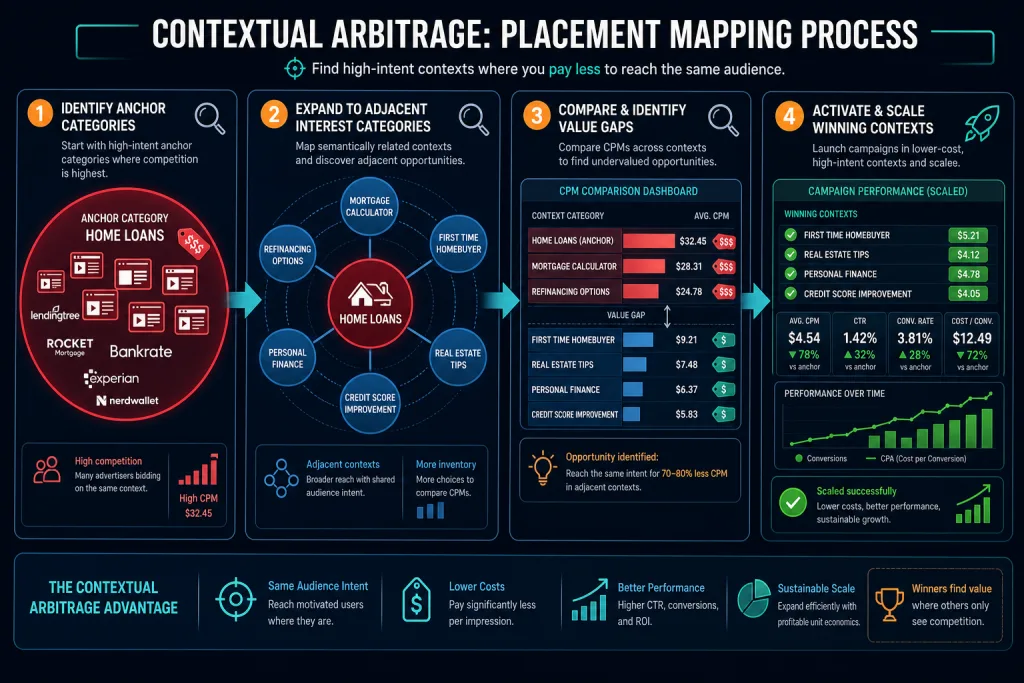
Placement mapping is the process of systematically searching for content environments where your target audience consumes content, but ad competition is minimal. The process consists of four steps.
Step 1: Define “anchor” categories
List 3–5 content categories where your competitors concentrate their budgets. For a nutra affiliate, these might be health, beauty, wellness. For betting — sports, entertainment, gaming. Use Competitive Analysis in Google Ads Auction Insights and tools like Anstrex, SpyGlass, or AdBeat to analyze competitor placements.
Step 2: Build a map of adjacent interests
For each anchor category, identify 5–10 adjacent interests. Ask the question: “Where else does this person spend time online?” A dog owner reads not only pet-care — they are interested in travel, outdoor, home-improvement, parenting. A football fan consumes not only sports — they watch tech reviews, investment content, automotive.
Use Google Trends Related Topics, In-Market and Affinity audiences in Google Ads, as well as SimilarWeb data to check traffic intersections between sites.
Step 3: Evaluate the CPM gap
Launch test Display campaigns targeting adjacent categories and compare the CPM with the anchor ones. Minimum test duration: 3–5 days, budget $50–$100 per category. Track not only CPM, but also CTR, bounce rate, and conversions.
Step 4: Scale the winners
Move categories where CPM is 30%+ lower while maintaining conversions into active campaigns. Exclude anchor categories from targeting to avoid mixing cheap and expensive inventory in the same campaign.
Practical context arbitrage examples for different verticals
Nutra and wellness
Anchor category: health-and-wellness. CPM: $3.80–$5.50.
Adjacent categories with low CPM:
- Parenting — young mothers actively seek health solutions. CPM: $1.90–$2.40.
- Self-improvement / productivity — an audience interested in personal growth converts well on wellness offers. CPM: $1.50–$2.00.
- Food & recipes — healthy eating content attracts the same audience. CPM: $1.70–$2.20.
Betting and gambling
Anchor category: sports news, entertainment. CPM: $2.80–$4.20.
Adjacent categories:
- Financial analysis / investing — an audience accustomed to risk and calculating probabilities. CPM: $1.60–$2.10.
- Tech reviews / gadgets — intersection with the gaming audience. CPM: $1.40–$1.90.
- Esports — lower competition than in traditional sports, with the same target audience. CPM: $1.20–$1.70.
mVAS and subscriptions
Anchor category: entertainment, mobile games. CPM: $0.80–$1.50.
Adjacent categories:
- Meme sites / humour — young audience with high impulsivity. CPM: $0.40–$0.70.
- Fan communities / fandom — loyal audience ready for subscriptions. CPM: $0.50–$0.80.
Tools for placement mapping
Effective context arbitrage requires a toolkit that allows you not only to find adjacent categories but also to validate them.
Google Ads Placement Report — the basic tool. Shows exactly where your ads are displayed. Use it to exclude expensive and ineffective placements.
Google Ads Contextual Targeting — allows targeting by topics and interests. The key feature is the ability to combine topics with exclusions, creating narrow adjacent segments.
Anstrex — competitive intelligence. Shows which placements competitors use, what creatives they employ, and in which categories they concentrate their budgets. Helps quickly identify anchor categories.
SimilarWeb — audience intersection analysis. Enter a competitor’s domain and look at “Also Visited” — this is your list of adjacent categories.
Google Trends — Related Topics and Related Queries. A quick way to find seasonal and trending adjacent interests.
Risks and pitfalls
Context arbitrage is not a silver bullet. There are several risks to keep in mind.
Brand safety. Adjacent categories may include content incompatible with your offer. Always use exclusions for sensitive topics. For affiliates running white-hat offers, this is critical — a single impression next to inappropriate content can lead to an advertiser complaint.
Traffic quality. A low CPM doesn’t always mean good conversions. Some adjacent inventory might be MFA (made-for-advertising) sites with high ad density and low traffic quality. Check domains using MFA detectors and monitor engagement metrics.
Scale. Adjacent categories usually have a smaller inventory volume. If a campaign scales, you might quickly exhaust cheap inventory and start getting expensive placements. The solution is to constantly search for new adjacent categories and rotate them.
Compliance. For affiliates in regulated verticals (gambling, pharma, financial offers), contextual targeting on adjacent categories might violate Google Ads policy. For example, showing gambling ads on sites for minors is a direct path to an account ban. Always check Google’s policy for your vertical and GEO.
Combination strategy: contextual + behavioral targeting
Maximum efficiency is achieved by combining contextual targeting with behavioral audiences. Instead of choosing one approach, create a multi-tier structure.
Tier 1: Contextual targeting on an adjacent category (e.g., outdoor-adventure for a pet offer).
Tier 2: Overlaying an Affinity audience (Pet Lovers) on contextual targeting. This narrows reach but increases relevance.
Tier 3: Exclusion of anchor categories (pet-care) to prevent mixing cheap and expensive inventory.
Tier 4: Retargeting users who clicked but didn’t convert, using a separate campaign with a higher bid.
This approach allows you to get the CPM of an adjacent category and the precision of behavioral targeting simultaneously.
How to measure context arbitrage success
Key metrics for evaluating context arbitrage efficiency:
- CPM gap — the difference between CPM in anchor and adjacent categories. Goal: at least 30%.
- CPA comparison — conversion cost in the adjacent category vs. the anchor one. If CPM is 40% lower, but conversions are 2x worse — arbitrage isn’t working.
- Viewability — adjacent categories might have lower viewability. Minimum threshold: 60%.
- IVT rate — invalid traffic share. If an adjacent category shows an IVT above 5% — exclude it.
- Frequency cap — in adjacent categories with smaller inventory volumes, the frequency of impressions per user grows faster. Set a cap of 3–5 impressions per day.
Checklist: launching context arbitrage in 7 steps
- Identify 3–5 anchor categories where competitors cluster, using Auction Insights and Spy tools
- Build a map of 10–15 adjacent interests using Google Trends and SimilarWeb
- Launch test Display campaigns with a $50–100 budget for each adjacent category
- Compare CPM, CTR, and CPA of adjacent categories with anchor ones after 5–7 days
- Exclude MFA domains and categories with an IVT above 5%
- Scale winners by overlaying Affinity audiences and excluding anchor categories
- Check compliance with Google Ads policy for your vertical and GEO before scaling
The future of context arbitrage: cookieless and AI context
With the gradual disappearance of third-party cookies, contextual targeting is getting a second wind. Without behavioral data, advertisers are forced to rely on context — the content of the page where the ad is shown. This makes context arbitrage not a temporary tactic, but a long-term strategy.
Google is already developing AI-powered contextual targeting within Performance Max, which analyzes page content at a semantic level. This means adjacent categories will be determined not manually, but algorithmically. Affiliates who master placement mapping now will find it easier to adapt to AI context in the future.
Practical takeaway: start testing context arbitrage today, while Google’s algorithms haven’t fully automated this process yet. Manual mapping provides a competitive advantage that might disappear in 12–18 months.
FAQ
How does context arbitrage differ from standard contextual targeting in Google Ads?
Contextual targeting is setting up impressions by topics and keywords. Context arbitrage is a strategy: you purposefully seek adjacent categories with low CPM where competitors are absent, and combine them with exclusions and behavioral audiences to maximize ROI.
Does context arbitrage work in Performance Max?
Partially. PMax automatically distributes the budget across placements, but you can use placement reports and exclusions to cut off expensive categories. Full control is provided by a Display campaign with manual topic targeting.
What is the minimum budget needed to test context arbitrage?
To test 5 adjacent categories, $250–$500 for 5–7 days is enough. This will be sufficient to get statistically significant data on CPM and CTR. Evaluating CPA might require a larger budget depending on the conversion cost.
Can context arbitrage be used for grey verticals?
Yes, but with increased attention to compliance. Adjacent categories might intersect with content for minors or sensitive topics, leading to a Google Ads ban. Use thorough exclusions and consult the policy for each GEO.
How often should the map of adjacent categories be updated?
At least once a quarter. Competitors might discover cheap categories and start buying there, driving up the CPM. Regular CPM monitoring across active categories helps spot new arbitrage opportunities in time.