Live shopping — a live broadcast format with instant purchasing right during the stream — is finally reaching critical mass in the US. After a decade of dominance in China, the stream-commerce model is crossing the ocean, and for affiliates, this means not just a new traffic source, but a fundamental shift in how users make purchasing decisions. If you’re running e-commerce, nutra, info-products, or even financial offers via Google Ads and Meta, you need to understand how live shopping breaks classic funnels and what to do with attribution when the click and conversion are separated by hours of watching a stream.
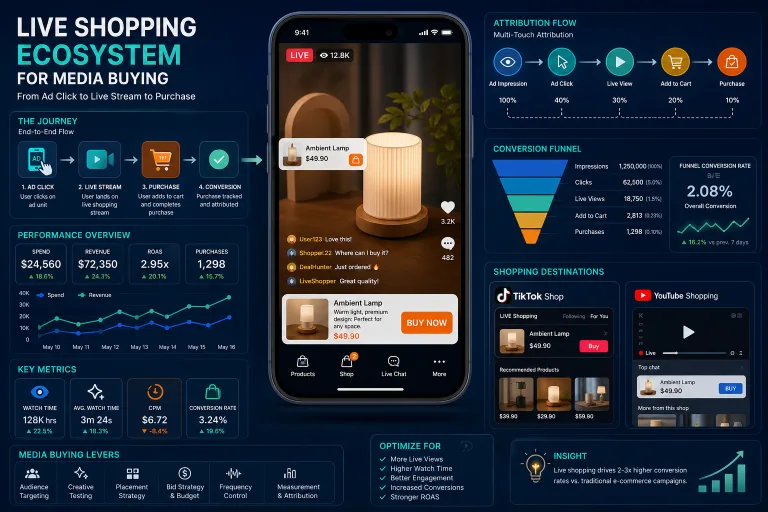
The key takeaway for media buyers: live shopping kills the “one click — one conversion” model and forces you to rebuild traffic buying around retention metrics and view-through attribution. A user might see your ad on Google Ads, visit a landing page, leave for a stream, watch the host for 40 minutes, and buy via a shoppable link at the end of the broadcast. Standard last-click attribution will record the conversion on TikTok or YouTube, and your ad channel will get zero. In 2026, this is no longer a theoretical problem — it’s a daily reality for teams working with US traffic.
What is Live Shopping and Why It’s Taking Off Now
Live shopping combines three elements: live video broadcasting, an integrated shopping cart, and social interaction (chat, reactions, polls). The viewer watches a real-time product demo, asks questions in the chat, and makes a purchase without leaving the stream screen. The format originated in China, where Taobao Live generated billions of dollars in revenue back in 2020, but it didn’t catch on in the US for a long time due to cultural differences in purchasing behavior.
In 2026, the situation has changed. TikTok Shop, Amazon Live, and YouTube Shopping have reached a critical mass of users and infrastructure. According to Axios, live shopping is finally “taking off” in America, and not just through TikTok — Amazon and YouTube are actively building their own stream-commerce ecosystems. For affiliates, this means the emergence of a new layer of conversion traffic that operates by different rules than classic paid search or display.
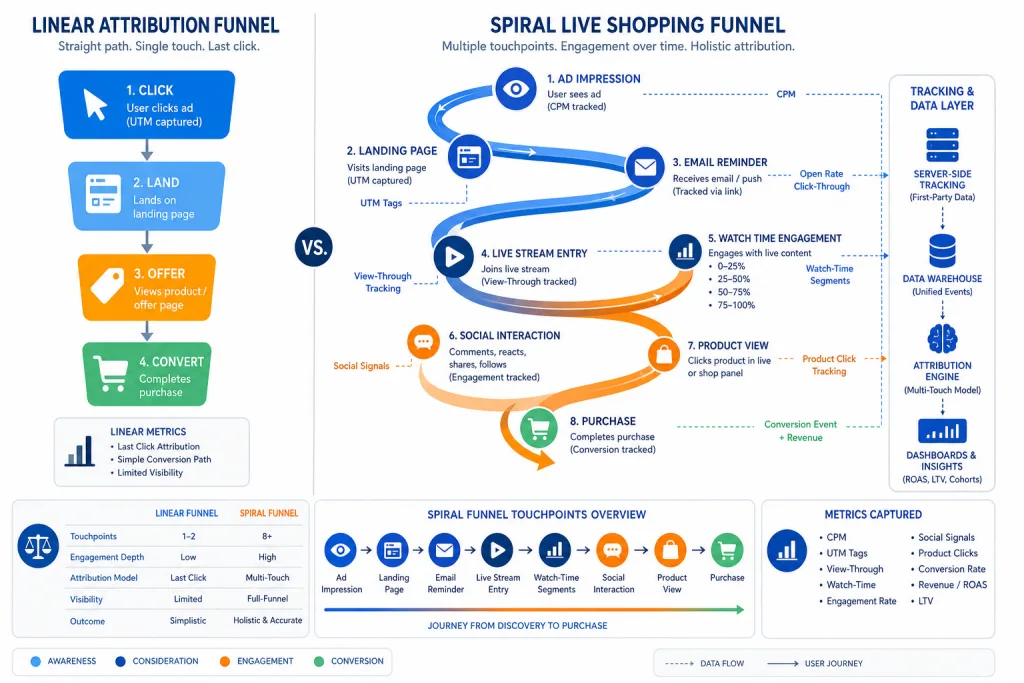
How Live Shopping Breaks the Classic Affiliate Funnel
The traditional traffic arbitrage funnel looks linear: ad impression → click → landing page → offer page → conversion. Each step is tracked, attribution is tied to the last click, and you know exactly which channel brought the conversion. Live shopping turns this line into a spiral.
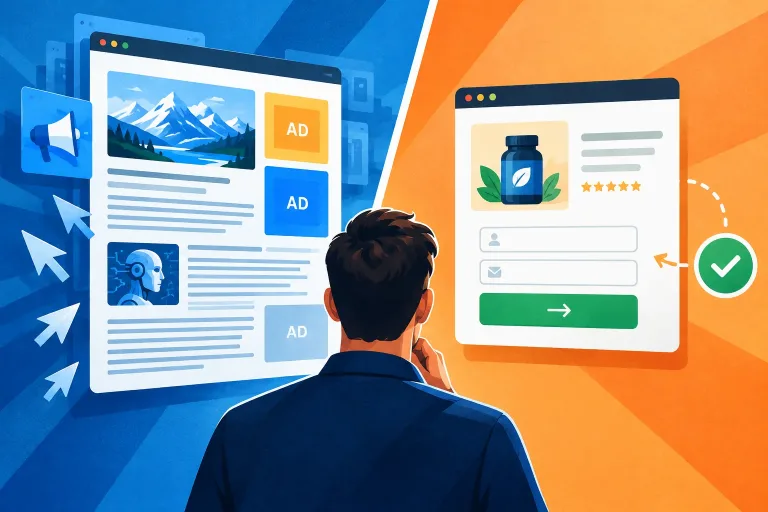
A user might come from your Google Ads campaign to a landing page, not buy immediately, but subscribe to a newsletter or go to the brand’s Instagram. A week later, they catch a live stream on TikTok, watch for 30 minutes, click a shoppable link, and buy. Last-click attribution will record the conversion on TikTok Organic. Your Google Ads budget is burned, and the ROAS for this channel looks negative — even though it was your first click that brought the user into the funnel.
This is especially painful for affiliates working on a CPA model with a fixed payout per conversion. If you can’t prove to the affiliate network that the conversion came from you, you lose money. Affiliate networks aren’t ready for view-through attribution and multi-touch models yet — they work on last-click, and this creates a systemic gap between how users buy and how affiliates get paid.
Attribution in the Stream-Commerce Era: What to Change Right Now
The first thing to do is implement server-side tracking and postback models that capture not just the click, but the touchpoint. If you’re running traffic through Google Ads to a landing page that sends users to live streams, you need to tag every transition with UTM parameters and pass them to the affiliate network via postback. This won’t solve the last-click problem completely, but it will give you data for analysis.
Second — use unique promo codes for each channel. If a user comes from Google Ads, show them a “GOOGLE15” promo code that only works when buying through your landing page. In a live stream, the host can mention a promo code, but if the user enters your code, the affiliate network will attribute the conversion to you. It’s a dirty but working hack for an era when proper attribution hasn’t been built yet.
Third — negotiate custom attribution with affiliate networks. Some networks already offer multi-touch models for large buyers. If you’re driving significant volume, you have leverage for negotiations.
TikTok Shop as the Main Front of Live Shopping
TikTok Shop is the main driver of live shopping in the US. The platform integrated a shopping cart directly into videos and streams, removing the friction of transitioning to an external site. For affiliates, this means two things: first, TikTok Shop is creating its own affiliate ecosystem where you can earn as an affiliate by promoting products through the live format. Second, TikTok Shop is cannibalizing traffic that previously went through Google Ads to external landing pages.
If you work with e-commerce offers, check if your product is on TikTok Shop. If it is, you either need to drive traffic directly to the TikTok Shop listing or create content that bypasses the internal platform. The second option is getting harder: TikTok algorithmically prefers content that leads to a purchase within the platform.
Google Ads and Live Shopping: Points of Intersection
At first glance, it seems like live shopping is the territory of TikTok and YouTube, and Google Ads is left out. This is wrong. Google Ads plays two roles in the stream-commerce ecosystem.
The first is the top of the funnel. Performance Max and Search campaigns on brand queries drive users to landing pages, which then send traffic to live streams. If you’re building a funnel around live shopping, Google Ads is your primary tool for generating initial demand. Use PMax with a product feed that will be shown in the stream, and set up dynamic retargeting for those who visited the landing page but didn’t make it to the live broadcast.
The second is YouTube Shopping. Google is actively integrating shoppable features into YouTube, opening a direct path for Google Ads budgets into live shopping. YouTube Shopping allows adding products directly to the stream, and advertisers can use Video Action Campaigns to promote live events. For affiliates, this means you can buy traffic through Google Ads and direct it to YouTube streams with an integrated cart.
The Economics of Live Shopping for Affiliates: Recalculating
Live shopping changes the unit economics of arbitrage. In the classic model, you calculate CPC, CR, and CPA — a linear formula where every click costs X, a conversion costs Y, and the difference is your margin. In live shopping, the variable of watch time is added: the user has to watch the stream long enough to reach a purchase.
This means the cost of conversion depends not only on the click price but also on traffic quality. Cheap traffic with low watch-time burns through the broadcast budget without yielding conversions. High-quality traffic that watches for 20+ minutes converts 3–5 times better but costs more at the buying stage. You need to rebuild your calculation model: instead of CPC → CR, calculate CPM → watch-time → CR.
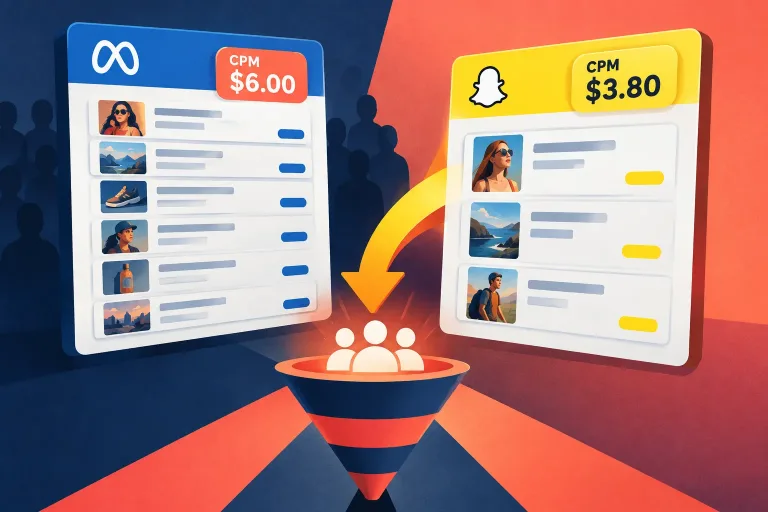
A practical example: you buy traffic through Meta Ads to a landing page that sends users to a TikTok stream. CPM on Meta is $8, CTR is 2%, transition to the stream is 40% of those who clicked. Of those who transitioned, 30% watch for more than 10 minutes, and 8% of them buy. Your real cost per conversion is not $8/1000 * 2% = $0.40 per click, but $8/1000 * 2% * 40% * 30% * 8% = $33.3 per conversion. If the offer payout is $45, the margin is $11.7. It’s tight, and any shift in watch-time kills the economics.
Creatives and Landing Pages for a Live Funnel
Creatives for traffic going to live shopping should prepare the user for the broadcast format. If you show a static banner with a product and send them to a stream, the user doesn’t understand where they’ve ended up and leaves. The creative should contain a “live broadcast coming up” signal — video format, footage from the stream, text like “Live Now” or “Watch the Live Stream.”
The landing page between the ad and the stream is a critical element. It must perform three functions: explain what will be in the stream, provide a broadcast schedule, and collect an email/phone for reminders. If you send traffic directly to the stream without an intermediate landing page, you lose the ability to retarget and send reminders, and conversion drops by 40–60%.
Risks and Compliance: What Can Go Wrong
Live shopping creates new compliance risks that don’t exist in classic arbitrage. The stream host might make a medical claim that violates Google Ads or FTC policies. If you’re running a nutra offer through a live format, one careless comment from the host about “healing” or “curing” can lead to an account ban.
TikTok Shop has its own rules for live sellers, including a ban on certain product categories and requirements for disclosing affiliate relationships. If you work as an affiliate on TikTok Shop, make sure your offer is allowed for live sales — the list of prohibited categories is broader than for regular ads.
For Google Ads campaigns that direct traffic to live streams, check the policy regarding dynamic content. Google cannot pre-check what the host will say on air, and formally, the responsibility lies with the advertiser. If the landing page where the Google Ads leads has an embedded stream, you are responsible for its content.
Strategy for Different GEOs: US vs. The Rest of the World
Live shopping in the US is developing differently than in Asia or Europe. In China, the model is already mature — users are used to buying through streams, the infrastructure is polished, and top streamers have celebrity status. In the US, user behavior is still forming: people watch streams as entertainment, but the conversion to purchase is lower than in China. This means that CPMs in the US are currently lower than the potential value of traffic, but conversion is also lower — the window for arbitrage exists, but it requires precise tuning.
For affiliates working in other GEOs, live shopping might be unavailable or operate by different rules. TikTok Shop is not available in all countries, and YouTube Shopping is just launching in several regions. If your primary GEO is Europe, watch for Amazon Live launching in new countries: Amazon is expanding the format, and this will create new arbitrage opportunities.
Checklist: Prepping an Affiliate Funnel for Live Shopping
- Implement server-side tracking with UTM tagging for every transition to a stream
- Create an intermediate landing page between the ad and the live broadcast with a subscription form
- Set up dynamic retargeting via Google Ads PMax for landing page visitors
- Issue unique promo codes for each traffic buying channel
- Recalculate unit economics using the formula CPM → watch-time → CR instead of CPC → CR
- Check the offer for compliance with TikTok Shop and Google Ads policies for the live format
What to Do Next
Live shopping in the US isn’t a hype that will disappear in six months. It’s a structural change in how users buy, and it directly affects the economics of traffic arbitrage. If you work with US traffic and aren’t testing live funnels yet, you’re missing the window of opportunity when CPMs are still low and competition for high-quality watch-time traffic is minimal.
Start small: pick one offer, create a landing page with a live broadcast schedule, buy traffic via Google Ads PMax or Meta Ads, and measure the conversion. Don’t expect the first campaign to be profitable — live shopping requires calibrating creatives, setting up attribution, and understanding watch-time economics. But after 2–3 iterations, you’ll get a funnel that operates by different rules than classic arbitrage — and that’s its value.
FAQ
Can I run traffic through Google Ads directly to a live stream?
Technically yes, if the stream is embedded in the landing page the ad leads to. But Google Ads cannot pre-check the content of a live broadcast, and you are responsible for all the host’s claims. It’s recommended to use an intermediate landing page with a broadcast description and a subscription form.
What affiliate attribution works for live shopping?
Most affiliate networks still use last-click attribution. This means the conversion is attributed to the last channel before the purchase — usually TikTok or YouTube. To get credit for the conversion, use unique promo codes or negotiate a custom model with the network.
Is live shopping more profitable than classic arbitrage for e-commerce?
Not always. Conversion in live shopping can be higher due to social proof and interactivity, but the cost of high-quality traffic with high watch-time is also higher. You need to calculate unit economics using the formula CPM → watch-time → CR, not the classic CPC → CR.
Which offers are best suited for live shopping?
Products with a visual demonstration of the effect: beauty products, gadgets, kitchenware, nutra with a visible result. Info-products and financial offers also work, but require a different broadcast format — more educational content and less direct selling.
Do I need to set up retargeting separately for live shopping?
Yes, and it’s critically important. Users who watched the stream but didn’t buy are the hottest audience. Set up dynamic retargeting via Google Ads PMax with a product feed shown in the broadcast, and use discounts for stream viewers.