What Happened: The Gemini Delay and Why It Matters for Google Ads
On July 16, 2026, Bloomberg and Reuters reported that Google is postponing the massive rollout of Gemini—the corporate model failed to meet internal goals for quality and performance. For the average user, this simply means a new chatbot or AI assistant will arrive later. For media buyers and affiliate marketers, it’s a signal: the roadmap for AI features inside Google Ads might also shift.
Google Ads has long ceased to be just a platform for buying clicks. Performance Max, Smart Bidding, generative creatives, AI audience optimization—all these tools run on models that Google develops under the hood. Gemini is one of the key drivers of this evolution. Its delay means that some promised features will appear later, and some will run on older models longer than planned.
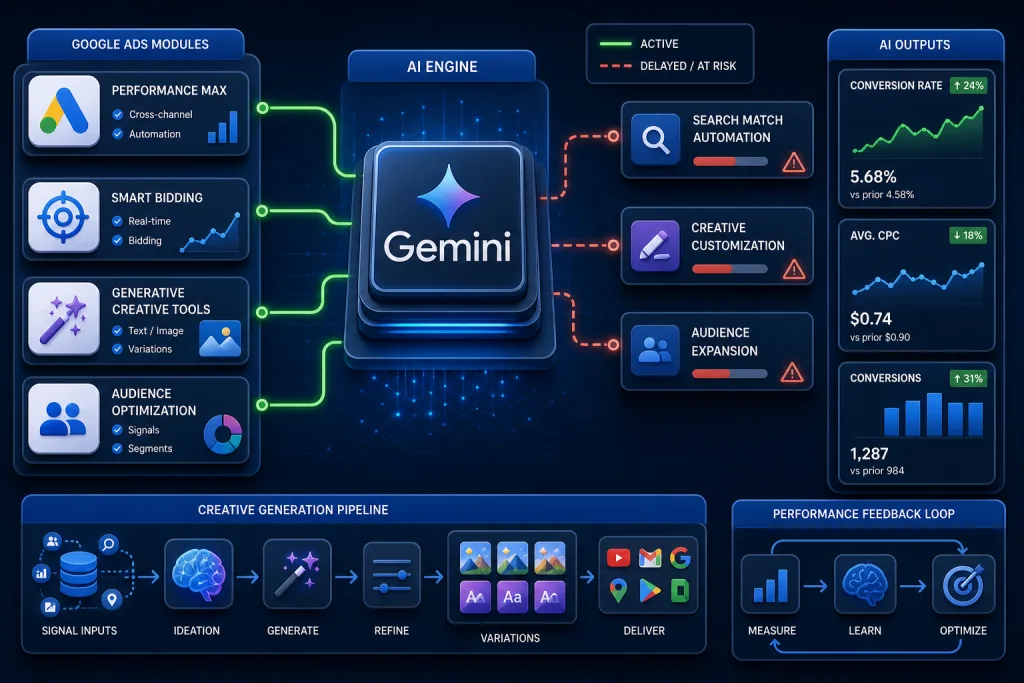
How Gemini Connects to Google Ads: The Dependency Chain
Gemini isn’t a standalone product but a family of models that Google integrates into various products. In Google Ads, these models are responsible for:
- Creative generation—text for RSAs, images for Demand Gen, videos for YouTube.
- Bid optimization—Smart Bidding uses predictive models to calculate conversion costs.
- Audience optimization—PMax and other campaigns use AI to find lookalike audiences and expand targeting.
- Context understanding—models help Google better understand search queries and match them with ads.
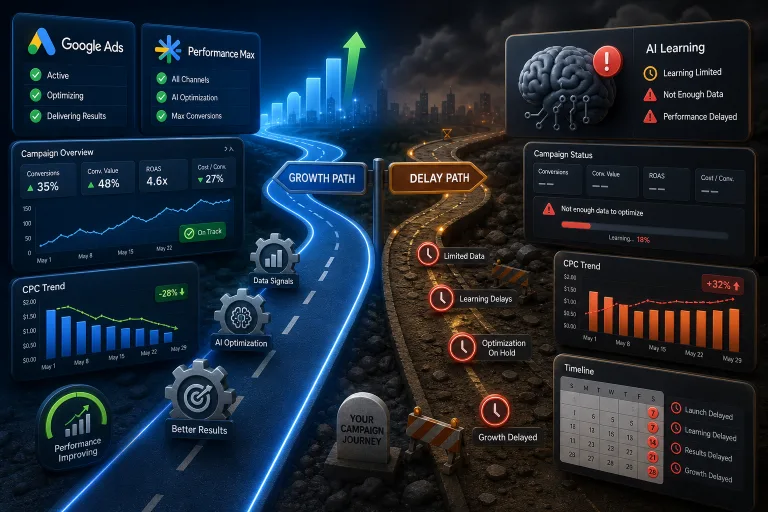
When Gemini is delayed, all these features either remain on previous models or receive updates more slowly. For an affiliate marketer, this means that expected improvements—like more accurate creative generation or lower CPA through new bidding models—might not materialize on schedule.
Performance Max: What Exactly Might Slow Down
Performance Max is the campaign type most dependent on Google’s AI models. PMax automatically distributes budgets across all Google channels, generates creatives, and optimizes bids. This is where the Gemini delay will be felt most acutely.
Generative Creatives
Google announced expanded generative capabilities for PMax: automatic creation of images, texts, and videos. These features were supposed to get a boost with the Gemini update. The delay means:
- The quality of automatically generated creatives won’t improve in the near future.
- New generation formats (e.g., video from text prompts) may launch later.
- Affiliates relying on mass creative generation for split tests will have to depend on third-party tools longer.
Bid Optimization
Smart Bidding in PMax uses predictive models to calculate conversion probability. Updating these models is part of Google’s overall AI development. The Gemini delay could mean:
- Bidding models will train on the same algorithms as they do now.
- Improvements in signal processing (especially for niche offers with low data volume) are postponed.
- For affiliates with low conversion volumes, this means a period of CPA instability may be prolonged.
Audience Expansion
PMax uses AI to find new audiences through similar segments and automated targeting. Updating these features also depends on model development. If Gemini isn’t updated, audience expansion might be less accurate, which for affiliates means a risk of wasting budget on irrelevant impressions.
Impact on Other Campaign Types
Search Ads and Match Types
Google has already tested new match type labels in Search Ads. The development of AI query understanding is directly tied to models like Gemini. The delay could mean:
- Improvements in semantic matching for broad queries are postponed.
- New AI-based negative keyword optimization features will arrive later.
- For affiliates working in expensive niches, this means targeting control won’t improve anytime soon.
Demand Gen and YouTube
Demand Gen campaigns and YouTube ads also rely on AI models for creative generation and optimization. The Gemini delay could slow down:
- The development of generative video formats.
- Improvements in automatically creating short videos from static creatives.
- New optimization features for YouTube ads.
Practical Implications for Affiliate Marketers
Growing Reliance on Third-Party AI Tools
If Google slows down its own AI feature development, affiliates will have to compensate with third-party tools. This means:
- More budget for creative generation tools (Midjourney, Runway, Canva AI).
- Using external platforms for predictive analytics.
- Manual control where automation was expected.
Slower Optimization for New GEOs
Google’s AI models are especially useful when entering new GEOs with little historical data. If model updates are delayed, affiliates will have to:
- Collect data for campaign training longer.
- Use more conservative bidding strategies.
- Set up targeting manually instead of relying on automatic optimizations.
Risk of CPA Stagnation
For affiliates whose CPA is already on the edge of profitability, a slowdown in AI improvements means the expected drop in conversion costs won’t happen. This is especially critical for highly competitive niches, where every optimization improvement directly impacts margins.
Adaptation Strategies: What to Do Right Now
1. Strengthen Manual Control Over PMax
While AI models aren’t updated, don’t rely entirely on PMax’s automatic optimization. Practical steps:
- Regularly check placement reports and exclude irrelevant ones.
- Use audience signals to guide the AI, rather than relying solely on automated targeting.
- Set stricter budget limits during the instability period.
2. Diversify Creative Sources
Don’t wait for Google to improve in-platform creative generation. Strategy:
- Use a Midjourney + Canva combo for mass static creative generation.
- For video—Runway or CapCut for fast variations.
- Keep a creative library outside Google Ads to avoid dependency on the platform’s internal tools.
3. Segment Campaigns Instead of All-Encompassing PMax
If PMax works less accurately due to delayed model updates, consider:
- Splitting campaigns by channel (Search, YouTube, Display separately).
- Using standard Shopping instead of PMax for e-commerce offers.
- More granular targeting setup instead of broad automation.
4. Enhance Analytics Outside Google Ads
Since Google’s internal models might temporarily perform worse than expected:
- Use Google Analytics 4 for independent attribution.
- Set up server-side attribution for accurate conversion tracking.
- Compare Google Ads data with tracker metrics (e.g., Voluum, RedTrack).
5. Monitor API Updates
The Google Ads API is updated regularly, and the Gemini delay might affect the release schedule. For teams using API automation:
- Keep an eye on the Google Ads API changelog.
- Check script compatibility with new versions.
- Don’t plan major migrations until API stability is confirmed.
Risks and Compliance: What to Watch Out For
Transparency of AI Decisions
Google has already introduced the “how this ad was made” label for AI-generated ads. The Gemini delay doesn’t cancel these requirements, but it might mean some creatives will be generated on older models. For affiliates, this means:
- Continue labeling AI-generated creatives according to Google’s policy.
- Don’t expect new models to automatically solve compliance issues.
- Manually check creatives for policy compliance.
Dependency on a Single Platform
The Gemini delay is a reminder of the risk of depending on a single ecosystem. If Google Ads AI features slow down, affiliates should:
- Distribute budgets between Google, Meta, and other platforms.
- Test alternative traffic sources (TikTok, Microsoft Advertising).
- Not build long-term strategies solely on promised but unreleased features.
Checklist: Adapting Campaigns to the Gemini Delay
- Review all active PMax campaigns for irrelevant placements and exclude them manually
- Create a backup creative library in external tools (Midjourney, Canva, Runway)
- Split at least one PMax campaign into separate channels to compare performance
- Set up independent attribution via GA4 and server-side tracking
- Check Google Ads API script compatibility with the latest changelog
- Allocate at least 20% of your budget to alternative platforms (Meta, TikTok, Microsoft)
What’s Next: When to Expect Updates
Google hasn’t canceled the Gemini launch—it delayed it. This means updates will come, but later. For affiliates, it’s important to:
- Follow official Google Ads announcements, not Gemini rumors.
- Check Google Ads release notes every month—some features might launch without the Gemini branding.
- Don’t freeze campaign optimization waiting for a “magic update”—work with what you have now.
The Gemini delay isn’t a disaster, but a signal that AI development in Google Ads isn’t linear. Affiliates who continue to optimize campaigns manually and don’t rely solely on automation will gain an edge during this period of uncertainty.
FAQ
Will the Gemini delay affect current Google Ads campaigns?
There is no direct impact on current campaigns—they will continue running on existing models. However, expected improvements (new generative creatives, improved Smart Bidding) may launch later than planned.
Should I disable Performance Max because of the Gemini delay?
No, there’s no need to disable PMax. But you should strengthen manual control: check placements, use audience signals, and set strict budget limits during the uncertainty period.
What alternatives to Google Ads AI features can I use?
For creative generation—Midjourney, Canva AI, Runway. For analytics—GA4, server-side tracking, third-party trackers (Voluum, RedTrack). For optimization—manual bid management and campaign segmentation.
When will Google release the updated Gemini?
There is no exact date—Bloomberg reported a delay without a specific timeframe. Google usually doesn’t tie Google Ads updates to consumer product releases, so some features might launch independently.
Will the Gemini delay affect CPC in Google Ads?
There is no direct impact on CPC. But if bid optimization doesn’t improve on schedule, CPA might remain higher than planned, especially for niche offers with low data volume.