What’s Happening: Publisher Panic and an Arbitrage Window
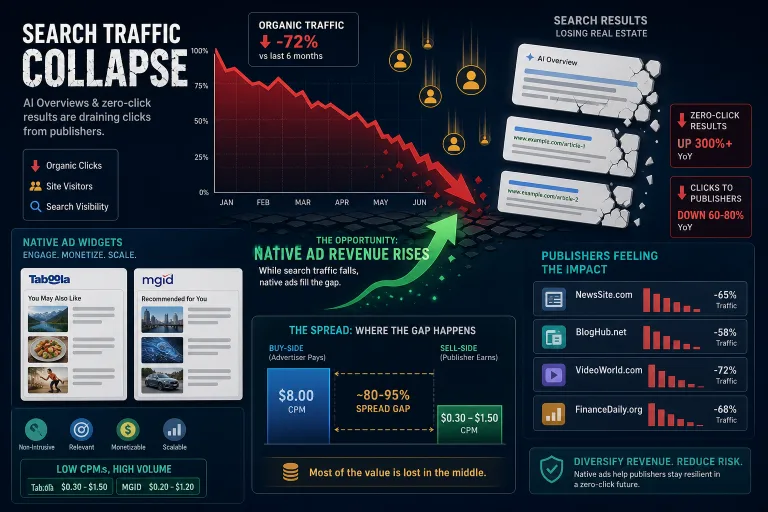
By early 2026, publishers found themselves facing what they dubbed a “SEO traffic collapse.” Forecasts suggest organic clicks from Google could be cut in half by Q3 2027. The cause isn’t a single factor but a combination: AI Overviews are siphoning clicks, zero-click search has become the norm, and SERPs increasingly answer users directly on the results page.
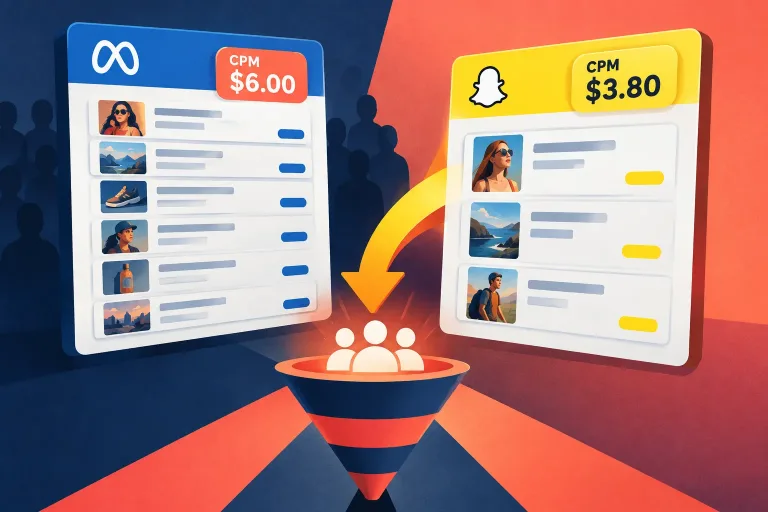
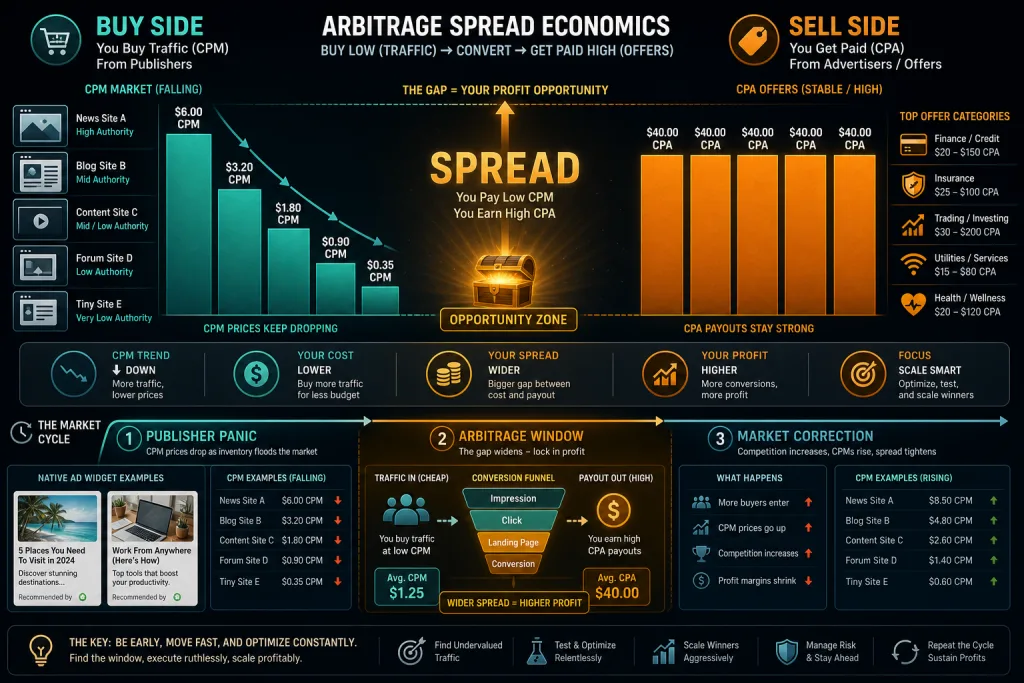
The publishers’ reaction is predictable: they’re slashing CPMs on native inventory to keep fill rates from collapsing. Advertisers who need engaged, high-intent audiences are holding or even raising their bids. This creates a spread — the difference between the cost of buying and selling attention — which is the essence of the arbitrage opportunity.
For media buyers, this means native traffic that was unjustifiably expensive just six months ago is now 20–40% cheaper across several verticals, while audience quality on many sites hasn’t dropped proportionally to the price.
The Economics of the Spread: Why It Works
Arbitrage exists where there’s an asymmetry of information or reaction speed. Publishers react to organic traffic drops quickly — they cut prices because empty inventory earns nothing. Advertisers react more slowly: they optimize based on historical data where conversions still look fine.
This creates a window lasting several quarters where:
- Buying — CPMs on native inventory from panicking publishers drop 20–40%
- Selling — CPA offers and affiliate programs hold or increase their payouts
- Spread — the gap between click cost and conversion payout widens
This isn’t a permanent opportunity. Once advertisers notice that native conversions are also declining (because the audience has become less intent-driven), they’ll start cutting bids too. The window will close. The question is whether you’ll make it in time.
Which Verticals Benefit from the SEO Collapse
Not all native inventory is equally useful for arbitrage in this situation. The publishers losing the most are content sites built on informational queries: health, finance, tech reviews, lifestyle. That’s where native widgets (Taboola, MGID, Revcontent) occupy a significant share of inventory.
Verticals where the spread is most pronounced right now:
- Health & Wellness — informational articles are losing traffic, but native clicks on “5 signs of…” and “How to get rid of…” still convert on dietary offers
- Personal Finance — publishers are cutting CPMs, while payouts on credit and insurance offers remain high
- Tech / Software Reviews — comparison articles are losing SERP positions, but native software recommendations still convert
- Lifestyle & Home — broad audience, low CPM, ideal for e-commerce and CPA offers with mass targeting
Verticals to avoid during this window:
- News / Politics — CPMs are dropping, but brand safety risks are rising and conversions are unstable
- YMYL content with strict compliance — publishers are cutting prices, but Google Ads policy risks aren’t going anywhere
How to Buy: A Practical Strategy
Step 1: Identify Cheapening Inventory
Not all publishers are cutting CPMs equally. You want those that:
- Depend on organic Google traffic for 60% or more of their visitors
- Use native widgets as a meaningful revenue source
- Have already started lowering minimum bids on self-serve platforms
Check the publisher’s organic traffic share via SimilarWeb or Ahrefs. If organic search is >60% and trending down — that’s your candidate.
Step 2: Test via Self-Serve Platforms
MGID, Taboola, Revcontent, and Outbrain give you access to native inventory with no minimum spend commitments. Start with MGID — they have the lowest minimum bid and a fast moderation process. Buy on CPC, not CPM: during periods of CPM volatility, you want to pay for clicks, not impressions.
Start your bid 15–20% below the platform’s recommended rate. If your fill rate is above 70%, lower it further. Publishers are hungry right now and accepting bids they would have rejected six months ago.
Step 3: Landing Pages Built for Native Traffic
A native click is a curiosity click, not an intent click. Your landing page should:
- Maintain visual continuity with the native teaser (headline, tone, style)
- Load in under 2 seconds — native audiences are impatient
- Have one clear CTA — don’t try to sell everything at once
- Use social proof above the fold
Step 4: Attribution and Tracking
Native traffic breaks standard last-click attribution. A user clicks from a widget, lands on your page, leaves, comes back via search, and converts. Without cross-channel tracking, you’ll see native as a “non-converting” channel.
Use server-side tracking (Stape, RedTrack, Binom) with postback integration. Set view-through windows to 7 days — native audiences convert more slowly than search traffic.
Risks and What Could Go Wrong
Audience Quality Degrades
A publisher loses SEO traffic → replaces it with traffic from other sources (social, aggregators, paid) → the audience quality in the native widget shifts. You might be buying cheap CPMs, but conversions drop faster than the price.
Solution: monitor post-click quality metrics — time on site, scroll depth, bounce rate — separately for each publisher. Cut off those whose metrics have declined over the past 30 days.
The Window Closes Faster Than Expected
If the SEO traffic collapse accelerates, advertisers will cut native bids faster than you can scale campaigns. You’ll invest in creatives and landing pages, and a month later the spread will collapse.
Solution: don’t invest in long-term assets (complex landing pages, custom tracking systems) at the start. Test with ready-made solutions, scale only what pays back within 2 weeks.
Compliance and Policy Risks
Native advertising lives in a gray zone between content and ads. Panicking publishers may lower their moderation standards, letting aggressive creatives through. You get cheap traffic, but risk your platform account and reputation.
Solution: stay within the platform’s policy guidelines. A cheap CPM isn’t worth losing an account with campaign history.
Comparing Native Advertising Platforms for Arbitrage
| Platform | Min. Budget | Min. CPC | Moderation Speed | Best For |
|---|---|---|---|---|
| MGID | $100 | $0.01 | 1–2 hours | Testing, mass-market verticals |
| Taboola | $50 | $0.03 | 24 hours | Brand verticals, finance |
| Revcontent | $50 | $0.01 | 2–4 hours | Aggressive verticals, health |
| Outbrain | $30 | $0.02 | 24 hours | Premium inventory, tech |
For getting started in the current window, I recommend MGID: low barrier to entry, fast feedback, and sufficient inventory volume from panicking publishers.
Metrics You Need to Track
- Buy-side eCPM — actual cost per 1,000 impressions after bid optimization
- Teaser CTR — if below 0.3%, the teaser isn’t resonating with that publisher’s audience
- LP CTR — click-through from landing page to offer; if below 20%, the landing page needs work
- EPC (earnings per click) — how much you earn per click from native
- ROI by publisher — calculated per domain, not averaged across the campaign
Example: Arbitrage in the Health Vertical
You buy native traffic on MGID at $0.02 CPC from a publisher that lost 40% of organic traffic in a quarter. Teaser: “5 Signs of Vitamin D Deficiency That 80% of People Ignore.” Landing page — a simple one-pager with a quiz and CTA to a dietary supplement offer paying $18 per conversion.
The math:
- 1,000 clicks × $0.02 = $20 spend
- LP CTR 25% → 250 clicks to offer
- Offer conversion 4% → 10 conversions
- Revenue: 10 × $18 = $180
- ROI: ($180 − $20) / $20 = 800%
This is an ideal scenario. In reality, conversion will be 1.5–2.5%, and CPC might be $0.03–0.04. But even with conservative estimates, a 200–400% ROI is a workable model that wasn’t available six months ago when CPMs were 30% higher.
The Window of Opportunity: How Much Time Is Left
The forecast of a 50% organic traffic reduction by Q3 2027 isn’t a sudden cliff — it’s a gradual trend. But publishers are reacting preemptively: they’re cutting prices now rather than waiting for traffic to drop. Advertisers react with a 2–3 quarter lag.
Realistic window estimate: 4–8 months of active arbitrage opportunity, after which advertiser bids will begin adjusting to the new conversion reality. Those who enter now get the maximum spread. Those who wait for “proof” get a squeezed-margin channel.
Checklist: Launching Native Arbitrage on Cheap Inventory
- Check the publisher’s organic traffic share via SimilarWeb — look for >60% organic and a downward trend
- Launch a test on MGID with a minimum bid 15–20% below the recommended rate
- Prepare a landing page with visual continuity from the teaser and a single CTA
- Set up server-side tracking with postback and a 7-day view-through window
- Monitor post-click quality metrics separately for each publisher
- Cut publishers with quality drops over 30 days — don’t wait for “recovery”
FAQ
FAQ
How is native arbitrage different from search arbitrage in Google Ads?
Search arbitrage is built on the difference between CPC in Google Ads and the payout from search traffic on a landing page. Native arbitrage is built on the difference between the cost of a click from a native widget (Taboola, MGID) and the payout per conversion. Native doesn’t have keyword auctions, targeting is contextual, and the audience is less intent-driven — but CPMs are currently significantly lower.
How much budget do I need to start?
The minimum threshold on MGID is $100, on Taboola $50. For a meaningful test with statistical significance, budget $300–500 per combination (teaser + landing page + offer). Anything less and you won’t collect enough data for optimization.
What should I do if native CPMs start rising again?
That’s a signal the window is closing. Don’t try to hold onto cheap traffic with aggressive bids — you’ll start overpaying. Switch to adjacent verticals where publishers haven’t adjusted prices yet, or move to other traffic sources.
Can I send native traffic to Google Ads landing pages?
Technically yes, but Google Ads policy doesn’t apply to native platforms. If your landing page complies with the affiliate program’s rules and the native platform’s guidelines, that’s sufficient. Google Ads policy only matters if you’re buying traffic through Google Ads, not through native networks.
Which offers convert best with native traffic in the current window?
Health & wellness (dietary supplements, vitamins), personal finance (loans, insurance), tech/software (SaaS products with free trials). These verticals have historically performed well with native, and right now CPMs on them are reduced due to publisher panic in these content categories.