What Is Surveillance Pricing and Why Arbitrage Marketers Need to Pay Attention
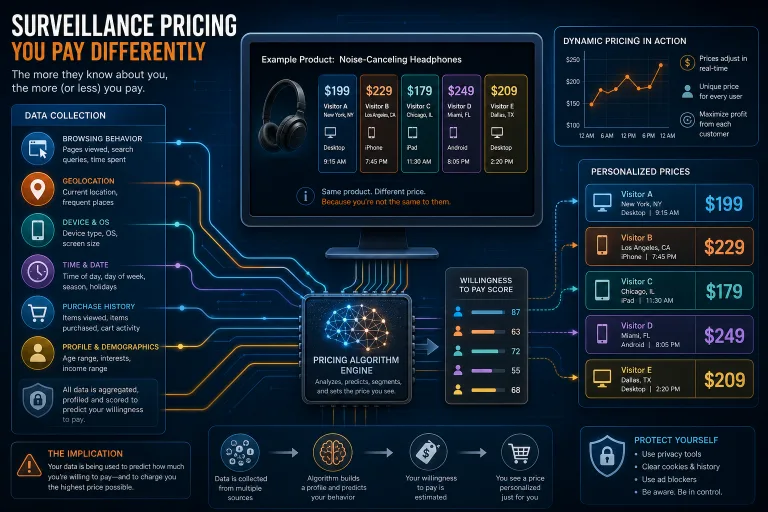
Surveillance pricing is the practice where a company charges different users different prices for the same product or service based on collected data: purchase history, device, geolocation, on-site behavior, and even time of day. In July 2026, the New York Post published an investigation confirming that “price surveillance” has gone mainstream: tourists, passengers, and online shoppers see different price tags depending on their digital profile.
For media buyers and affiliate arbitrage marketers, this means a fundamental shift: a user who clicks your Google Ads ad may see a price on the landing page that differs from what you factored into your conversion economics. If the offer partner uses surveillance pricing, your campaign economics stop being predictable.
How Surveillance Pricing Works Technically
Personalized pricing is built on several layers of data:
- Behavioral signals — how long the user has been on the site, how many pages they viewed, whether they returned before.
- Device context — browser type, operating system, presence of ad blockers.
- Geo data — country, city, regional income level.
- Transaction history — previous purchases, average order value, order frequency.
- External signals — weather, exchange rates, competitive landscape in real time.
The advertiser or affiliate program combines these signals through an ML model and outputs an individual price. For the average buyer, this goes unnoticed. For an arbitrage marketer running traffic at a fixed cost per conversion, it’s a disaster: the same offer can convert differently depending on which “price profile” a specific click receives.
Why Surveillance Pricing Breaks Arbitrage Campaign Economics
Imagine a classic setup: you launch a Google Ads campaign on an e-commerce offer with a $25 CPA. You calculate that at $1.20 CPC and a 5% conversion rate, you earn $125 in revenue from $100 in spend. But if the partner platform uses surveillance pricing, the actual product price for the user could end up 15–30% higher or lower than expected.
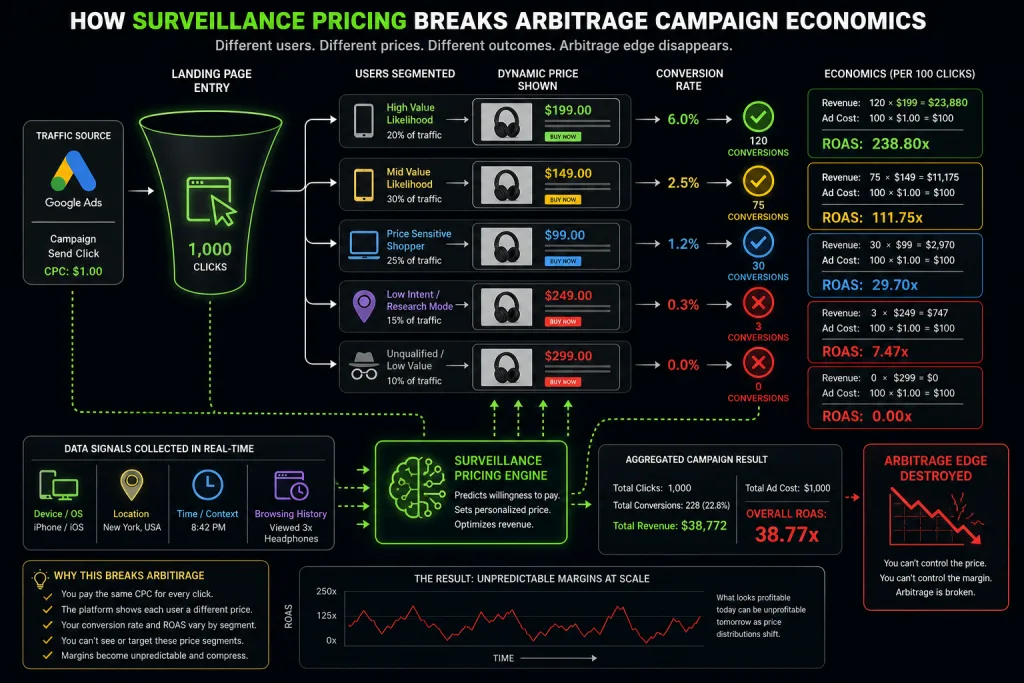
This creates three problems:
- Unpredictable conversion. A user with a high “price profile” sees a price above expectations and leaves. Conversion drops from 5% to 2.5%, and the campaign goes negative.
- Distorted A/B tests. You test two creatives, but the difference in CTR may be driven not by the creative but by the fact that one audience received a higher price on the landing page.
- Scaling problem. A campaign showing 140% ROAS on one audience starts burning budget when scaled to a new segment because the new segment gets a different price profile.
How to Tell If a Partner Uses Surveillance Pricing
Not all affiliate programs and advertisers openly disclose dynamic pricing. Here are the warning signs a media buyer should watch for:
- Sharp conversion swings when changing targeting without altering the creative or bid.
- Different conversion rates across similar GEOs with comparable purchasing power.
- Unstable EPC (earnings per click) at a steady traffic volume.
- Discrepancies between the price on the landing page and the price in the offer feed you see in the affiliate network.
- User complaints in reviews or comments about “different prices” for the same product.
If you spot two or more signs simultaneously, there’s an 80%+ probability the advertiser applies personalized pricing.
Adaptation Strategies: How to Work with Offers Under Surveillance Pricing
1. Segment Traffic by “Price Profiles”
Instead of sending all traffic to a single landing page, split campaigns by segments likely to receive different prices. Key segments:
- New vs. returning users (different bids in Google Ads).
- Mobile vs. desktop (different landing pages or pre-landing pages).
- GEOs with different income levels (separate campaigns, not one targeting for the entire country).
- Time of day (evening traffic may receive a higher price due to “urgency” of the query).
2. Test Pre-Landing Pages with a Fixed Price
If the partner allows it, use a pre-landing page where you anchor the price in the creative or on the page. This creates a psychological anchor: the user expects a certain price and is more likely to convert, even if the final landing page shows a different price. However, be careful: if the stated price diverges significantly from the real one, this can lead to complaints and a Google Ads account suspension for misleading advertising.
3. Recalculate Economics by Segment, Not in Aggregate
A classic mistake is calculating average ROAS across the campaign. Under surveillance pricing, the average hides failing segments. Break down the report by audience segments and calculate conversion, EPC, and ROAS separately for each. Disable segments with ROAS below the threshold, even if the average looks fine.
4. Diversify Offers Within the Same Niche
If you work with three partners in the same niche, test them in parallel on identical traffic. A partner without surveillance pricing may deliver more stable conversion, even if the base CPA is lower. Predictability matters more than the maximum payout when scaling.
Compliance Risks: How Google Ads Reacts to “Deceptive Pricing”
Google Ads has strict policies against misleading content. If your creative states one price and the user sees another on the landing page, this can be classified as a violation, even if the price changes through no fault of your own.
Key risks:
- Ad disapproval — Google may reject ads if the system detects a mismatch between the stated price in the ad and the price on the landing page.
- Lower Quality Score — high bounce rates due to price shock reduce the relevance metric.
- Account ban for repeated violations or user complaints.
To minimize risks, avoid stating a specific price in creatives if you don’t control the landing page. Use phrasing like “from $X” or “special price” instead of a fixed number.
Impact on Different Arbitrage Verticals
Surveillance pricing affects verticals differently:
- E-commerce — maximum impact. Advertisers actively test dynamic prices, especially in travel, electronics, and fashion.
- Financial offers (loans, insurance) — rates depend on the user’s credit profile, which is essentially a form of surveillance pricing. Arbitrage marketers have long dealt with this, but models are getting more complex.
- iGaming — bonus offers are personalized by player profile, affecting FTD conversion.
- Lead generation — the cost per lead can change depending on the quality of user data, affecting payout.
- mVAS — minimal impact, as the price is usually fixed by the operator.
How Tracking Helps Detect Price Anomalies
Proper tracking is your primary tool for detecting surveillance pricing. Set up the following metrics in Google Ads and your tracking system:
- Conversion by hour — if conversion drops during certain hours, it may signal a temporary price change.
- Conversion by device — a significant difference between mobile and desktop traffic isn’t always explained by UX.
- Conversion by audience list — compare remarketing vs. new users. If remarketing converts worse on the same offer, returning users may be getting a higher price.
- EPC by day of week — weekends vs. weekdays may show different patterns due to changes in the partner’s pricing algorithms.
Practical Steps: Checklist for Media Buyers
Checklist: Protecting Your Campaign from Surveillance Pricing
- Check conversion stability by segments (device, GEO, time of day) over the last 14 days
- Compare EPC across the same offers from 2–3 partners on identical traffic
- Remove fixed prices from Google Ads ad copy if you don’t control the landing page
- Set up separate campaigns for new and returning users with different bids
- Add hourly conversion monitoring to your dashboard and set an alert for a 30%+ drop
- Ask your affiliate network directly about dynamic pricing practices
The Future of Surveillance Pricing and What It Means for Arbitrage
Regulators in the US and EU are already examining surveillance pricing as a potentially discriminatory practice. If legislation restricts personalized pricing, it could stabilize conversion for arbitrage marketers. Until then, media buyers need to operate under uncertainty.
Key takeaway: the era of fixed offer economics is ending. Successful arbitrage marketers in 2026 are those who can segment traffic, track price anomalies, and quickly disable unprofitable segments. Surveillance pricing makes media buying harder, but it also creates an opportunity: if you understand which segments receive more favorable prices, you can concentrate your budget on them and achieve above-market ROAS.
FAQ
How is surveillance pricing different from regular dynamic pricing?
Dynamic pricing changes the price for all users based on external factors (demand, time, competitors). Surveillance pricing changes the price individually for each user based on their personal data — purchase history, device, behavior. This makes the price unpredictable for an arbitrage marketer who can’t see what price a specific click will receive.
Can Google Ads ban your account for surveillance pricing on a partner’s landing page?
Not directly, since you don’t control the partner’s pricing. But if your creative states one price and the user sees another, Google may disapprove the ad for misleading content. Repeated violations can lead to an account ban. Don’t state fixed prices in ads if you don’t control the landing page.
Which arbitrage verticals suffer most from surveillance pricing?
E-commerce (especially travel and electronics), financial offers (loans, insurance), and iGaming. In these verticals, advertisers actively use personal data for pricing, which directly impacts the conversion of arbitrage traffic.
Can you use surveillance pricing to your advantage as an arbitrage marketer?
Yes, if you identify segments that receive more favorable prices from the partner and concentrate your budget on them. For example, new users often get a “first purchase” discount, boosting conversion. Analyze conversion by segment and reallocate budget to the most profitable ones.
What should you do if an affiliate network hides its use of surveillance pricing?
Test it yourself: run test traffic from different segments (device, GEO, time) and compare conversion and EPC. If the difference exceeds 20–30% with the same traffic quality, personalized pricing is likely in play. Discuss this with your network manager and request a fixed price or at least transparent pricing rules.