What is Apple Maps Ads and Why It Matters for Media Buyers
Apple Maps is gradually evolving from a navigation service into a full-fledged advertising platform. After years of testing, Apple has started opening ad slots in Maps to third-party advertisers — directly changing the local media buying landscape, where Google Local Ads (formerly Google Local Service Ads and Local Inventory Ads) has dominated without a serious alternative.
For traffic arbitrage specialists and media buyers, this means the emergence of a new channel with a fundamentally different data structure, different moderation policies, and a different audience. Apple Maps uses its own cartographic database, location data from iPhone devices, and Siri integration — providing unique targeting capabilities not available in Google.
But before shifting budgets, it’s crucial to understand the key differences between the two platforms — from ad formats to compliance.
Key Differences Between Apple Maps Ads and Google Local Ads
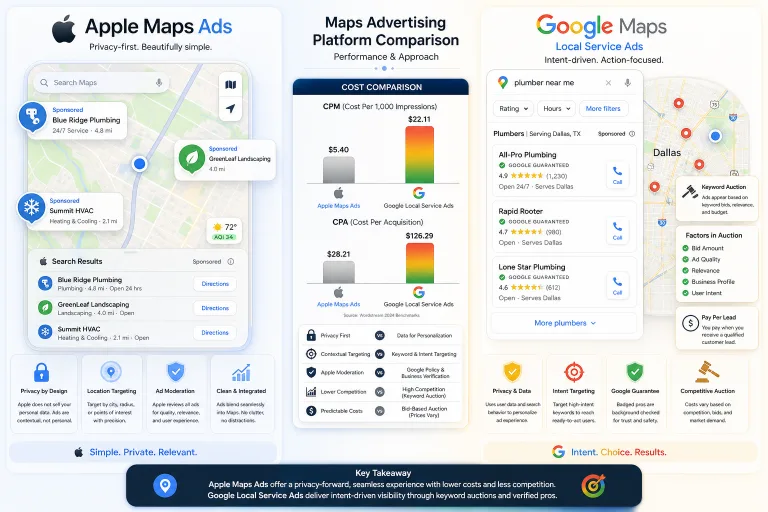
Apple and Google approach local advertising from different angles. Google builds its system on top of Search and Maps, where ads compete in keyword-based auctions. Apple Maps, on the other hand, operates with location context and user intent within a navigation scenario.
Here are the main differences affecting buying strategy:
- Auction model. Google uses a CPC auction based on keywords. Apple Maps operates closer to a CPM/CPA model, prioritizing category and location relevance.
- Targeting. Google relies on search queries and location history. Apple Maps uses On-Device data, Siri queries, and route context.
- Formats. Google displays text ads, Local Service Ads with badges and reviews. Apple Maps integrates ad pins directly into the map, offering a more native look.
- Moderation. Apple has historically been stricter than Google regarding content and privacy. This creates additional risks for arbitrage funnels.
- Data and attribution. Google provides detailed attribution through Google Ads and GA4. Apple Maps currently operates in a more closed ecosystem with limited analytics.
How Targeting Works in Apple Maps Ads
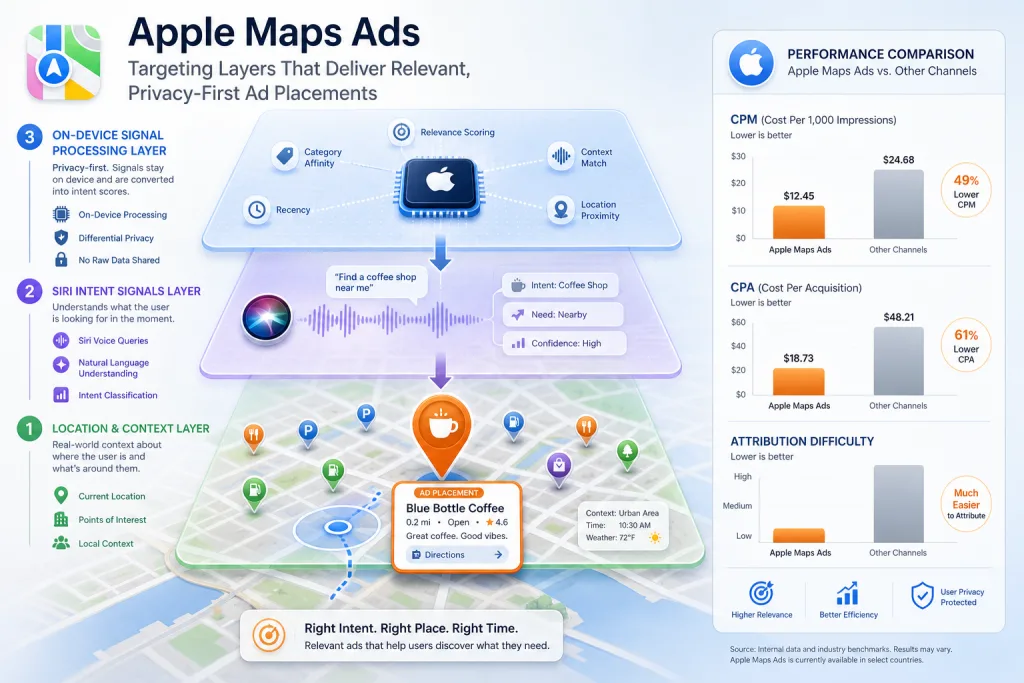
Apple Maps uses three main data layers for targeting:
-
Geo-context. The user searches for a business or service in a specific location. Apple displays ad pins on the map based on category relevance and distance.
-
Siri queries. Voice requests like “find the nearest gas station” or “where to fix a phone” form an intent signal that Apple can use for ad delivery.
-
On-Device data. Apple focuses on processing data directly on the device, aligning with its privacy policy. This means advertisers don’t get raw user data — only aggregated results.
This is fundamentally important for media buyers: you cannot use third-party audience files or pixels the way you do in Google Ads. Targeting is built on top of Apple’s data, not your own segments.
Pricing and Campaign Economics
Apple Maps Ads hasn’t publicly disclosed rates yet, but initial agency data reveals several patterns:
- CPM is lower than in Google Local Ads for low-competition categories (local services, niche retail).
- CPA can be higher in categories with high conversion frequencies because attribution is harder — a user might find a business in Maps but visit offline without clicking.
- Minimum budgets in Apple Maps Ads are higher than Google Ads’ entry threshold, weeding out small arbitrage players with budgets under $500.
For traffic arbitrage, this means: Apple Maps Ads is suitable for funnels with high average order value and long conversion cycles (real estate, auto, legal services), but is poorly suited for impulse offers with quick conversions.
Moderation Policy: Where Apple is Stricter Than Google
Apple traditionally applies stricter rules to advertising content. In the context of Apple Maps Ads, this manifests in several key restrictions:
Offer Content
Apple prohibits advertising certain categories that Google allows with restrictions: for example, some financial offers, gambling services (even in legal GEOs), and aggressive nutra products. If you run nutra or fintech through Google Local Ads, your funnel might not pass moderation in Apple Maps.
Data Collection
Apple requires advertisers to explicitly explain what data they collect and why. This creates a problem for arbitrage landing pages that use hidden pixels or aggressive lead collection forms. Apple may reject a campaign if the landing page doesn’t comply with its privacy policy.
Geographic Accuracy
Apple Maps Ads requires the business address in the ad to match the actual location. This blocks a popular arbitrage practice — virtual addresses and fake locations to expand reach.
Practical Scenarios for Arbitrage Specialists
Let’s look at three typical scenarios where Apple Maps Ads can be useful or harmful for an arbitrage specialist.
Scenario 1: Local Lead Gen for Legal Services
Offer: legal services in the US (personal injury, bankruptcy). Google Local Ads gives a CPL of $35–60. Apple Maps Ads might deliver cheaper leads ($20–40) due to lower competition. However, offline conversion attribution is harder — you need call-tracking and CRM integration to prove lead quality to the advertiser.
Scenario 2: Nutra Offers with Local Targeting
Offer: weight loss supplements with a landing page and delivery. Google Local Ads allows such funnels with restrictions. Apple Maps Ads will likely ban the campaign due to its health-claims policy. The risk of account suspension is high.
Scenario 3: Local Retail and E-commerce
Offer: local electronics store with inventory. Google Local Inventory Ads shows products directly in Maps and Search. Apple Maps Ads currently lacks a Local Inventory equivalent — limiting its applicability for e-commerce arbitrage.
Risks and Limitations for Arbitrage Funnels
The main risks to consider before launching campaigns in Apple Maps Ads:
- No API for mass management. Unlike the Google Ads API, Apple doesn’t yet provide full programmatic access to campaigns. This blocks automation for arbitrage teams managing hundreds of accounts.
- Limited attribution. Without GA4 integration or third-party trackers, you won’t be able to link an Apple Maps click to a landing page conversion. For arbitrage, where margins are calculated in pennies, this is critical.
- Account ban risk. Apple bans policy violations faster and harder than Google. Account recovery is harder — there isn’t a developed appeals process like in Google Ads.
- Limited GEO coverage. Apple Maps Ads isn’t available in all countries. For arbitrage specialists working in Tier-2 and Tier-3 GEOs, the platform is currently useless.
How to Prepare for Launch: A Strategy for Media Buyers
If you decide to test Apple Maps Ads, here’s a step-by-step strategy:
-
Offer audit. Check if the offer passes Apple’s policy. If it already raises questions in Google Ads, it almost certainly won’t pass in Apple Maps.
-
Landing page preparation. Ensure the landing page complies with Apple’s privacy policy: no hidden forms, no aggressive data collection, transparent cookie policy.
-
Attribution setup. Use call-tracking and unique UTM tags for each ad in Apple Maps to at least partially track conversions.
-
Test budget. Start with $1,000–2,000 per category and one location. Don’t spread across multiple GEOs simultaneously — Apple Maps Ads requires quality optimization by location.
-
Comparison with Google. Launch a parallel campaign in Google Local Ads with the same offer and location. Compare CPL, lead quality, and ROAS after 2 weeks.
Checklist: Should You Shift Your Budget to Apple Maps Ads?
- The offer passes Apple’s policy (no nutra, restricted fintech, gambling)
- You have call-tracking and an offline conversion attribution system
- Minimum test budget — from $1,000 per category
- The landing page complies with Apple’s privacy policy
- The offer is tied to a real location (not a virtual address)
- You have a parallel campaign in Google Local Ads for comparison
The Future of Local Media Buying
Apple Maps Ads isn’t a “Google Local Ads killer” but an additional channel that makes sense in certain niches. For arbitrage specialists working with local lead gen in Tier-1 GEOs, it’s an opportunity to diversify traffic sources and reduce dependence on Google.
However, in the next 12–18 months, Apple Maps Ads won’t replace Google in volume, automation, and attribution quality. The strategy of “moving the entire budget” is flawed. The right approach is to allocate 10–15% of the local budget for testing and scale only with positive ROAS.
The key factor that will determine the platform’s future is an open API and integration with trackers. Until Apple provides programmatic access and improves attribution, a mass migration of arbitrage teams won’t happen.
FAQ
Can you run arbitrage traffic through Apple Maps Ads?
Technically yes, but with significant restrictions. Apple is stricter than Google on content and privacy policies. Nutra, fintech, and gambling offers are highly likely to fail moderation. Local lead-gen offers (legal services, repair, real estate) work best.
How much cheaper is Apple Maps traffic compared to Google Local Ads?
In low-competition categories, CPM can be 20–40% lower. However, CPA isn’t always lower due to complex offline conversion attribution. The real economics can only be assessed after 2 weeks of parallel testing.
Is there an API for automating campaigns in Apple Maps Ads?
Currently, there is no full API for mass campaign management. This blocks automation for arbitrage teams managing dozens or hundreds of accounts.
In which GEOs is Apple Maps advertising available?
The platform is gradually expanding but currently focuses on Tier-1 countries (US, UK, Canada, Australia). For arbitrage specialists working in Tier-2 and Tier-3, the channel is currently of limited use.
What to do if your Apple Maps Ads account gets banned?
The appeals process at Apple is less developed than at Google Ads. The chances of recovery are lower. It’s recommended to strictly follow the policy from day one and avoid risky gray-area offers — the cost of a mistake is higher than in Google.