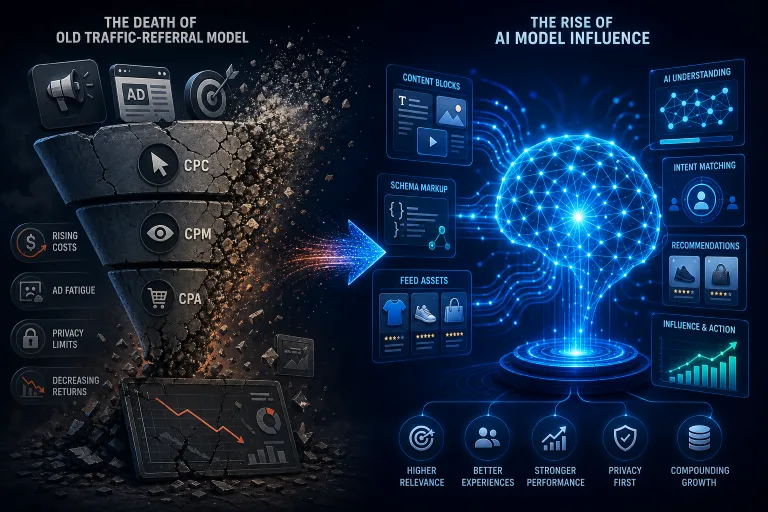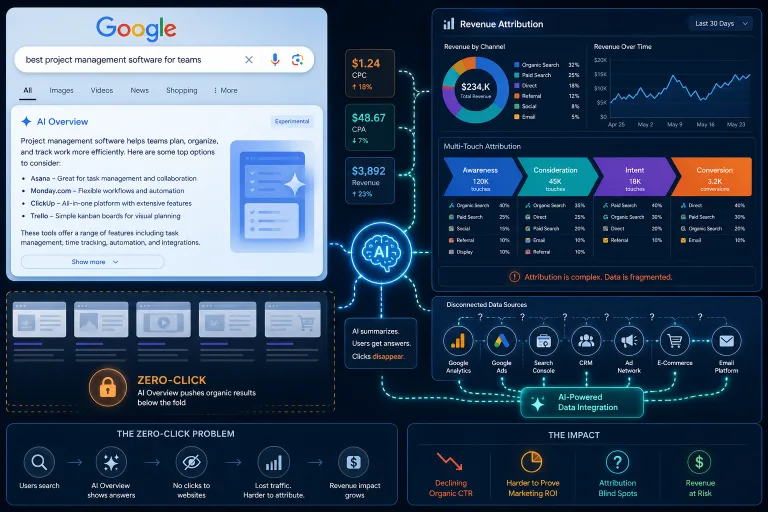
By mid-2026, zero-click searches in Google surpassed 65%. This means most queries end right on the search results page—users get their answers through AI Overviews, featured snippets, or knowledge panels and never click through to a website. For arbitrage buyers and media buyers, this is a fundamental shift: the classic “query → ad click → landing page → conversion” funnel is becoming less effective, and tying a specific traffic source to actual revenue is increasingly difficult. When commissions are flowing, nobody asks questions. But when most Google searches end without a click, understanding which source brings in the money becomes a matter of survival.
The solution isn’t to “get into AI Overviews”—that’s a separate SEO task. The solution is to rebuild your attribution model: use AI to connect fragmented data, move from last-click to multi-touch attribution, and learn to measure revenue, not just clicks. Below is a practical breakdown of how zero-click changes every layer of the arbitrage funnel and what to do right now.
What is Zero-Click and Why is This Share Growing?
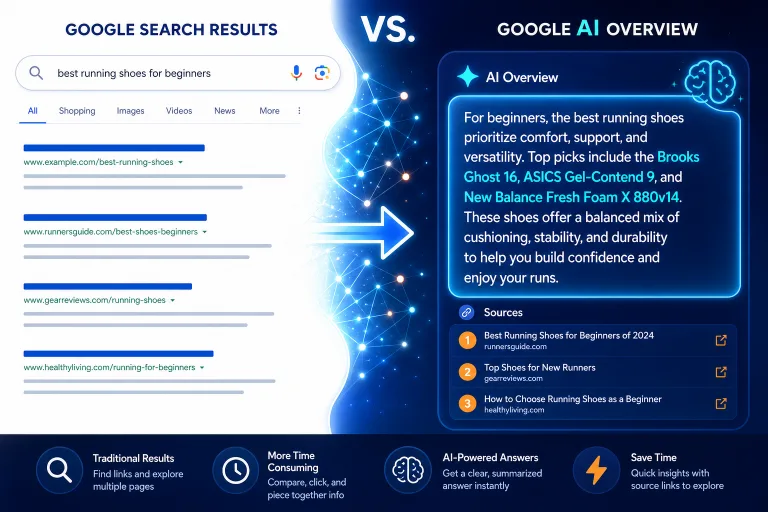
A zero-click search is a search query after which the user doesn’t visit any external website. They get the answer directly on the SERP (Google’s search engine results page). Reasons for the growth:
- AI Overviews — Google generates a comprehensive answer right in the results, compiling data from multiple sources. The user doesn’t click because the answer is already in front of them.
- Featured snippets — short answer blocks that Google pulls from sites but displays without requiring a click.
- Knowledge panels — knowledge graphs for brands, people, places — fulfilling informational queries without a click.
- Local packs — for “near me” queries, Google shows a map and reviews, replacing the need to visit a site.
According to SimilarWeb, the zero-click share was about 58% in 2024, 62% in 2025, and by mid-2026, it exceeded 65%. For informational queries, this figure reaches 80%+. For commercial queries, it’s lower, but also growing.
For an arbitrage buyer, this means: even if you buy clicks through Google Search Ads, part of your potential traffic is “eaten” by AI Overviews before the user even sees your ad. And if they do click, you’re paying for a click that previously would have been organic.
How Zero-Click Breaks the Classic Attribution Model
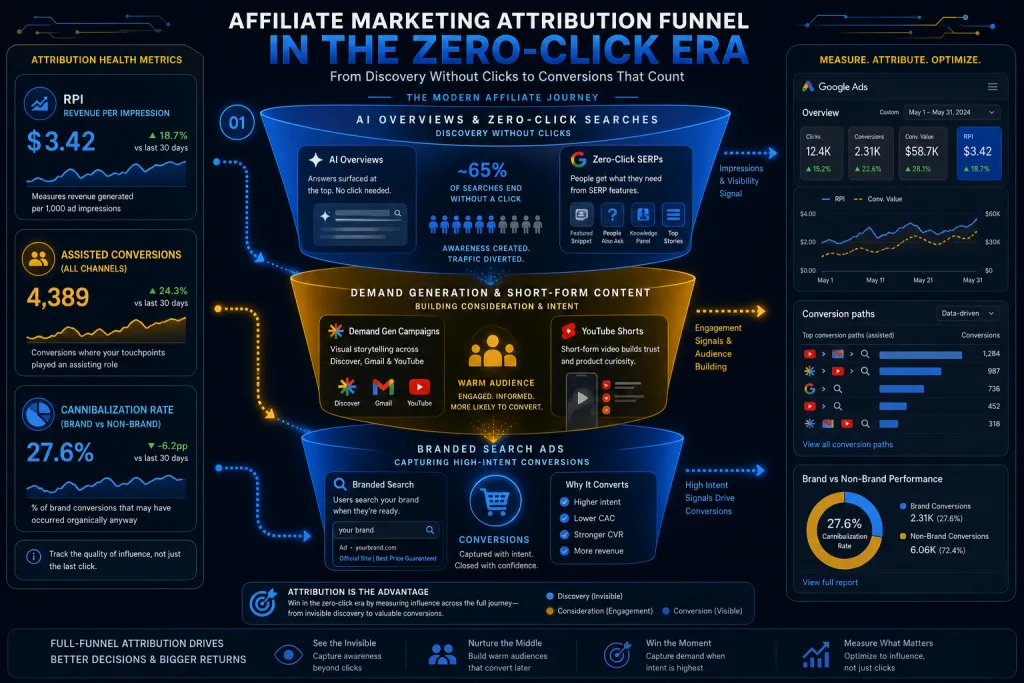
Most arbitrage teams still use last-click attribution: the last source before conversion gets 100% of the credit. In the zero-click era, this creates three problems.
Problem 1: Invisible touchpoints. A user searches for “best VPN for streaming,” sees an AI Overview mentioning your brand, and doesn’t click. A week later, they search “your brand reviews,” click on organic results, and read. Two weeks later, they search “buy your brand,” click on your Google Ads, and purchase. Last-click gives 100% credit to the branded search campaign. But the real journey started with an AI Overview you didn’t pay for or measure.
Problem 2: Disconnected data. A commerce publisher knows an article ranks in Google, but doesn’t know if it generates enough commissions to justify advertising for its promotion. Another article might get almost no search traffic but bring in anomalously high commissions from newsletter visitors. A third might convert in October but not in April. When commissions are flowing, these details don’t matter. But when most Google searches end without a click, knowing the source of commissions becomes critical.
Problem 3: Cannibalization of organic by paid traffic. If you buy Google Ads for keywords where you already have organic results (including AI Overviews), you’re paying for clicks you would have gotten for free. Without proper attribution, you don’t see this—it seems like Ads is working, when in reality, you’re cannibalizing your own organic traffic.
Data Disconnect: Why You’re Losing Money Without Knowing It
Disconnected data is the main enemy of the modern arbitrage buyer. Here’s what it looks like in practice.
Imagine an affiliate project with three traffic sources: Google Search Ads, email newsletters, and SEO articles. In Google Analytics, you see conversions for each channel. But you don’t see:
- Which specific SEO article brought in the user who purchased via email a month later;
- Which search query led to the AI Overview where the user first saw your brand;
- What percentage of conversions from the branded search campaign are new users versus returning users initially brought in by the organic channel.
Without this data, you’re making decisions blind. You increase the budget for branded search, although it just brings back users you already acquired for free. You cut the budget for informational campaigns, although they are what generate initial demand. You buy traffic for keywords that are fully covered by AI Overviews.
How AI Helps Connect Traffic Source and Revenue
Some publishers and affiliate teams are starting to use AI to solve the disconnected data problem. This isn’t about ChatGPT writing texts, but about ML models analyzing conversion patterns.
Approach 1: ML-based multi-touch attribution. Instead of last-click, the model analyzes all user touchpoints before conversion and distributes credit among them. Google Attribution 360 and third-party tools (Adjust, AppsFlyer, Triple Whale) offer such models, but most arbitrage buyers don’t use them—too complex, too expensive, too “not for us.”
Approach 2: Predictive revenue modeling. An AI model is trained on historical data: which sources, keywords, and landing pages historically bring in the most revenue (not clicks, but commissions). It then predicts the revenue of new campaigns before launch. This allows you to cut unprofitable combinations before you spend your budget.
Approach 3: Content revenue attribution. For affiliate publishers: AI links specific articles, reviews, and landing pages to actual commissions, not clicks. You see that an article about “VPN for Netflix” brought in $3,400 in commissions over a quarter, even though it gets almost no search traffic—because it converts through email and direct. Meanwhile, an article about “VPN for gaming” gets 50,000 search clicks but brings in only $200 in commissions. Without AI attribution, you would conclude the first article is trash and the second is a star. With AI attribution, it’s exactly the opposite.
Adaptation Strategies: What to Change in Google Ads Right Now
1. Shift from Informational to Commercial Keywords
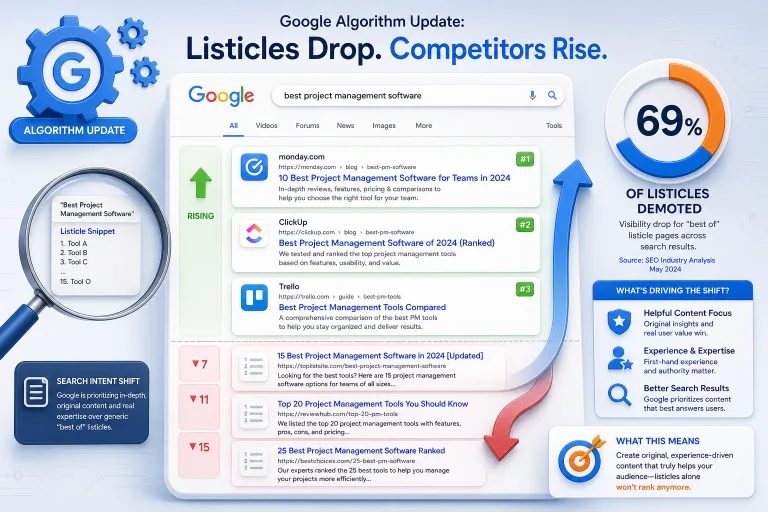
Informational queries (“what is a VPN,” “how does a VPN work”) are increasingly covered by AI Overviews. CTR for Search Ads on such queries is dropping. Reallocate your budget to commercial keywords with a clear intent component: “buy VPN,” “VPN subscription price,” “VPN for streaming buy.” These queries are less frequently covered by AI answers because Google can’t “answer” a purchase query.
2. Performance Max Instead of Pure Search
PMax uses all of Google’s inventory—Search, Display, YouTube, Discover, Gmail—and optimizes for conversions, not clicks. In the zero-click era, this gives two advantages: first, you’re not tied to a single channel where AI Overviews eat clicks; second, Google’s AI itself finds the audience that converts, bypassing the classic search funnel.
But there’s a risk: PMax is opaque. You don’t see which placements it shows your ads on. The solution is to use asset group reporting and exclusion lists to cut out junk placements.
3. Demand Gen for Warming Up, Search for Conversion
Split the funnel: Demand Gen campaigns (YouTube Shorts, Discover, Gmail) warm up the audience and build brand awareness. Search Ads catch those who are already warmed up and searching for your brand or product. This compensates for zero-click on informational queries: instead of waiting for the user to click on a Search Ad after an informational query, you create demand yourself through video and feed.
4. Branded Search as Insurance, Not as Growth
Branded search campaigns (advertising on your own brand) in the zero-click era are insurance, not growth. If a user searches for your brand, they will likely find you organically. Branded Ads are needed so competitors don’t intercept this traffic through competitive campaigns. But don’t count branded search conversions as an “achievement” of the Ads campaign—this is returned traffic you would have gotten for free.
New Metrics for the Zero-Click Era
Old metrics—CTR, CPC, CPA—are insufficient. Add:
- Revenue per impression (RPI) — how much revenue 1,000 impressions bring, not clicks. Important for PMax and Demand Gen, where impressions don’t always lead to clicks but do generate demand.
- Assisted conversion rate — the percentage of conversions in which a channel participated but wasn’t the last touchpoint. Shows the real value of top-of-funnel campaigns.
- Zero-click exposure rate — the share of your keywords for which Google shows an AI Overview that eats clicks. Monitor this through SERP-tracking tools (Semrush, Ahrefs, SE Ranking).
- Organic-to-paid cannibalization rate — the percentage of paid clicks you would have gotten organically. If the rate is > 40%, you’re overspending your budget.
- Content revenue attribution score — for affiliate publishers: the ratio of commissions to clicks for a specific article. Helps find “hidden stars”—articles with low traffic but high revenue.
Practical Examples: What Works in 2026
Case 1: VPN affiliate, transition from Search to PMax. An arbitrage team was buying Google Search Ads for 12,000 keywords. After the rise of AI Overviews, CTR dropped by 34%, and CPA increased by 28%. They shifted 60% of the budget to PMax with feed-based assets, 25% to Demand Gen via YouTube Shorts, and 15% to branded search. Result for the quarter: CPA decreased by 19%, conversions increased by 22%. The key factor—PMax found the audience through YouTube and Discover, bypassing zero-click search.
Case 2: Affiliate publisher, AI content attribution. A blog with 400+ reviews used last-click attribution and believed that 80% of revenue came from SEO articles. After implementing content revenue attribution (via Triple Whale + custom ML model), it turned out that 45% of revenue came from email newsletters linking to articles with low search traffic but high conversion rates. They reallocated the budget to promote the newsletter—revenue grew by 31% over two quarters.
Case 3: E-commerce affiliate, fighting cannibalization. A team was buying branded search Ads, considering them highly effective (CPA lower than non-branded). After analyzing the organic-to-paid cannibalization rate, it turned out that 52% of paid branded clicks were users who would have clicked on the organic result anyway. They cut the branded budget by 40%, reallocating to Demand Gen. Overall conversions didn’t drop, and ROI increased by 27%.
Risks and Compliance: What Can Go Wrong
- Over-reliance on PMax. Placement opacity can lead to ads showing on junk sites. Regularly check placement reports and exclude sites with anomalously high impressions and zero conversions.
- Brand safety violation. Demand Gen and PMax can show your ads next to content that doesn’t fit your brand. Use brand suitability controls and sensitive content exclusions.
- Transparency for advertisers. If you’re an arbitrage buyer working through affiliate networks, ensure your attribution model doesn’t conflict with the network’s attribution. If the network uses last-click and you use multi-touch, you’ll argue over who brought the conversion.
- GDPR and data privacy. AI attribution requires collecting data on the user journey. Ensure your consent management platform (CMP) correctly collects consent and that you’re not violating GDPR/CCPA.
Checklist: Adapting an Arbitrage Team to the Zero-Click Era
- Keyword audit: determine the share of queries for which Google shows AI Overviews, and reallocate budget from informational to commercial keywords
- Implement multi-touch attribution: at minimum, data-driven attribution in Google Ads instead of last-click; for advanced users, third-party ML models
- Launch a PMax campaign with feed-based assets and set up asset group reporting to control placements
- Create a Demand Gen funnel via YouTube Shorts to warm up an audience that later converts through Search
- Calculate the organic-to-paid cannibalization rate for branded search campaigns and cut the budget if the rate exceeds 40%
- Implement content revenue attribution for affiliate articles: link commissions to specific URLs, not just channels
- Set up monitoring of the zero-click exposure rate through SERP-tracking tools and revise the strategy monthly
What’s Next
Zero-click is not a temporary trend, but a structural shift. Google will expand AI Overviews to new types of queries, including commercial ones. This means that even “safe” keywords like “buy VPN” right now might be partially covered by AI answers with inline purchases in a year.
For arbitrage buyers, this means a gradual shift from pure search arbitrage to diversified media buying: video, feed, email, push, native. Google Ads remains a crucial channel, but its role is changing—from the primary traffic source to one of the tools in a multi-layered funnel. Those who rebuild their attribution model and learn to measure revenue, not clicks, will maintain ROI. Those who continue to optimize for last-click and CTR will lose budget to zero-click searches that never lead to a site.
FAQ
What is a zero-click search and why is it important for an arbitrage buyer?
A zero-click search is a search query after which the user doesn’t visit an external website because Google gives the answer right on the results page through AI Overviews, featured snippets, or knowledge graphs. For an arbitrage buyer, this means a decrease in CTR for Search Ads, an increase in CPA, and a disconnect between search results and actual site visits.
How do AI Overviews affect Google Ads campaigns?
AI Overviews reduce CTR for informational queries because the user gets the answer without clicking. Commercial queries are less affected so far, but Google is expanding AI answers to them as well. The practical implication is the need to reallocate budget from informational keywords to commercial ones and diversify channels through PMax and Demand Gen.
What is content revenue attribution and why do affiliate publishers need it?
Content revenue attribution is a method of linking specific articles and URLs to actual commissions, not just clicks or traffic. It’s needed because in the zero-click era, an article with low search traffic can bring high revenue through email or direct, while an article with high traffic might bring almost nothing. Without this attribution, you’re investing in the wrong content.
Should you completely abandon Google Search Ads because of zero-click?
No. Search Ads remain effective for commercial and branded queries where intent is high. But you need to diversify: add PMax to use all of Google’s inventory, Demand Gen for warming up through video, and reallocate budget from informational keywords that are covered by AI Overviews.
How do you calculate the organic-to-paid cannibalization rate?
Compare the share of paid clicks for branded queries with the share of organic clicks for the same queries during a period when Ads are turned off (or use the Google Ads Brand Lift Study). If more than 40% of paid clicks are users who would have clicked on organic anyway, you’re overspending your budget and should cut the branded campaign.