What Happened: 80% of Clicks Are Not Human
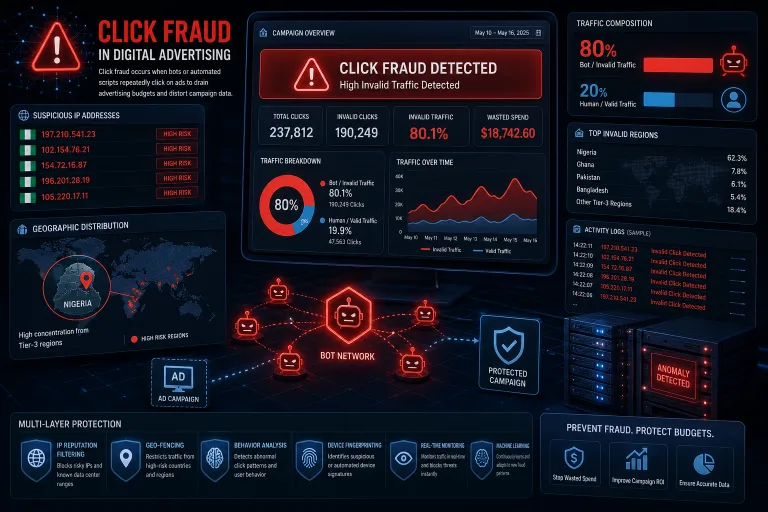
In August 2026, analysts tracking Nigeria’s advertising market recorded a figure that should make every media buyer recalculate their campaign economics: 80% of clicks on one advertiser’s ads came from bots, not real people. At the same time, the yield on Nigerian Treasury Bills (NTBs) exceeded 17%, making the macroeconomic context even more alarming — inflation and naira devaluation are pushing more people toward fraud operations, as honest earnings in the Nigerian economy become increasingly unpredictable.
For arbitrage specialists who buy cheap traffic in tier-3 countries and monetize it through AdSense or native ad networks, this means one thing: a portion of the traffic you consider “cheap and working” may be bots. You’re paying for clicks that will never convert, while simultaneously risking an AdSense account ban for invalid traffic.
Why AdSense Arbitrage Is Especially Vulnerable to Click Fraud
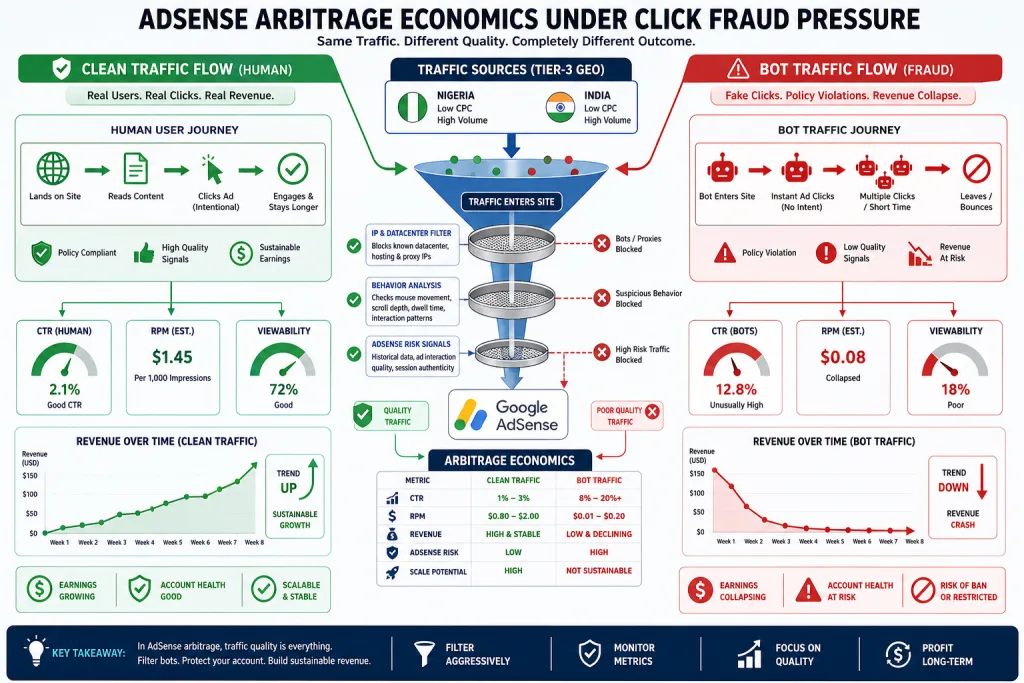
AdSense arbitrage follows a simple formula: buy traffic cheaper than what you earn from Google ad impressions and clicks. The lower the source CPM, the higher the spread. That’s exactly why tier-3 GEOs — Nigeria, India, Bangladesh, Pakistan, the Philippines — look attractive: a click costs pennies, and AdSense still pays some dollar amount per RPM.
The problem is that these same GEOs have the highest concentration of bot networks and click farms. The economics of click fraud work just like the economics of arbitrage: the cheaper the click, the more profitable it is to fake. A click farm in Lagos or Dhaka can generate thousands of clicks per day at a cost that makes fraud ROI obvious.
Three factors make AdSense arbitrage vulnerable:
- Google’s data opacity. You see clicks and revenue in AdSense, but you don’t see what percentage Google flagged as invalid and deducted. Often, you only learn about the problem after your account is banned.
- The double blow. Bots click your ads (you “earn” revenue), but Google detects the fraud and refunds advertisers. You lose both the income and your account standing.
- Low barrier to entry. All you need to start AdSense arbitrage is a domain, content, and an account. That same simplicity makes it an easy target for competitors who can send bot traffic to your site to trigger a ban.
How Bots Bypass Google’s Basic Protection
Google uses automated filters to detect invalid traffic, but they’re not foolproof. Here are the main methods used by click farm operators and bot networks in tier-3 GEOs:
1. Residential Proxy Networks
Bots operate through residential proxies — real IP addresses of devices belonging to ordinary users who have been infected with malware or installed “earn-money” apps. To Google, such a click looks like it’s coming from a legitimate user in Lagos with the correct User-Agent, language, and session timing.
2. Headless Browsers with Behavioral Emulation
Modern click bots don’t just load a page and click. They emulate mouse movements, scrolling, time on page, and even “random” clicks on internal links. This bypasses primitive behavioral filters.
3. Click Farms with Real Devices
In tier-3 GEOs, physical click farms are common: dozens of cheap smartphones on racks, operated manually or via ADB scripts. Each click comes from a unique device, a real mobile IP, and a genuine browser. Distinguishing this from organic traffic is nearly impossible.
4. Competitive Fraud
Your competitor can send bot traffic to your AdSense site to provoke a ban. This is especially dangerous in high-CPC niches — insurance, finance, legal services — where a single banned account means thousands of dollars in lost revenue.
Signs of a Bot Attack on Your AdSense Account
Google doesn’t disclose its exact invalid traffic detection algorithms, but there are external signals you can monitor yourself:
- Abnormal CTR spike. If your site’s average CTR was 2% and suddenly jumped to 8–10%, that’s a red flag. Bots click more often than humans.
- Geographic anomaly. 90% of clicks from a single city or ISP when your content targets a different audience.
- Zero page depth. A bot lands on a page, clicks an ad, and leaves. Average time on page drops to a few seconds.
–High bounce rate with high CTR. Organic users rarely click an ad and immediately leave. If this is happening at scale, fraud is likely. - Declining revenue despite rising clicks. Google deducts invalid clicks, so you may see click counts go up while actual revenue goes down.
- AdSense warnings. If you see notifications about “suspicious activity” or “policy violations” — respond immediately.
Tier-3 GEOs and the Economics of Click Fraud
To understand why tier-3 GEOs become the epicenter of click fraud, you need to look at the economics from both sides.
From the arbitrage specialist’s side: you buy traffic in Nigeria at $0.02–0.05 per click. AdSense pays $1–3 RPM. The spread looks positive. But if 40–80% of your clicks are bots, real RPM drops 2–5x, and the risk of account suspension grows exponentially.
From the fraud operator’s side: a click farm in Nigeria generates clicks at a cost of $0.001–0.003. If they click on high-value ads (finance, insurance — $5–15 per click), the fraud margin is enormous. Meanwhile, the risk of punishment is minimal — law enforcement doesn’t pursue click farms.
From Google’s side: the company is motivated to refund advertisers for invalid traffic because it protects trust in the platform. But automated filters work with a delay — sometimes weeks. During that time, the arbitrage specialist has already spent their budget, and the ban arrives after the fact.
Technical Defense Methods: From Filtering to Third-Party Tools
Monitoring Through Google Analytics 4
Connect GA4 and set up a dedicated segment for traffic with anomalous behavior: time on page < 5 seconds, 1 page per session, AdSense CTR above average. If this segment exceeds 20% of your traffic — you have a problem.
Third-Party Anti-Fraud Services
Services like ClickCease, CHEQ Essentials, and Spider AF specialize in detecting click fraud for Google Ads and AdSense. They analyze each visit across 100+ parameters: browser fingerprint, proxy type, behavioral patterns, IP reputation. Pricing starts at $30–50/month for small sites, which pays for itself with a single prevented ban.
IP and Geo Blocking
If you see that the bulk of bot clicks come from specific IP ranges or cities where you have no target audience, block them at the server level (nginx, Cloudflare rules). This won’t stop residential proxies, but it will filter out primitive bot networks.
Limiting AdSense Impressions by Geo
AdSense doesn’t have a direct geo-targeting setting for impressions, but you can control which traffic reaches your site. If you buy traffic through Google Ads or native networks, use exclusion lists for cities and ISPs with high fraud rates.
Server-Side Log Analysis
If you have access to server logs, analyze patterns: repeating User-Agents, identical screen resolutions, zero scroll events. This is the most reliable way to detect headless browsers that fool client-side analytics.
What to Do If Google Bans Your Account
An AdSense account ban for invalid traffic isn’t a death sentence, but the appeal process is complex. Here’s the sequence of steps:
- Don’t create a new account. Google will link it to the banned one via domain, payment details, and fingerprint. A second ban will be permanent.
- Gather evidence. Screenshots from GA4, server logs, third-party anti-fraud service reports, data on purchased traffic broken down by source.
- Describe the source of invalid traffic. If you know which source or campaign led to the fraud, state it. Google wants to see that you understand the problem and have taken action.
- Submit an appeal through the form. A response may take 2–4 weeks. During that time, the site earns nothing.
- Reassess your traffic sources. After reinstatement (if it happens), completely cut off high-fraud-risk sources and shift to more expensive but cleaner channels.
Strategy: How to Rebuild Traffic Buying in High-Risk GEOs
If you work with tier-3 GEOs, abandoning them entirely isn’t the only option. Often, these are the very GEOs that deliver the best spread. But you need to restructure your strategy:
Reduce dependence on a single source. Don’t pour 100% of traffic from one native network or one Facebook account. Diversification reduces the risk that one compromised source kills your entire project.
Pay for conversions, not clicks. If possible, switch to a CPA buying model. Bots don’t fill out forms or make purchases. If you pay for conversions, fraud is automatically filtered out at the economic model level.
Add an intermediate filter. Place a landing page or intermediate page with JavaScript verification between the traffic source and your AdSense page. Bots that don’t execute JS or fail behavioral checks never reach AdSense.
Monitor daily. Don’t wait until the end of the month. Check CTR, traffic sources, and behavioral metrics every day. Anomalies are easier to catch early, before Google flags them as systemic fraud.
Checklist: Protecting AdSense Arbitrage from Click Fraud
- Connect GA4 and set up a segment for anomalous traffic (CTR > average × 2, time on page < 5 sec)
- Install a third-party anti-fraud service (ClickCease, CHEQ, or equivalent) and track bot-click share daily
- Check the geographic distribution of clicks: if >60% come from one city — block the IP range in Cloudflare
- Shift at least 30% of your buying to a CPA model where bots are filtered out automatically
- Maintain server logs and analyze headless browser patterns once a week
- At the first sign of “suspicious activity” in AdSense — pause buying and gather evidence for an appeal
FAQ
Can Google ban my AdSense account for bot traffic I didn’t purchase?
Yes. Google doesn’t distinguish between who sent the bots — you, a competitor, or an infected botnet. The account gets banned for invalid traffic regardless of source. That’s why it’s critical to monitor anomalies and document evidence that you took preventive measures.
What percentage of bot clicks is considered normal for tier-3 GEOs?
There’s no standard — it depends on the niche and source. But if suspicious clicks exceed 15–20% of total volume, you’re already in the risk zone. In Nigeria, recent data shows the figure can reach 80%, making uncontrolled buying in this GEO extremely risky.
Is it worth working with Nigerian traffic for AdSense arbitrage at all?
You can, but only with strict filtering and monitoring. Use vetted sources, anti-fraud services, and a CPA buying model. Don’t buy blindly from cheap native networks without traffic quality control.
Does Cloudflare help against click fraud?
Partially. Cloudflare blocks known botnet IPs and primitive bots via Bot Fight Mode. But residential proxies and click farms on real devices will bypass this protection. Cloudflare is a necessary baseline layer, but not the only one.
What should I do if a competitor is deliberately sending bots to my AdSense site?
Collect logs with IP addresses, behavioral patterns, and timestamps. File a complaint with Google through the AdSense Policy Report form. Simultaneously, block suspicious IPs at the server level. If the problem is systemic — consider moving your content to a new domain with a new AdSense account.
Conclusion
80% bot clicks in a single GEO is not a statistical anomaly — it’s a structural problem in tier-3 markets. For arbitrage specialists, this means that cheap traffic is no longer cheap once you factor in the risk of account bans and invalid traffic deductions. Click fraud protection isn’t an optional add-on; it’s a fundamental operational procedure that must be built into every stage, from traffic source selection to daily metric monitoring. Those who ignore this signal will lose accounts and budgets. Those who restructure their strategy will find a competitive advantage where others are burning money on bots.