What Happened: 80% of Ad Clicks Came from Bots
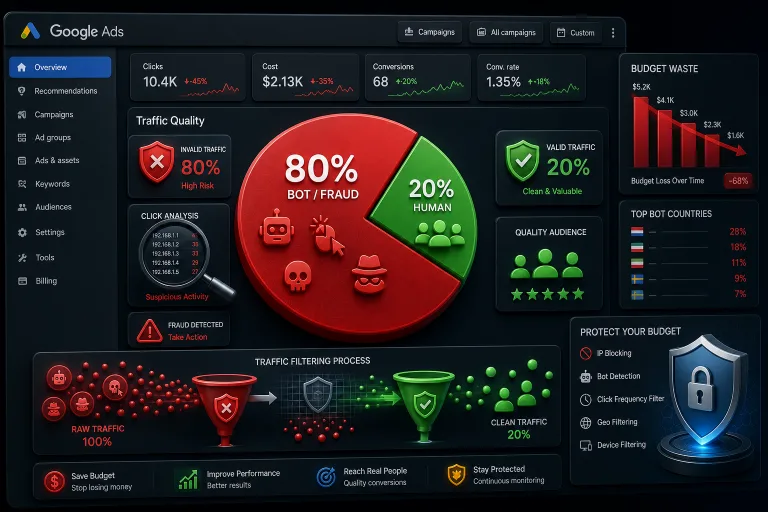
In August 2026, a report on Nigeria’s economic forecast surfaced a troubling detail: one advertiser recorded a sharp spike in ad clicks, but upon validation it turned out that 80% of clicks came from bots, not humans. This isn’t a theoretical scenario from a whitepaper — it’s real statistics that media buyers face when purchasing traffic in Tier-3 GEOs.
For an arbitrageur, an 80% figure means the following: if you spend $1,000 a day on Google Ads and 80% of clicks are generated by bots, you’re effectively paying $800 for zero conversions. With a target ROI of 30%, this doesn’t just reduce profit — it turns a profitable campaign into a loss-making one. And the worst part: you might not notice this for weeks, because Google Ads doesn’t flag invalid clicks in real time within the campaign interface.
How Click Fraud Differs from General Invalid Traffic
Invalid traffic (IVT) is an umbrella term covering any traffic that doesn’t come from a real human with real intent. Click fraud is a deliberate subset of IVT, where bots or click farms specifically target ads to drain a competitor’s budget or earn money through cost-per-click schemes.
In the context of traffic arbitrage, it’s important to distinguish between three types:
- General IVT — crawlers, prefetch requests, double clicks. Google filters these automatically and typically issues refunds.
- Competitive click fraud — targeted clicks on your ads to exhaust your budget. Common in highly competitive verticals: finance, insurance, education.
- Click farm traffic — click farms in Tier-3 countries where operators mass-click ads for pennies. This type dominates statistics like the 80% bot-click figure from Nigeria.
Why Google Ads Doesn’t Catch Everything Automatically
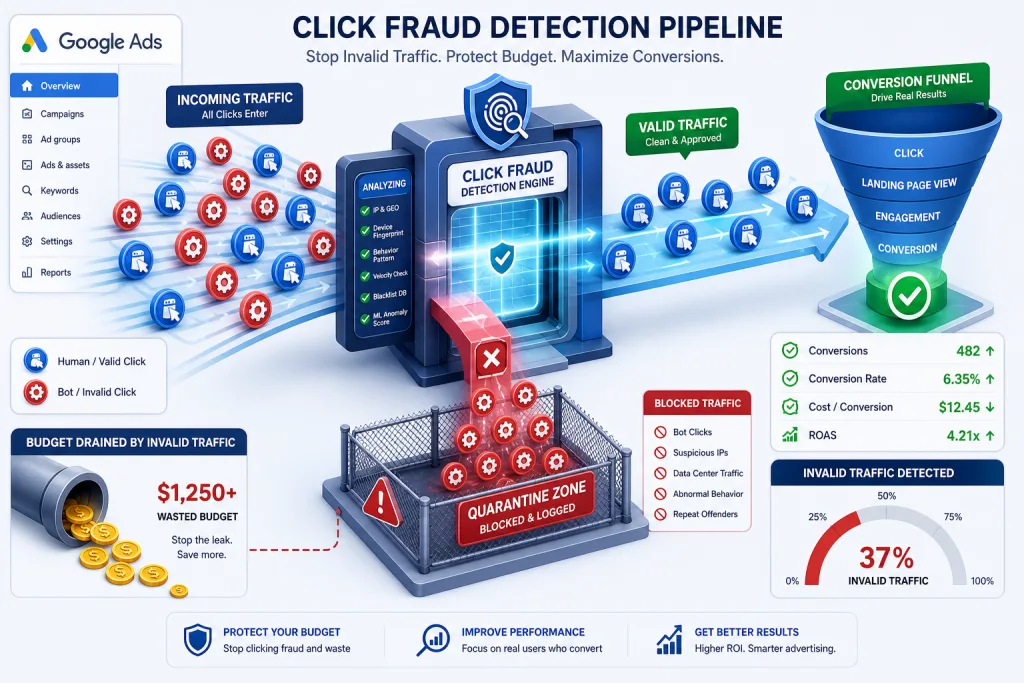
Google uses its own invalid click filtering system that analyzes behavioral patterns, IP addresses, click frequency, and dozens of other signals. The system automatically filters a significant portion of IVT and refunds credits through the invalid activity refund mechanism. However, the problem is that this system operates after the fact, not in real time.
Between the moment of a click and the moment Google identifies it as invalid, anywhere from several hours to several days pass. During that time, the arbitrageur has already spent budget, accumulated data in reports, and possibly made decisions based on skewed metrics. Moreover, click farm operators constantly refine their techniques — using residential proxies, emulating human behavior, and distributing clicks over time.
How Click Fraud Breaks Arbitrage Campaign Economics
Let’s look at a specific scenario. An arbitrageur launches a Google Ads campaign in a Tier-3 GEO (Nigeria, India, Bangladesh) with the following parameters:
- CPC: $0.08
- Conversion rate on valid traffic: 3%
- Payout per conversion: $4.50
- Daily budget: $500
Under ideal conditions, daily revenue: (500 / 0.08) × 0.03 × $4.50 = $843.75. ROI — 68%. The campaign is profitable.
Now let’s add 80% bot clicks. Out of 6,250 clicks, only 1,250 are from humans. Conversions: 1,250 × 0.03 = 37. Revenue: 37 × $4.50 = $166.50. Loss: $333.50 per day.
But the problem goes deeper. The arbitrageur sees 6,250 clicks and 37 conversions in the interface — a conversion rate of 0.59%. They start optimizing: pausing keywords, changing creatives, lowering bids. In reality, the problem isn’t with keywords or creatives — the problem is that 80% of the traffic could never have converted in the first place.
Signs of Click Fraud in Google Ads: What to Watch For
You can identify click fraud without third-party tools by looking for several patterns in Google Ads reports:
Abnormal CTR on Specific Placements
If a single site or app in the Display network shows a CTR of 15–20% when the campaign average is 1.5%, that’s a red flag. Bots often click on the same placement because it’s programmed for a specific pattern.
Click-to-Session Mismatch
Compare clicks in Google Ads with sessions in Google Analytics (or GA4). If clicks significantly exceed sessions, some clicks are likely generated by bots that don’t execute JavaScript tracking. A gap of more than 15–20% warrants investigation.
Click Spikes During Off-Hours
Click farm operators often work at night in their local time. If you see a surge in clicks between 2:00 AM and 5:00 AM in the target GEO’s timezone during otherwise low activity — that’s a characteristic pattern.
Zero Time on Site with High CTR
Bots click but don’t engage with content. In GA4, this shows up as sessions with 0-second duration and 0 events, even though the source is a Google Ads click.
Validation Tools: What’s Available Inside Google Ads
Google provides several built-in mechanisms to help detect and prevent click fraud, though none of them is a complete solution.
Placement Exclusions
In Display and PMax campaigns, you can exclude websites and apps that generate suspicious traffic. Once a week, review the placement report and exclude those with a CTR 5+ times higher than the average. This doesn’t solve click fraud in search ads, but it significantly reduces risks in Display.
IP Exclusions
In campaign settings, you can exclude up to 500 IP addresses. If you’ve identified specific IPs generating multiple clicks, add them to the exclusion list. The 500-address limit makes this method ineffective against distributed click farms, but useful against targeted attacks.
Frequency Capping
Limiting the number of impressions per user per day reduces the likelihood of a bot seeing your ad multiple times. This works poorly for Search campaigns but is effective for Display and Video.
Requesting Refunds via the Invalid Activity Form
If you’ve detected large-scale click fraud and can provide data, use the invalid activity contact form in Google Ads. Google will investigate and may issue credits. The process takes 2–4 weeks, and refunds are not guaranteed.
Third-Party Anti-Fraud Solutions for Arbitrageurs
Google Ads’ built-in tools are insufficient for serious protection. Arbitrageurs working with budgets of $5,000+/month use third-party platforms:
- ClickCease — real-time click monitoring, automatic IP blocking, Google Ads API integration. Starting at $25/month for small accounts.
- PPC Protect — focused on Google Ads, automatic IP exclusion, detailed bot-pattern reports.
- CHEQ Essentials — broader coverage, including protection against brand bidding fraud and competitor clicking.
- Lunio (formerly AdProtect) — specializes in IVT filtering for programmatic and Google Ads.
For arbitrageurs on a tight budget, a starting strategy is to use a free trial of one of these services alongside manual pattern monitoring in GA4.
Tier-3 GEOs: Why the Click Fraud Risk Is Higher
The 80% bot-click statistic from Nigeria is no accident. In Tier-3 countries, several factors create ideal conditions for click fraud:
Low cost of click farms. In Nigeria, Bangladesh, the Philippines, and Indonesia, click farm operators can hire people for $2–5 a day to click on ads. This makes manual click fraud economically viable.
Residential proxy networks. Residential proxy networks are widely available in Tier-3 GEOs, allowing bots to masquerade as real users with local IP addresses. Google has a harder time distinguishing such traffic from valid traffic.
High share of mobile traffic. In these regions, mobile traffic dominates, and bot identification on mobile devices is more difficult due to cookie and fingerprinting limitations.
Weak regulation. The absence of legal consequences for click farm operators lowers the barrier to entry in this “business.”
Defense Strategies for Arbitrage Campaigns
1. Segregation by GEO and Device
Don’t mix Tier-3 and Tier-1 traffic in the same campaign. Separate campaigns allow you to isolate risks and validate metrics more precisely. If 80% of bot clicks come from one GEO, you’ll see it in a separate campaign rather than in mixed data.
2. Use Audience Targeting Instead of Broad Targeting
Bots are less likely to be targeted by audience lists (remarketing, similar audiences, in-market). Broad keyword targeting in the Display network is the most vulnerable format. Narrowing through audience signals reduces exposure to bots.
3. Switch to Conversion-Based Bidding
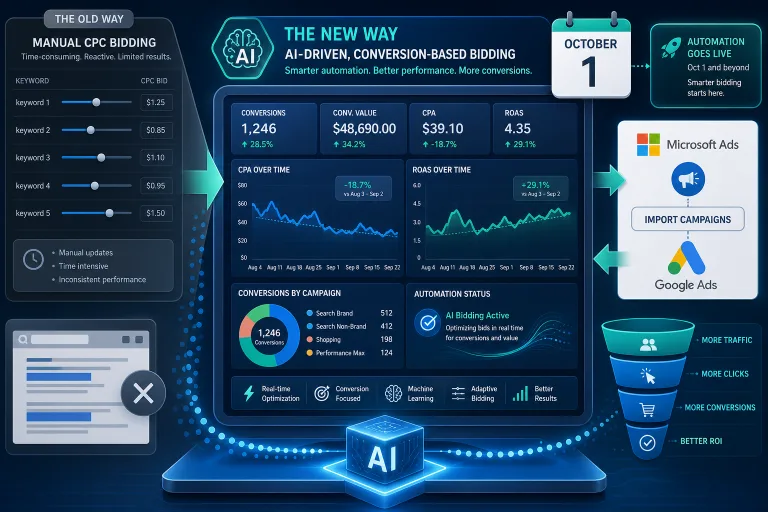
If you use CPC bidding, bots directly impact your strategy — you pay for every click. With tCPA or tROAS, Google optimizes for conversions, and bot clicks without conversions gradually reduce the likelihood of impressions in those auctions. This doesn’t eliminate click fraud entirely, but it reduces its impact on campaign economics.
4. Monitor Placement Reports Weekly
In PMax and Display campaigns, placement on specific sites and apps can be a source of bot traffic. Once a week, download the placement report, sort by CTR, and exclude anomalous placements. A normal CTR for Display is 0.5–2%. Anything above 5% is suspicious.
5. Server-Side Conversion Tracking
Bots click but don’t convert. If you use server-side tracking (Server-Side GTM, a partner’s conversion API), you get cleaner data on real conversions. This helps Google Ads algorithms faster understand which traffic is valid.
Checklist: Protecting Against Click Fraud in Google Ads
- Separate campaigns by GEO — don’t mix Tier-3 and Tier-1 in one campaign
- Review placement reports weekly and exclude sites with CTR above 5%
- Compare Google Ads clicks with GA4 sessions — a gap over 15% warrants investigation
- Use tCPA/tROAS instead of manual CPC bidding in high-risk GEOs
- Set up IP exclusions for repeatedly suspicious addresses
- Request a trial of an anti-fraud service (ClickCease, Lunio) at daily budgets of $200+
- Submit an invalid activity form when you detect mass click fraud
What to Do If You’ve Already Lost Budget
If you discover that a significant portion of your budget went to bot clicks, here’s the sequence of actions:
- Pause the campaign. Don’t disable the account — pause the specific campaign to stop the budget drain while preserving data.
- Gather evidence. Export click logs, screenshots of anomalous patterns, and click-vs-session comparisons from GA4. The more detailed the data, the higher the chance of a refund.
- Submit the invalid activity form. Describe the situation as specifically as possible: dates, amounts, GEO, patterns. Attach screenshots.
- Recalculate campaign economics. After receiving (or not receiving) a refund, recalculate ROI based on the actual percentage of valid traffic. If valid traffic is 20% and CPC is $0.08, the real cost per click for a valid audience is $0.40, not $0.08.
- Decide whether to continue. If the campaign remains profitable after recalculation — continue with enhanced protection. If not — switch to a different GEO or format.
The Future of Click Fraud: AI vs. AI
Click farm operators are already using AI to emulate human behavior: randomizing time between clicks, scrolling, cursor movement, even filling out forms. This makes traditional detection methods increasingly ineffective.
On the other side, Google is deploying machine learning to detect botnet patterns at the network level. The system doesn’t analyze individual clicks but rather the graph of interactions between IP addresses, devices, and behavioral patterns. This allows it to identify click farms even when individual clicks look human.
For arbitrageurs, this means that manual pattern monitoring in GA4 is a temporary measure. In the medium term, click fraud protection will require integration of third-party AI-powered anti-fraud solutions that analyze traffic at a deeper level than Google Ads’ built-in tools.
FAQ
Does Google automatically refund money for bot clicks?
Yes, but partially and after the fact. Google filters a significant portion of invalid clicks and issues refunds as account adjustments. However, this process takes days and doesn’t cover all cases. For large-scale click fraud, you need to submit the invalid activity form manually.
What percentage of bot traffic is considered normal in Google Ads?
For Tier-1 GEOs, a normal IVT level is 5–10%. For Tier-3 GEOs (Nigeria, India, Bangladesh), the norm can reach 20–30%. Anything above 30% requires active protective measures. 80%, as in the news case, is an extreme scenario requiring immediate campaign suspension.
Does click fraud happen in Search campaigns or only in Display?
Click fraud occurs in both formats, but the mechanics differ. In Display, bots click on placements on specific websites. In Search, competitors or click farm operators click on ads for specific keywords. Search click fraud is harder to detect because the placement is the search results page, which can’t be excluded.
Should I use third-party anti-fraud services with a $200/day budget?
With a $200/day budget and Tier-3 GEO traffic — yes. The cost of a basic ClickCease or similar plan ($25–50/month) pays for itself if the service prevents even 10% of bot clicks. At budgets below $50/day, manual pattern monitoring in GA4 may be sufficient.
Can click fraud be completely eliminated from a campaign?
No. Click fraud cannot be 100% eliminated, but it can be reduced to an acceptable level (5–10%). A combination of Google Ads’ built-in tools, third-party anti-fraud services, and a strategic approach to GEO and targeting is the best achievable result as of 2026.