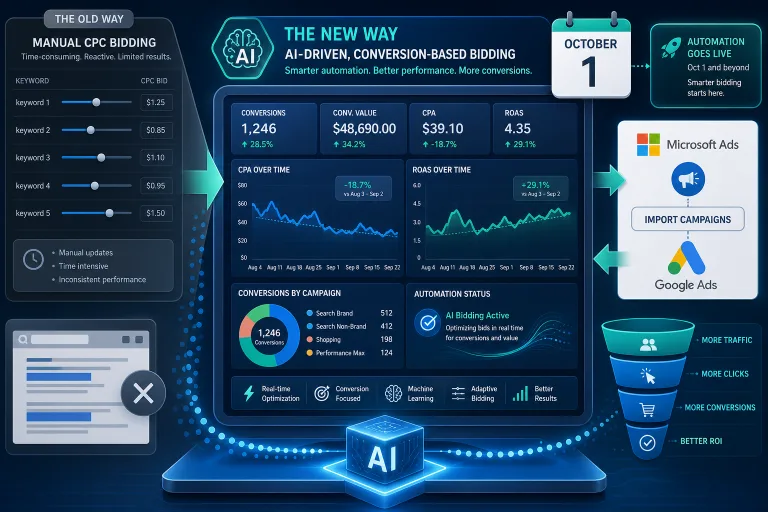
Starting October 1, 2026, Microsoft Advertising will completely remove manual maximum cost-per-click (Max CPC) management. Advertisers will no longer be able to manually set a maximum bid limit—instead, the platform will forcibly migrate all campaigns to automated, conversion-based bidding strategies. For media buyers and affiliate marketers, this means a fundamental paradigm shift: familiar control over CPC disappears, while the quality of conversion data and proper tracking setup take center stage.
Microsoft’s decision fits logically into the broader industry trend toward full automation. Google Ads has been moving in this direction for years, gradually stripping advertisers of manual bids in favor of Smart Bidding. Microsoft is following the same path, but doing so in one decisive step rather than gradually. The platform explicitly states its goal: to “push advertisers toward conversion-based targets and other automated bidding controls.” This means that without properly configured conversion tracking and UET tags, campaigns in Microsoft Ads simply won’t be able to perform effectively.
For affiliates accustomed to using Microsoft Ads as an alternative or supplementary traffic source to Google Ads, this change requires immediate adaptation. In this article, we’ll break down exactly what is changing, how to prepare your campaigns for the transition, and which bidding strategies to use to avoid burning through your budget.
What Exactly is Changing: The End of Manual CPC Control
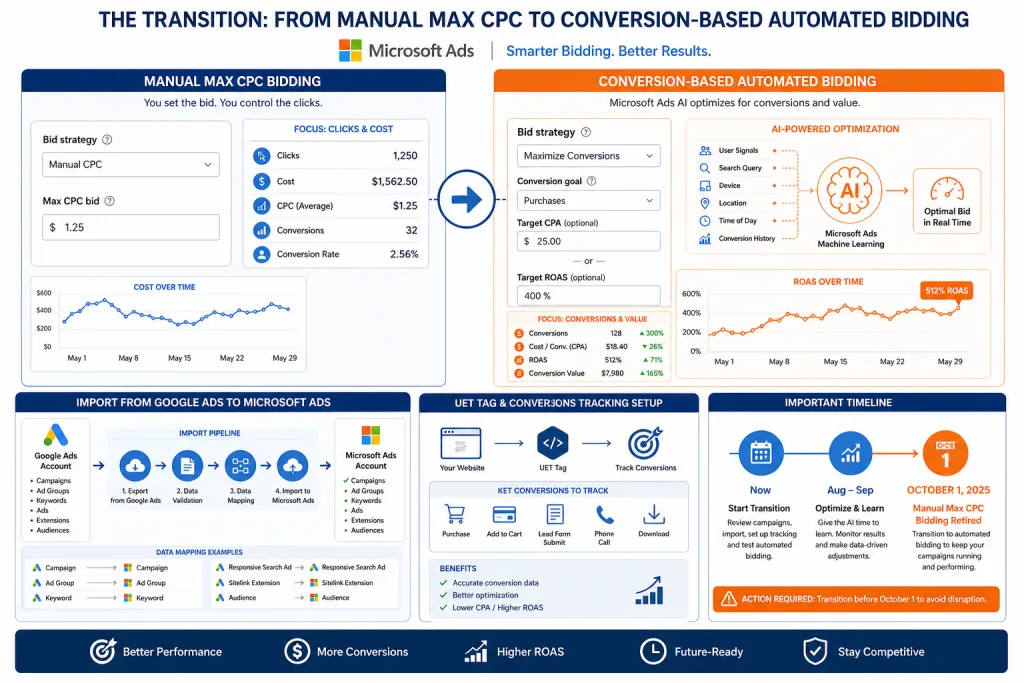
The main change is the removal of the Max CPC field from the Microsoft Ads interface. Advertisers will no longer be able to set a hard cap on the cost per click, such as “no more than $0.50 per click.” Instead, all campaigns will use automated bidding strategies that focus on conversions or conversion value.
Microsoft is already actively developing its AI features for automation. The platform offers AI Max—a suite of features that generates ad copy based on existing assets and site content, selects the most relevant combinations at the time of auction, and uses URL expansion to route traffic to the most relevant pages.
Starting October 1, 2026, automation becomes not an option, but a mandatory requirement. Campaigns that continue to use old Max CPC settings will be forcibly migrated to conversion-based bidding.
Why Microsoft is Removing Max CPC: The Platform’s Logic
Microsoft explains this decision simply: automated, conversion-based bidding strategies perform better than manual bids. The platform has access to a larger volume of data than the advertiser and can optimize bids in real-time based on dozens of signals: device, browser, time of day, search history, demographics, and on-site behavior.
For affiliates, this means the platform takes over bid management but demands high-quality conversion data in return. Without a properly configured UET tag and conversion imports, automated bidding will operate blind—with nothing to optimize.
How This Impacts Affiliate Marketing: Three Key Consequences
1. Loss of Micro-Control Over CPC
Previously, an affiliate could set a Max CPC at $0.10 and be confident that no click would cost more. This allowed for buying cheap traffic on low-volume, long-tail queries and precisely controlling campaign economics. With the shift to conversion-based bidding, this micro-control vanishes. The platform might decide that a $1.20 click is worth it because the probability of conversion is high, and it will automatically bid above your usual ceiling.
2. The Need for High-Quality Conversion Tracking
Without properly configured conversion tracking, automated bidding doesn’t work. If an affiliate is running traffic to an offer through an affiliate network, they need to set up conversion imports (postback or S2S) in Microsoft Ads, or use UET tags with custom events to track target actions on the landing page.
3. Increased Reliance on Platform Data
Automated bidding depends on historical data. New campaigns without history will require a learning period. For affiliates who frequently launch new campaigns for new offers, this means the first 7–14 days will be unstable while the algorithm gathers enough data.
AI Max and Importing Campaigns from Google Ads: How to Use Them
Microsoft is actively promoting AI Max as a tool that simplifies campaign launches. One of its key features is the seamless import of campaigns from Google Ads. If you already have a running campaign in Google Ads, you can import it into Microsoft Ads, and the system will automatically create a corresponding campaign, transferring keywords, ad copy, and targeting settings.
With AI Max enabled, imported campaigns gain additional capabilities:
- Automatic generation of ad copy based on existing assets and site content.
- Selection of the most suitable combinations of headlines and descriptions at the time of auction.
- URL expansion—routing traffic to site pages that best match user intent, instead of a static landing page.
For affiliates, this means you can quickly scale winning combinations from Google to Microsoft. But there’s a crucial nuance: imported campaigns will use automated bidding, not your manual bids from Google Ads. If you used manual Max CPC in Google, it will be replaced by a conversion-based strategy in Microsoft.
Conversion-Based Bidding: Strategies for Affiliates
With the loss of manual Max CPC, affiliates need to switch to the following bidding strategies available in Microsoft Ads:
- Maximize Conversions — the platform tries to get the maximum number of conversions within the daily budget. Suitable for new campaigns without historical conversion value data.
- Target CPA — the platform optimizes bids to achieve a target cost per conversion. Requires historical data and properly configured tracking.
- Target ROAS — optimization for a target return on ad spend. Suitable for e-commerce and offers with variable conversion values.
For most affiliate funnels, the optimal sequence looks like this: launch a campaign on Maximize Conversions to gather data, then switch to Target CPA once the algorithm has gathered enough conversions (usually 30–50 over the last 30 days).
How to Prepare Your Campaigns: A Step-by-Step Plan
Preparation for the transition should begin before October 1. If you wait until the deadline, your campaigns will be migrated to automated bidding without your input, and the results could be unpredictable.
Step 1. Audit UET Tags and Conversion Tracking
Check that the UET tag is installed on all landing pages and correctly tracks target actions. If you are running traffic to an affiliate offer via redirect, ensure that conversions are imported back into Microsoft Ads via postback or S2S integration.
Step 2. Analyze Historical Conversion Data
Automated bidding operates on historical data. Analyze which campaigns already have enough conversions over the last 30–90 days. Campaigns with low conversion volume (less than 30 per month) will perform poorly with Target CPA—they need Maximize Conversions.
Step 3. Test Conversion-Based Bidding Before the Deadline
Don’t wait until October 1. Switch a portion of your campaigns to Maximize Conversions or Target CPA now to understand how the algorithm works with your data. Compare the results with manual bids for the same period.
Step 4. Recalculate Campaign Economics
Without manual Max CPC, campaign economics change. Previously, you could accurately calculate that with a $0.20 CPC and a 5% CR, the cost per conversion is $4.00. Now, CPC will fluctuate, and you need to focus on a CPA target rather than the cost per click. Recalculate the offer’s economics: what CPA target allows you to stay profitable considering the affiliate network’s payout.
Step 5. Set Up Import from Google Ads (If You Haven’t Already)
If you aren’t already using Microsoft Ads as an additional traffic source, now is the time to start. Importing campaigns from Google Ads via AI Max allows you to quickly launch campaigns with minimal effort. But remember: structure and ad copy are imported, not the bidding strategy.
Risks and Pitfalls for Affiliates
The transition to mandatory conversion-based bidding carries several risks that affiliates need to consider in advance.
Risk 1: Budget Drain During the Learning Period
In the first 7–14 days after switching to automated bidding, the algorithm goes through a learning period. During this time, bids can be unstable, and CPCs higher than expected. Set daily budgets at a level you are prepared to lose in a worst-case scenario.
Risk 2: Inaccurate Conversion Data
If conversion tracking is set up incorrectly—for example, counting duplicate conversions or tracking irrelevant actions—the algorithm will optimize based on flawed data. The result: the campaign will bring low-quality conversions that generate no revenue.
Risk 3: URL Expansion and Loss of Landing Page Control
The URL expansion feature in AI Max can route traffic to site pages you didn’t intend to use as landing pages. For affiliates using specific offer landing pages, this can be a problem. Solution: restrict URL expansion in campaign settings or use exclusions for pages that shouldn’t receive traffic.
Risk 4: Dependence on Data Volume
Automated bidding requires data. If your campaign generates few conversions (less than 30 per month), the algorithm won’t be able to optimize bids effectively. In this case, consider consolidating campaigns or using Maximize Conversions instead of Target CPA.
Microsoft Ads vs. Google Ads: Where to Buy Traffic Now
With the removal of Max CPC, Microsoft Ads becomes more similar to Google Ads in its mechanics. Both platforms now require high-quality conversion tracking and use automated bidding strategies. But differences remain.
Microsoft Ads traditionally offers lower CPCs and less auction competition than Google Ads. However, traffic volume on Microsoft is lower. For affiliates, this means Microsoft Ads remains a useful channel for testing new funnels and buying traffic at a lower cost, but it can’t fully replace Google Ads in terms of volume.
With the introduction of AI Max and campaign imports from Google Ads, launching campaigns in Microsoft is easier. But with the loss of manual Max CPC, affiliates lose one of Microsoft Ads’ main advantages—precise control over CPC. Now, both platforms operate on a “set it and forget it” principle with automated bidding.
Geography and Verticals: Where the Transition Will Hurt
The shift to conversion-based bidding will be felt differently depending on the GEO and offer vertical.
In tier-1 GEOs (US, UK, Canada, Australia), traffic and conversion volume is usually sufficient for quick algorithm learning. The transition here will be relatively painless, but CPCs might rise due to automation.
In tier-2 and tier-3 GEOs, conversion volume might be insufficient for Target CPA to work effectively. In these regions, affiliates are better off using Maximize Conversions and preparing for a longer learning period.
For verticals with high conversion values (finance, insurance, education), Target CPA and Target ROAS will work efficiently. For verticals with low conversion values (e-commerce, mobile apps), Maximize Conversions might be the more suitable strategy.
Alternative Strategies: What to Do If Automation Fails
If campaigns perform worse after switching to conversion-based bidding than they did with manual Max CPC, affiliates have a few alternative strategies.
Strategy 1: Reallocate Budget to Google Ads
If Microsoft Ads becomes unprofitable due to automation, reallocate your budget to Google Ads, where some elements of manual bid management still persist (although Smart Bidding is becoming dominant there too).
Strategy 2: Use Native Formats and Programmatic
If search ads in Microsoft Ads become too expensive due to automated bidding, consider native formats and programmatic buying via DSPs. These channels often offer more predictable economics.
Strategy 3: Focus on CTV and Video Ads
Microsoft Ads includes integration with CTV and video inventory. For affiliates working with offers that convert well through video formats, this could be an alternative to search ads with automated bidding.
Checklist: Preparing for the Removal of Max CPC in Microsoft Ads
- Check the installation of UET tags on all landing pages and confirm conversion tracking
- Set up conversion imports from your affiliate network via postback or S2S
- Analyze historical data: which campaigns have 30+ conversions per month
- Switch test campaigns to Maximize Conversions before October 1
- Recalculate offer economics: determine your acceptable CPA target
- Restrict URL expansion if you use specific landing pages
- Set daily budgets at a safe level for the algorithm’s learning period
FAQ
What will happen to my Microsoft Ads campaigns after October 1, 2026?
All campaigns using manual Max CPC will be forcibly migrated to automated, conversion-based bidding strategies. If you don’t have conversion tracking set up via UET tags, your campaigns will perform poorly, as the algorithm will have nothing to optimize bids on.
Can I continue using manual bids after October 1?
No, Microsoft is completely removing the ability to set Max CPC manually. All campaigns will use conversion-based bidding. The only way to influence bids is by setting target CPA or ROAS metrics.
Which bidding strategy is best for affiliate campaigns?
For new campaigns without historical data, Maximize Conversions is best. Once a campaign gathers 30–50 conversions in 30 days, switch to Target CPA with a target metric that keeps you profitable considering the affiliate network payout.
How do I set up conversion imports from an affiliate network in Microsoft Ads?
Use UET tags with custom events to track conversions on your landing page, or set up an S2S postback so the affiliate network sends conversion data back to Microsoft Ads. Without this, automated bidding cannot optimize bids.
Is it worth continuing to use Microsoft Ads after Max CPC is removed?
Yes, if you have conversion tracking set up and sufficient data volume. Microsoft Ads still offers lower CPCs and less competition than Google Ads. But without manual bid control, be prepared for campaign economics to potentially shift.