OpenAI is actively scaling its advertising platform inside ChatGPT — and, according to recent data from ADWEEK, users are less likely to close ad messages as reach grows. This is a signal for media buyers and affiliate marketers: a new advertising channel is taking shape, lowering the barrier to entry, and starting to compete for budgets with familiar traffic sources. If you work with Google Ads, Facebook Ads, or native ads, it’s time to figure out what ChatGPT Ads is and whether you should add this channel to your mix.
In this article, we’ll break down how advertising in ChatGPT works, what formats and targeting are available, how to access it through platforms like StackAdapt, how it differs from Google Ads, what risks it carries, and which traffic arbitrage scenarios are already working on it.
How ChatGPT Advertising Works
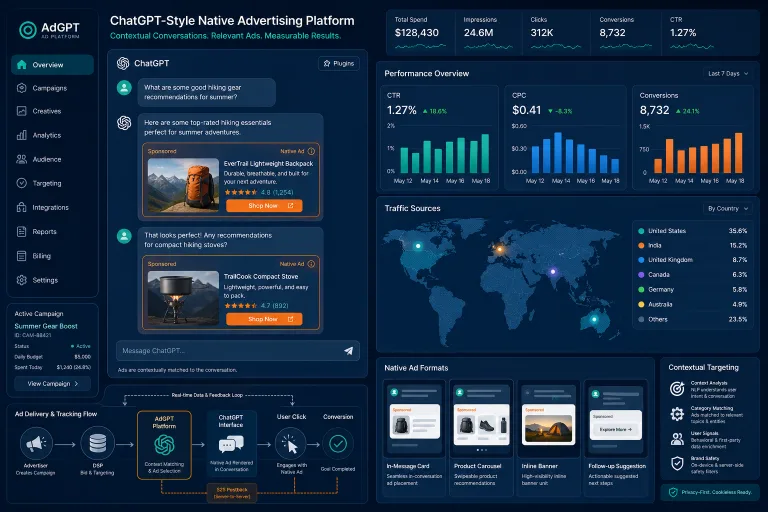
OpenAI launched ad placements inside ChatGPT in 2026. Ads appear in the conversational interface — a user asks a question, and among the answers or next to them, an ad block related to the topic of the query may be displayed. According to ADWEEK, as the platform scales, the share of users closing or ignoring ads is decreasing — meaning the audience is adapting and ads are perceived as less intrusive than on classic platforms.
The key difference from traditional search or social advertising systems is context. ChatGPT knows the topic of the conversation, the message history, and the user’s intent. This provides hyper-contextual targeting: ads are shown not based on a keyword, but on the semantics of the entire conversation. For a media buyer, this means a fundamentally new type of signal — not intent based on a search query, but intent based on conversational context.
Ad Placement Formats
Currently, ad formats in ChatGPT are evolving, but from open sources and partner data, several directions can be highlighted:
- Sponsored text inserts — native blocks inside the response, labeled as ads. Similar to sponsored content, but built into the dialogue.
- Image and description cards — visual blocks with a headline, short description, and CTA button. Closer to native ads.
- Product recommendations — for e-commerce and affiliate offers when a user asks about a product or category.
- Link blocks — compact placements with a click-through to the advertiser’s site or landing page.
The formats are highly native — these are not banners or pre-rolls. For affiliate marketers, this means that classic aggressive creatives with clickbait headlines might not work. The platform requires a more subtle approach to copywriting and design.
Access via StackAdapt and Other DSPs
One of the key signals for media buyers is that StackAdapt has removed the minimum spend requirement for ChatGPT ads. This means the barrier to entry is lowered: previously, significant budgets were required for testing, but now you can start small.
StackAdapt is a DSP (demand-side platform) specializing in native and contextual advertising. Integration with ChatGPT Ads means media buyers can purchase inventory through a familiar DSP interface, using existing optimization, frequency capping, and attribution tools.
The practical launch path looks like this:
- Register on StackAdapt (or another DSP with access to ChatGPT inventory).
- Create a campaign targeting contextual categories.
- Upload creatives in a native format — text + image + CTA.
- Set up conversion events (via pixel or postback).
- Launch a test budget and evaluate CTR, CPC, and conversions.
Comparison with Google Ads: Where is it Cheaper and More Effective?
For media buyers, the main question is how ChatGPT Ads compares to Google Ads in terms of cost and traffic quality. While there isn’t enough data for definitive conclusions yet, we can outline some hypotheses.
| Parameter | Google Ads | ChatGPT Ads |
|---|---|---|
| Targeting type | By keywords, audiences, topics | Contextual based on dialogue |
| Format | Text, banners, Performance Max | Native text-visual blocks |
| Competition | High, mature market | Low at launch, growing |
| CPC | Depends on niche, often high | Potentially lower due to low competition |
| Intent quality | High (explicit search query) | Medium-high (conversational context) |
| Scalability | Very high | Limited by ChatGPT audience size |
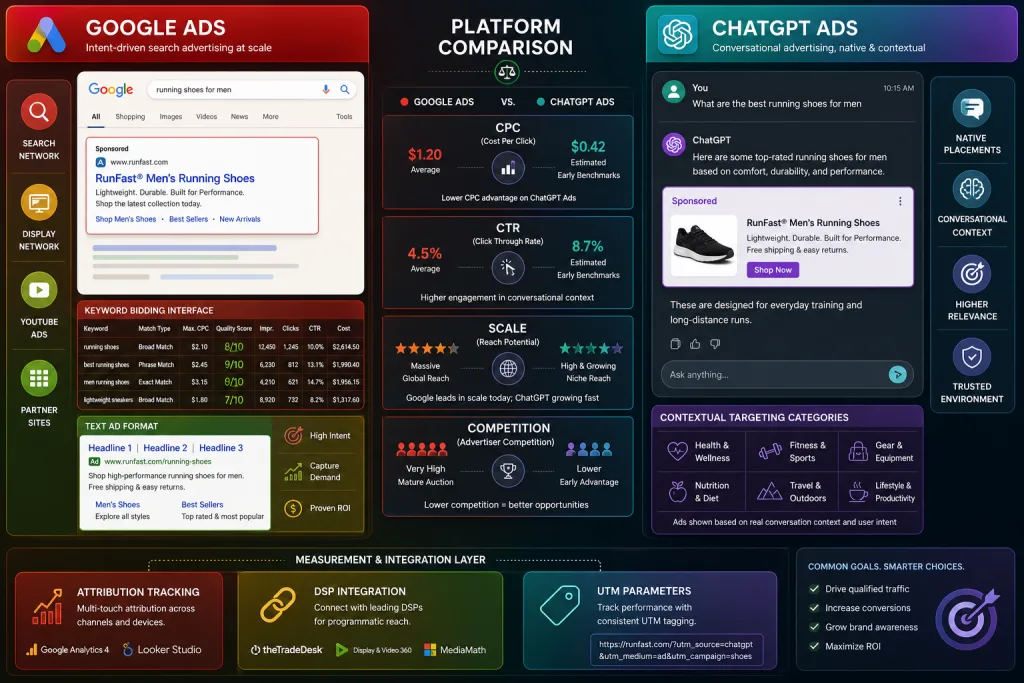
The key advantage of ChatGPT Ads at launch is low competition. When a new channel opens, CPC is usually lower and inventory quality is higher because there are few advertisers. This is a window of opportunity that closes as large brands enter the platform.
The main risk is limited scale. The ChatGPT audience is huge (hundreds of millions of users), but ad impressions are currently limited to specific formats and scenarios. For an affiliate marketer used to driving thousands of clicks a day through Google Ads, ChatGPT’s volumes might be insufficient.
Targeting: What’s Available Now
Targeting in ChatGPT Ads is built on the context of the conversation, not on classic demographic or behavioral signals. This means:
- Contextual categories — selecting topics where ads are shown (finance, technology, health, travel, etc.).
- Key conversation topics — targeting specific types of questions or discussions.
- Geo-targeting — restriction by countries and regions.
- Language targeting — showing ads only in specific languages.
Behavioral retargeting and lookalike audiences are likely unavailable or limited at launch. This complicates classic arbitrage funnels, where retargeting plays a key role in converting the audience.
Practical Scenarios for Traffic Arbitrage
Let’s look at a few scenarios where ChatGPT Ads can be useful for affiliate marketers and media buyers.
Scenario 1: Affiliate Offers in the Finance Vertical
A user asks ChatGPT: “How to invest in ETFs?” — and gets a sponsored block from a broker or financial aggregator. The context perfectly matches the offer, and the intent is high. For an affiliate program in the finance vertical, this is potentially higher quality than Google Ads, where competition for “invest” keywords is off the charts.
Scenario 2: mVAS and Subscriptions
A user asks about a game, movie, or content — and gets a product recommendation with a subscription. The native format reduces friction, and the conversational context increases relevance. The main thing is to follow platform rules and avoid misleading creatives.
Scenario 3: E-commerce and Dropshipping
A user asks about a specific product or category — and gets a product card with a click-through to the store. For dropshippers, this is an analog to Shopping Ads, but with less competition at launch.
Scenario 4: Lead Generation in B2B
A user asks about CRM, analytics, or business tools — and gets a sponsored block from a SaaS provider. The context of B2B queries in ChatGPT can be of higher quality than cold search in Google.
Platform Risks and Limitations
A new channel brings not only opportunities but also risks. Here’s what to keep in mind.
Moderation and compliance. OpenAI is a company with strict safety principles. Ads that mislead, use aggressive techniques, or violate policy will be rejected faster than on Google or Facebook. For affiliate marketers working in gray niches, this can be a blocking factor.
Limited scale. The volume of impressions is limited by the size of ChatGPT’s ad inventory. If you are used to driving 10,000+ clicks a day, ChatGPT might not handle such volumes at launch.
Lack of data. The platform is new, and there is little data on CTR, conversions, and costs broken down by niche. You will have to test blindly and gather your own statistics.
DSP dependency. Direct access to ChatGPT Ads is currently limited. Buying through StackAdapt or other DSPs adds an intermediary, meaning extra commissions and less control.
Volatility of rules. OpenAI can change formats, targeting, or policies at any moment. New platforms often revise their rules in the first few months of operation.
How to Measure Effectiveness: Attribution and Tracking
Tracking is critical for affiliate marketers. ChatGPT Ads via DSPs like StackAdapt supports standard attribution methods:
- Tracking pixel — installed on the landing page, records views and conversions.
- Postback / S2S tracking — server-side tracking for affiliate networks and mVAS.
- UTM parameters — for passing data to Google Analytics or other analytics systems.
Given the novelty of the platform, it is recommended to use server-side tracking (S2S postback) as a more reliable method. Client-side pixels can lose data due to browser restrictions and ad blockers.
A separate issue is neutral attribution. AppsFlyer recently attracted over $1 billion in investments from Google, Meta, Unity, and Moloco to develop AI measurement. This is a market signal: independent attribution becomes critical when AI platforms start managing ad buying and optimization. If you run traffic through ChatGPT Ads, independent tracking via AppsFlyer or Adjust will help ensure data isn’t skewed by the platform’s interests.
Testing Strategy: Where to Start
If you decide to test ChatGPT Ads, here is a step-by-step approach.
Start with a niche where the conversational context obviously matches the offer. Finance, technology, education, health — these are categories where users ask specific questions and are open to recommendations. Prepare 3–5 creatives in a native format: text headline, description, image, and CTA. Avoid clickbait — the platform won’t let it through.
Allocate a test budget for 7–14 days. Don’t expect instant conversions — a new channel takes time to learn and optimize. Track CTR, CPC, conversions, and cost per conversion. Compare them with your current metrics in Google Ads for the same niche.
If CTR is higher and CPC is lower — scale up. If conversions aren’t coming — check the landing page and the funnel. The problem might not be the traffic, but the landing page.
Checklist: Launching Your First ChatGPT Ads Campaign
- Register on StackAdapt or another DSP with access to ChatGPT inventory
- Choose a niche with a clear conversational context (finance, tech, education, e-commerce)
- Prepare 3–5 native creatives without clickbait or misleading headlines
- Set up server-side tracking (S2S postback) for reliable attribution
- Launch a 7–14 day test with a minimal budget
- Compare CTR, CPC, and cost per conversion with Google Ads for the same niche
- Scale only the funnels where the conversion is at least 20% cheaper than your current channel
What to Expect Next
Advertising in ChatGPT is not a replacement for Google Ads, but an additional channel. At an early stage, it is interesting precisely because of low competition and a new type of contextual targeting. As the platform grows, competition will increase, CPC will rise, and the window of opportunity will narrow.
For media buyers and affiliate marketers, this is a classic “early entry — early profit” situation. Those who set up funnels and gather data now will gain an advantage when the platform goes mainstream. But remember: new channels are unpredictable, and you should allocate exactly as much for testing as you are willing to lose without regret.
FAQ
Can I buy ChatGPT ads directly without a DSP?
Currently, direct access for most advertisers is limited. Purchasing is done through DSP partners like StackAdapt, which has removed the minimum spend requirement for ChatGPT inventory. A direct self-service interface may appear later as the platform develops.
Is ChatGPT Ads suitable for gray and aggressive offers?
More no than yes. OpenAI is known for its strict safety and moderation policies. Offers with misleading creatives, hidden subscriptions, or aggressive techniques will be rejected. The platform is aimed at legitimate advertisers and brand advertising.
What is the minimum budget needed for a test?
StackAdapt has removed the minimum spend threshold for ChatGPT inventory, allowing you to start with a small budget. The recommended test budget is $200–500 for 7–14 days to gather enough data to evaluate CTR and conversions.
How is ChatGPT Ads different from advertising in Google AI Overviews?
Google AI Overviews show ads in search results based on AI answers, but the context is a search query. ChatGPT Ads work inside a conversational interface, where the context is the entire message history. This provides a deeper understanding of user intent but limits audience scale.
Can I use UTM parameters and Google Analytics for tracking?
Yes, UTM parameters are supported. However, due to browser restrictions and ad blockers, it is recommended to additionally use server-side tracking (S2S postback) via AppsFlyer, Adjust, or your own analytics system for reliable conversion attribution.
Conclusion
Advertising in ChatGPT is a fresh channel with a low barrier to entry and a new type of contextual targeting. For media buyers and affiliate marketers, it’s an opportunity to diversify traffic sources and find cheap clicks before large brands flood the platform. Key conditions for success: native creatives, legitimate offers, server-side tracking, and a readiness to test without guarantees. If you work with Google Ads and are looking for new sources — ChatGPT Ads deserves a test budget right now.