What is Conquesting in ChatGPT and Why It Changes Everything
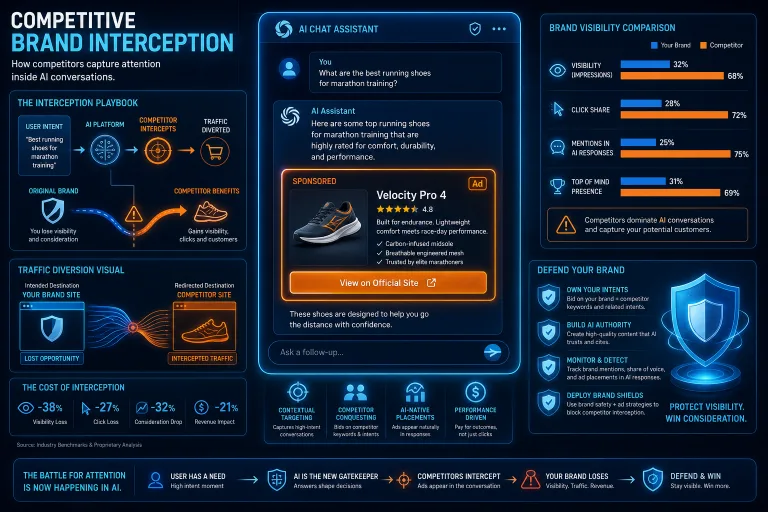
Conquesting is the practice of showing a competitor’s ad at the exact moment a user asks an AI assistant about your brand. Previously, a competitor could only hijack your brand traffic in Google Search through brand bidding. Now, they can do it right inside a ChatGPT conversation—in a context where the user trusts the AI’s answer more than traditional ad listings.
ChatGPT advertising has been scaling since mid-2026, bringing a new problem: brands have discovered that competitors can ‘infiltrate’ organic AI responses with ad blocks that appear right next to mentions of your brand. This isn’t just another ad channel—it’s a fundamentally new vector of attack on brand traffic.
For media buyers and traffic arbitrage specialists, this means two things: first, there’s a new way to hijack competitor traffic, and second, your own brand traffic becomes vulnerable. Let’s break down how it works and what to do about it.
How Conquesting Works in AI Answers: The Mechanics
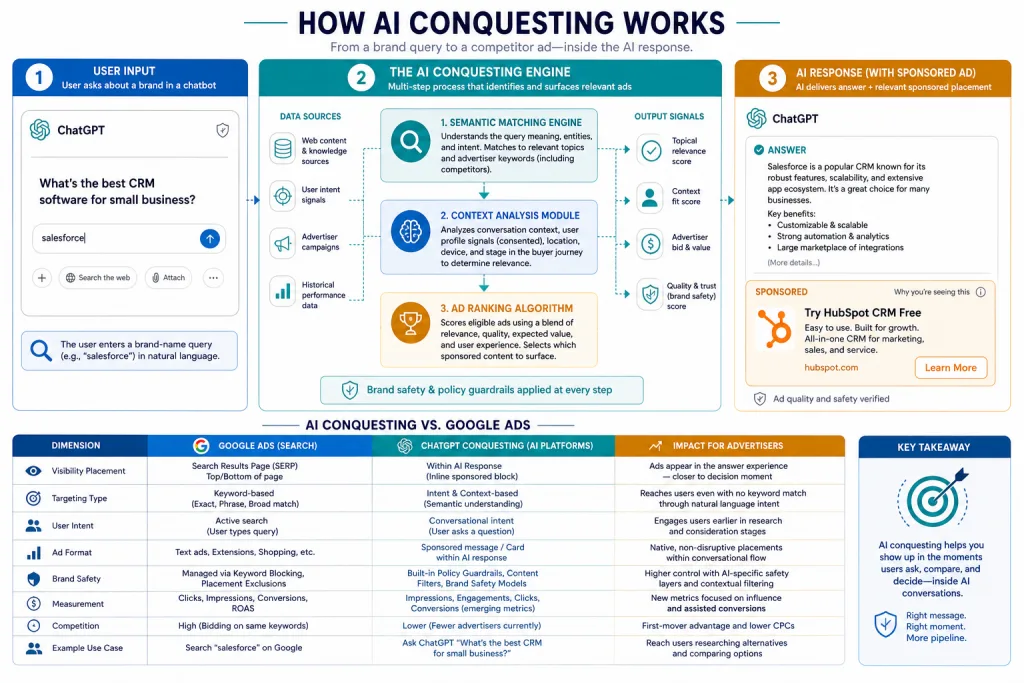
When a user asks ChatGPT something like ‘which CRM is best for small business’ or ‘compare Notion and Coda,’ the AI generates a detailed response. Inside or next to this response, an ad block may appear—a sponsored placement contextually linked to the query.
The key difference from classic search ads: in Google, users see ads separated from organic results, clearly labeled as ‘Ad.’ In ChatGPT, the boundary between the organic answer and the ad block can be less obvious, especially if the ad is integrated into the response structure.
The targeting mechanics in ChatGPT ads are based on:
- Prompt context — keywords and user intent
- Semantic matching — the AI determines the ad’s relevance to the conversation topic
- Conversation history — previous messages influence which ad is shown
This means that if a user asks about your brand, a competitor can set up a campaign so their ad appears precisely in this context.
Differences from Brand Bidding in Google Ads
Brand bidding in Google Search is a well-known tactic. A competitor buys ads on your brand query, and their listing appears above your organic result. But there are significant differences from conquesting in ChatGPT:
| Parameter | Google Ads Brand Bidding | ChatGPT Conquesting |
|---|---|---|
| Visibility | Ads clearly separated from organic | Boundary can be blurred |
| Brand Control | Can file a trademark complaint | Protection mechanisms not yet defined |
| Context | Search query only | Full conversation context |
| Trust | User sees ‘Ad’ label | User may perceive it as part of the AI answer |
| Frequency | Shown on every brand query | Depends on AI ranking algorithm |
The main risk for brands: in Google, users are used to ignoring ad blocks for brand queries. In ChatGPT, trust in the AI’s answer may transfer to the embedded ad, making conquesting a more effective hijacking tool.
Why Your GEO Strategy Is No Longer Separate from Paid
Before ads in ChatGPT, you could view Generative Engine Optimization (GEO) as a purely organic discipline—the equivalent of SEO for AI search. You optimized content so AI models would cite your brand in responses.
Now, paid ads in AI responses create a situation where your organic content might be cited in the AI’s answer, but a competitor’s ad appears right next to it. This is similar to ranking #1 organically in Google, but having three competitor ad blocks sitting above you.
For media buyers, this means GEO and paid strategy must be planned together:
- If you invest in GEO but don’t defend your brand context with paid ads—competitors can hijack conversions
- If you run paid campaigns in ChatGPT but ignore organic visibility—you lose free traffic
- Brand safety in AI requires monitoring which ad blocks appear next to your brand mentions
Strategies for Defending Brand Traffic in AI
1. Monitor Brand Mentions in ChatGPT
Regularly test prompts related to your brand, product category, and competitors. Record which ad blocks appear, who is showing them, and in what context. This is a basic step—you can’t build a defense without understanding the current situation.
2. Buy Your Own Brand Context
The equivalent of Google brand bidding: set up ChatGPT campaigns for your own brand and product queries. This doesn’t guarantee complete displacement of competitors, but it increases the likelihood that your ad will appear next to the organic mention.
3. Content Strategy for AI Citation
Create content that AI models prefer to cite: structured comparisons, clear definitions, data, and statistics. The more often the AI cites your brand as a source, the harder it is for competitors to displace you contextually.
4. Legal and Compliance Defense
Trademarks in AI ads are a gray area. Platforms haven’t yet built clear complaint mechanisms for using brand terms in the context of AI responses. Document cases where competitors use your brand in targeting, and consult trademark lawyers.
Opportunities for Arbitrage Specialists: Offensive Conquesting
If conquesting is a threat for brands, it’s a new opportunity for traffic arbitrage and affiliate marketers. Hijacking brand traffic in ChatGPT can be especially effective in niches with high conversion values: fintech, SaaS, insurance, and education.
Key considerations for offensive conquesting:
- Target selection — brands with high AI search volume but weak paid defense
- Contextual relevance — the ad message should fit organically into the AI response context, not look like an aggressive hijack
- Compliance — check the ad platform’s policy on using third-party brand terms
- GEO synergy — if your content is already cited by AI in responses to competitor brand queries, paid ads amplify the effect
- Attribution — track what percentage of conversions come from AI responses and how conquesting impacts ROI
It’s important to understand: conquesting in AI isn’t an exact science. You can’t guarantee your ad will appear exactly when a user asks about a competitor. The AI ad ranking algorithm is opaque, and impression frequency depends on many factors, including conversation history and semantic matching.
Risks and Limitations of Conquesting in AI
Despite its potential, conquesting in ChatGPT has serious limitations to consider before launching campaigns:
Targeting opacity. Unlike Google Ads, where you know exactly which keyword triggers your ad, ChatGPT targeting is based on semantic matching to the conversation context. You can’t directly ‘buy’ an impression on a competitor’s brand.
Low volume. ChatGPT ads don’t yet generate click volumes comparable to Google Search. For arbitrage specialists working on volume, this might be insufficient.
Reputational risks. Aggressive conquesting can lead to brand complaints and account bans. Platforms are introducing trademark rules, and violating them could cost you access to the channel.
Lack of established attribution. How do you link a ChatGPT impression to a landing page conversion? UTM tags work, but the attribution model for AI channels is still evolving.
How to Measure Conquesting Campaign Effectiveness
Since conquesting in AI is a new channel, standard metrics need adapting:
- Share of AI Voice (SOAIV) — the percentage of AI responses to brand queries in your niche that mention your brand or show your ad
- Conquest Rate — the percentage of your ad impressions in the context of competitor brand queries
- AI-assisted Conversion Rate — conversions where the first touchpoint was an AI response impression
- Brand Defense Rate — the percentage of brand prompts where your ad appeared before or instead of a competitor’s ad
These metrics aren’t standardized yet, but they provide a framework for evaluating conquesting strategy effectiveness.
Checklist: Launching a Conquesting Campaign in ChatGPT
- Make a list of 10–15 competitor brands with high AI search volume in your niche
- Test 20+ prompts mentioning each competitor and record current ad blocks
- Set up a campaign with contextual targeting on the product category, not the brand directly
- Prepare 3–5 creative variations that fit organically into the AI response format
- Set up UTM tags with a separate source for ChatGPT and campaign for conquesting
- Check the platform’s trademark policy before launching
- Monitor weekly which ad blocks appear next to your brand
What’s Next: The Future of Conquesting in AI
Advertising in AI assistants is at a stage comparable to early Google AdWords in 2002. Targeting, brand protection, and attribution mechanisms will evolve and become more complex. It’s expected that in the next 12–18 months:
- Platforms will introduce formal trademark complaint procedures for AI ads
- Brand safety tools will emerge, similar to those in display advertising
- Attribution will become more transparent with integration into Google Analytics and similar platforms
- Competitive intelligence in AI will become a separate discipline—tools for monitoring who advertises in AI responses to your brand queries and how
For media buyers and arbitrage specialists, this means the window of opportunity for conquesting with low barriers to entry is currently wide open. As platforms introduce rules and restrictions, the cost and complexity of conquesting campaigns will rise.
FAQ
Can you directly target a competitor’s brand in ChatGPT?
No, direct targeting on brand terms like in Google Ads is not yet available. Targeting is based on semantic matching to the conversation context. However, an advertiser can set up a campaign for a product category, and their ad might appear in a context where the user mentions a competitor’s brand.
How does conquesting in ChatGPT differ from brand bidding in Google?
In Google, you buy impressions on a specific keyword and see clearly separated ads and organic results. In ChatGPT, targeting is contextual, the boundary between the AI answer and the ad can be less obvious, and the user’s trust in the AI answer may transfer to the ad block.
Which niches are most vulnerable to conquesting in AI?
Niches with high conversion values and active brand search in AI: fintech, SaaS, insurance, online education, and premium e-commerce. The more users ask AI about specific brands, the more conquesting opportunities exist.
How do you track conversions from conquesting campaigns in ChatGPT?
Use UTM tags with a unique source (e.g., chatgpt) and campaign (conquesting_brand_name). Set up a separate channel group in Google Analytics 4. Keep in mind that attribution can be last-click or data-driven—the AI channel often acts as the first touchpoint in a long chain.
Is there a risk of account suspension for conquesting in ChatGPT?
The risk exists, especially if the ad message directly uses a third-party trademark or misleads the user. Before launching, study the platform’s trademark and brand term policy. Start with contextual targeting on a category, not a specific brand.