What Happened: Google Fails to Control Search Arbitrage on Election Queries
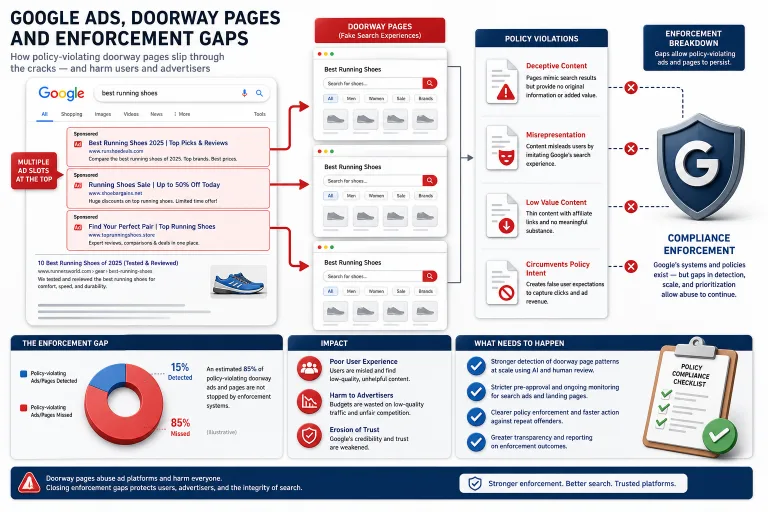
The Tech Transparency Project (TTP), a tech research initiative, has published an investigation showing that Google cannot stop exploitative advertising targeting American voters. Users searching for polling locations — for example, querying “polling place” in Maricopa County, Arizona — saw up to three ads from search arbitrage sites on the first page of Google. These pages visually mimicked Google’s interface but were essentially doorway pages: they redirected users to other ad-heavy resources instead of providing original content.
For traffic arbitrage professionals, this isn’t just another news story. It exposes a systemic issue: Google writes policies against arbitrage and doorway pages, but doesn’t enforce them consistently. This creates a gray zone where some buyers get banned for similar practices, while others freely funnel traffic through intermediary pages on highly sensitive queries.
What Is Search Arbitrage in the Context of Google Ads
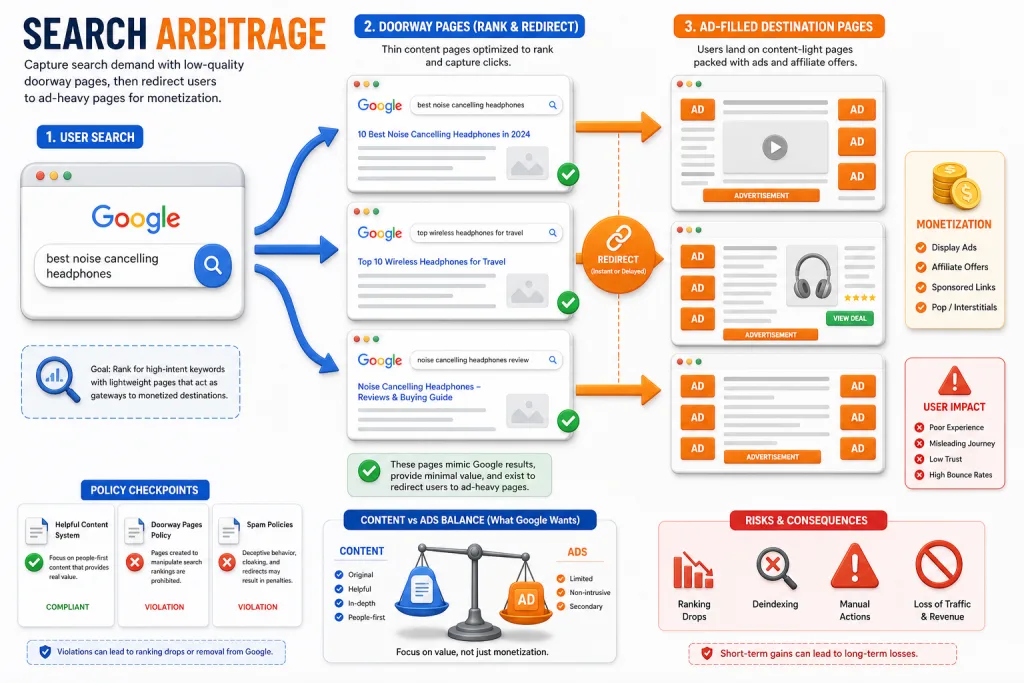
Search arbitrage is the practice of buying paid traffic on Google Search and then monetizing it through ads on a landing page. The arbitrageur buys a click for less than they earn from impressions/clicks on their page. The classic model: cheap long-tail query → landing page with aggressive monetization → ad revenue.
Google explicitly prohibits “directing traffic (via arbitrage or other methods) to pages with more ads than original content, with minimal original content, or with excessive advertising.” Ads leading to “doorway, gateway, or other intermediate pages used solely to link to other sites” are also banned.
The problem is that the line between legitimate arbitrage (e.g., an aggregator that provides real value to the user) and prohibited doorway arbitrage is blurry and inconsistently interpreted by Google.
How the Scheme Works on Election Queries
TTP documented a specific mechanism. A user enters a voting-related query — “polling place,” “where to vote,” “ballot drop box.” Two to three ads appear on the first page of Google results. Upon clicking, the user lands on a page that:
- Visually mimics Google — similar font, color scheme, element layout
- Contains minimal original content
- Is packed with ad blocks, often Google contextual ads
- Redirects the user to third-party resources
This is a classic doorway pattern that Google’s own policy prohibits. Nevertheless, these ads pass moderation and appear in search results.
Why Google Doesn’t Enforce Its Own Policies
Volume and Automated Moderation
Google processes billions of ads. Moderation is automated in the vast majority of cases. Algorithms are trained to recognize explicit violation patterns, but doorway pages that mimic Google are a specific case requiring contextual analysis rather than simple keyword matching.
The Gray Zone Between Legitimate Arbitrage and Doorways
Many aggregators, comparison sites, and affiliate landing pages technically resemble doorway pages: they collect traffic and redirect it further. The difference lies in user value. But an algorithm can’t always determine whether a page adds value or simply redirects. This creates room for exploitation.
Political Sensitivity
Election queries are a particularly sensitive category. Google has introduced special rules for political advertising, but search arbitrage on these queries isn’t necessarily classified as political advertising. Ads may not be identified as political if they formally don’t promote a candidate or initiative but merely “inform” about polling locations.
Risks for Traffic Arbitrage Professionals
Sudden Mass Bans
When Google faces public pressure (as with the TTP investigation), its response is often sharp and sweeping. Arbitrageurs using similar schemes on less sensitive verticals may get caught in the crossfire. Google Ads history has many examples where a narrow problem led to broad crackdowns.
Unpredictable Compliance
If Google can’t enforce its own policies on election queries — where reputational risk is at its peak — what does that say about lower-priority verticals? An arbitrageur might run traffic through doorway pages for months without issues, only to receive a permanent ban with no explanation.
Reputational Risk for the Entire Industry
Public investigations like TTP’s shape a negative narrative around arbitrage in general. Regulators and platforms may start viewing all arbitrage as an exploitative practice, leading to tighter policies for everyone — including legitimate buyers.
How Doorway Pages Differ from Legitimate Arbitrage
The key distinction is user value. Legitimate arbitrage:
- Provides original content or value-added aggregation
- Doesn’t mimic a search engine interface or other brand
- Maintains a reasonable content-to-ad ratio
- Gives the user an answer to their query
Doorway arbitrage:
- Minimal original content
- Mimics Google’s interface or another recognizable brand
- Ads dominate over content
- The user doesn’t get an answer — they’re redirected further
Practical Takeaways for Media Buyers
Don’t Rely on Google’s Inconsistency as a Strategy
The fact that Google doesn’t enforce its policies today doesn’t mean it won’t tomorrow. The TTP investigation is a trigger that could spark a wave of crackdowns. If your model depends on Google “not noticing” a violation, that’s not a strategy — it’s a ticking time bomb.
Audit Your Landing Pages for Doorway Patterns
Check your landing pages against Google’s criteria:
- Ratio of original content to ads
- Presence of doorway redirects
- Mimicking third-party platform interfaces
- User value with ads disabled
Diversify Your Traffic Sources
If your primary channel is Google Search Ads with doorway landing pages, you’re in the highest-risk zone. Consider diversifying to Meta, TikTok, native networks, and other sources where doorway page policies are less strict (but not absent).
Future Scenarios: What Google Might Do
Targeted Crackdown on Voter Queries
Google could selectively ban accounts and domains involved in arbitrage on election queries. This would be the minimal response, allowing the company to claim it “took action” without systemic changes.
Tighter Automated Moderation
Google could update its doorway page detection algorithms, especially for those mimicking Google’s interface. This would impact arbitrageurs across all verticals using similar patterns.
New Policies for Sensitive Queries
Google could introduce a separate “election queries” category with additional advertising restrictions, similar to what’s already in place for pharma, finance, and gambling.
What to Do Right Now
Checklist: Auditing Doorway Risks in Your Google Ads Campaigns
- Check the content-to-ad ratio on your landing pages — content should dominate
- Make sure your landing pages don’t mimic Google’s or other platforms’ interfaces
- Remove intermediate redirects that add no value for the user
- Verify whether the user gets an answer to their query without needing to click further
- Diversify your traffic sources — don’t keep 100% of your budget in Google Search Ads
- Prepare backup accounts and domains in case of a mass crackdown
Impact on Affiliate Marketing and Partner Programs
For affiliate marketers, the situation creates a double risk. On one hand, partner programs often require traffic of a certain quality, and doorway pages can lead to commission clawbacks. On the other, if Google launches a mass crackdown on doorway patterns, legitimate affiliate landing pages that the algorithm deems similar will also suffer.
Recommendation: document the added value of your landing pages. If you aggregate offers, make sure the aggregation is real and useful — not just a facade for redirecting traffic.
Regulatory Context: Why This Isn’t Just Google’s Problem
The TTP investigation is part of broader pressure on ad platforms from regulators and public interest groups. In the US, the FTC and Congress are increasingly scrutinizing advertising practices through a consumer protection lens. If doorway arbitrage on election queries is classified as “consumer deception,” it could lead to legislative restrictions that go beyond Google’s own policies.
For arbitrageurs working with US GEO, this means accounting for not only platform policies but also potential regulatory risks.
FAQ
What is search arbitrage in Google Ads?
Search arbitrage is buying paid traffic on Google Search and monetizing it through ads on a landing page. The arbitrageur profits from the difference between the cost per click and the ad revenue generated on the page. Google prohibits variants where ads dominate over original content or where the page serves only to redirect traffic.
How does a doorway page differ from a regular landing page?
A doorway page is an intermediate page created solely to redirect users to another site, with no original value for the user. A regular landing page provides content, an answer to the query, or an offer that the user clicked the ad for.
Yes. Inconsistent enforcement doesn’t mean policies are repealed. Google can ban an account at any time, especially after a public investigation or regulatory pressure. Inconsistency is a risk, not legalization.
What should I do if my landing page looks like a doorway but adds value?
Document the added value: original content, aggregation, comparisons, unique data. Make sure content dominates over ads. Avoid mimicking Google’s or other platforms’ interfaces. Prepare your arguments in case of an appeal.
Does this investigation affect arbitrageurs outside the US?
Not directly, but Google often applies policy updates globally. If doorway page detection algorithms are updated in response to the TTP investigation, it will affect arbitrageurs across all GEOs.
Bottom Line
The TTP investigation exposed not just an isolated moderation failure, but a systemic problem: Google doesn’t enforce its own policies against search arbitrage and doorway pages even on the most sensitive queries. For arbitrageurs, this means the “gray zone” is wider than it appears — but that’s exactly why the risk of a sudden crackdown is higher. Don’t build your strategy on Google’s inconsistency. Audit your landing pages, diversify your channels, and prepare for tighter enforcement — not because it will definitely happen, but because the cost of being unprepared is disproportionate.