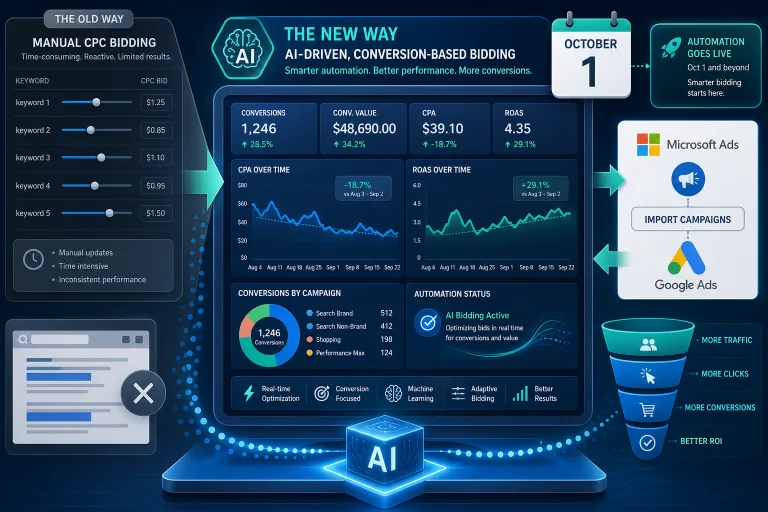
Value-based bidding is an approach in Google Ads where you feed the algorithm a variable value for each conversion instead of a fixed one. For traffic arbitrage affiliates, this means tCPA and tROAS start optimizing not for conversion count, but for total revenue. In 2026, media buyers scaling campaigns through Google Ads increasingly hit a ceiling: standard tCPA values a $2 payout conversion and a $20 payout conversion equally if you don’t pass variable values. Value-based bidding solves this — the algorithm focuses budget on traffic with higher margins and filters out cheap conversions that don’t cover the click cost.
Media buyer job listings at affiliate networks like vCommission already explicitly require experience with tCPA, tROAS, and value-based bidding for scaling. This isn’t a trendy metric — it’s a foundational skill for anyone who wants to outgrow manual bid management and scale arbitrage funnels without losing margin.
What is value-based bidding in Google Ads
Value-based bidding isn’t a separate bidding strategy — it’s a method of passing conversion data to Google Ads. Instead of telling the system “a conversion happened,” you pass “a conversion worth X happened,” where X varies for each event.
In the standard model, you set up a conversion action with a fixed value — say, $5 per registration. The tCPA algorithm tries to get conversions at a $5 target cost, without distinguishing whether a registration led to a $10 deposit or a $500 one. In the value-based model, you pass the actual value through the Google Ads API or Google Tag Manager — and tROAS starts optimizing so that every dollar spent generates maximum revenue.
This is critical for traffic arbitrage, where the difference between click cost and conversion revenue is the only thing separating profit from burning budget.
How tCPA and tROAS use variable value
tCPA with variable value works differently than tCPA with a fixed value. When you pass zero value for incomplete conversions and the real amount for successful ones, the algorithm factors “empty” conversions into cost calculations but optimizes toward events with real value. This is especially useful in affiliate funnels where the first step — an ad click — doesn’t generate revenue, but the second or third step does.
tROAS with variable value is the primary scaling tool. You set a target ROAS, say 300%, and pass a variable value for each conversion. The algorithm analyzes which keywords, audiences, and placements bring high-value conversions, raises bids in auctions where expensive conversions are likely, and lowers bids where conversions are cheap or don’t happen at all.
For an arbitrage affiliate, this means Google Ads starts “understanding” the difference between traffic that brings $2 per conversion and traffic that brings $50 — and reallocates budget toward the latter.

Value-based bidding vs standard model: the economics difference
Imagine two versions of the same campaign: a nutra offer with a $15 payout per confirmed sale and $2 for a three-day trial.
Standard tCPA with a fixed $15 value for all conversions: the algorithm doesn’t see the difference between a user who signed up for the trial and canceled, and one who made a purchase. It may reinvest in cheap trial traffic that doesn’t monetize.
Value-based tROAS: you pass $2 for a trial and $15 for a sale. The algorithm sees that one segment of traffic brings 7.5x more value and shifts budget toward it. The same daily budget generates more revenue.
The difference becomes critical during scaling. When you increase your budget 3–5x, standard tCPA often loses efficiency — the algorithm starts buying more expensive, lower-quality traffic because its goal is volume, not value. Value-based bidding lets you scale while preserving margin because the algorithm filters out junk conversions based on their actual profitability.
How to set up variable conversion value for an arbitrage funnel
Setting up value-based bidding in Google Ads requires a few steps and depends on your infrastructure.
Via Google Tag Manager
- Create a conversion action in Google Ads with the value type set to “Variable.”
- In Google Tag Manager, set up a Data Layer variable that captures the conversion value.
- Pass the offer’s payout value via
dataLayer.pushon the confirmation page. - Link the variable to your Google Ads conversion tracking tag.
Via Google Ads API
- Use ConversionAdjustmentService to pass variable value.
- For each conversion, send an adjustment with the actual payout amount.
- Set the adjustment window — typically 7–14 days for offers with delayed payouts.
Via server-side tagging
- Set up a server-side GTM container.
- Pass the conversion value from your funnel’s backend.
- This gives you more control over data and reduces the impact of ad blockers.
For affiliate offers with postbacks from the partner network, you can automate value passing: when you receive a postback with the payout amount, send a conversion adjustment to Google Ads via the API. This closes the loop: click — conversion — actual payout — bid adjustment.
Practical scenarios: when value-based bidding gives you an edge
Multi-step funnels with delayed payouts
Offers with 3–7 day confirmation — finance, iGaming, nutra with COD — are the ideal use case. You pass zero value at the first step and the real amount upon confirmation. tROAS starts optimizing for actual revenue, not lead count. Without variable value, the algorithm treats all leads as equal and may overload traffic with a 5% approval rate instead of traffic with a 20% approval rate.
Multi-offer campaigns
If you’re running several offers in one campaign with different payouts, value-based bidding lets the algorithm distribute budget proportionally to each offer’s profitability. Without variable value, Google Ads treats all conversions as equal and may overload a cheap low-payout offer because it generates more conversions — even if they’re less profitable.
Multi-GEO campaigns
When launching across multiple GEOs with different click costs and payouts, value-based bidding automatically balances: an expensive click in tier-1 is justified by high conversion value, while a cheap click in tier-3 is justified by volume. Without variable value, the algorithm may equalize conversion count instead of revenue and burn budget on cheap GEOs with low payouts.
Risks and limitations of value-based bidding for arbitrage affiliates
Value-based bidding isn’t a magic switch. Here are the key risks to keep in mind.
Learning period
tROAS with variable value needs more data for stable performance. A minimum of 30 conversions per month with varying values — otherwise the algorithm won’t find patterns. For new campaigns, this means 2–3 weeks of running in testing mode with potentially suboptimal bids.
Data delay
If you pass value via postback with a delay of several days, the algorithm receives the signal with a lag. During this period, bids may be too high or too low. The solution — use enhanced conversions to pass data faster, and set a preliminary value at the first funnel step with an adjustment upon confirmation.
Value inflation
Some arbitrage affiliates pass inflated conversion values to “force” the algorithm to bid higher. This leads to budget overspend — Google Ads optimizes toward the stated value, not the real one. If the actual payout is lower than what you passed, ROAS drops and the campaign goes negative. Only pass real payouts.
Data quality dependency
If your pixel or postback is set up incorrectly, conversion values get distorted. One mistake in passing the amount — and the algorithm optimizes toward a false signal. Always verify that passed values match actual payouts from the affiliate network.
Common mistakes when implementing value-based bidding
The most common mistakes I see among arbitrage affiliates transitioning to value-based bidding.
-
Passing a fixed value into a value-based action. If you created a conversion action with variable value but always pass $5 — that’s just a fixed value. tROAS won’t get any additional information and will behave like a standard strategy.
-
Ignoring the conversion window. If the payout arrives in 7 days but your conversion window is set to 1 day — Google Ads won’t link the conversion to the click. Set the attribution window to at least the offer’s confirmation period plus 3 days.
-
Mixing offers with different payout models. CPA offers with fixed payouts and RevShare offers with variable payouts in the same campaign. tROAS won’t be able to optimize correctly because one conversion type’s value is predictable and the other’s isn’t. Separate them into different campaigns.
-
Scaling before learning completes. Increasing the budget by 50% or more in the first 2 weeks after launching value-based tROAS. The algorithm hasn’t learned yet, and the extra budget goes to unoptimized auctions. Increase by no more than 20% per day.
-
No negative adjustments. For returns and cancellations — chargebacks, refunds, subscription cancellations — pass a negative adjustment value so the algorithm accounts for failed conversions and lowers bids on traffic with high cancellation rates.
Value-based bidding and other strategy elements
Value-based bidding doesn’t replace other elements of your arbitrage strategy. It works on top of them.
Creatives still determine CTR and click quality. tROAS with variable value won’t save a bad creative that attracts the wrong audience. The landing page affects conversion — the algorithm optimizes bids, not funnel content. Bot traffic filtering remains the media buyer’s job — tROAS may optimize toward bot clicks if they generate fake conversions with positive value.
Value-based bidding is a bid optimization layer that only works with clean conversion data. Garbage in, garbage bids. If your funnel loses 30% of conversions due to a misconfigured pixel, tROAS will optimize toward a distorted picture and make wrong bidding decisions.
Checklist: transitioning to value-based bidding
- Verify that your conversion action is set to “Variable” value type, not “Fixed”
- Set up passing the actual payout via GTM, Google Ads API, or server-side tagging
- Set the conversion window to the offer’s confirmation period plus 3 days
- Ensure at least 30 conversions per month have varying values — otherwise the algorithm won’t learn
- Don’t increase the budget by more than 20% per day in the first 2 weeks after launch
- Pass negative values for cancellations, refunds, and chargebacks
- Once a week, reconcile passed values against actual payouts from the affiliate network
FAQ
Can I use value-based bidding with CPA offers where the payout is fixed?
Yes, but it only makes sense if you have multiple offers with different payouts in one campaign, or a multi-step funnel where the payout depends on user action. If all conversions bring the same amount, variable value equals fixed value — and tROAS won’t get any additional signals.
How long does it take for tROAS with variable value to learn?
Usually 2–3 weeks, provided you have at least 30 conversions per month with varying values. If there’s less data, the learning period stretches or the algorithm never exits learning mode. In that case, tROAS functions like an enhanced tCPA without value optimization.
What should I do if the payout arrives with a 7+ day delay?
Pass a preliminary value at the first funnel step — for example, the offer’s average payout. When you receive the postback with the actual amount, send an adjustment via ConversionAdjustmentService. Set the conversion window to at least the confirmation period plus 3 days so Google Ads can link the adjustment to the original click.
How is value-based bidding different from enhanced conversions?
Enhanced conversions is a method of passing conversion data (e.g., email, phone) with higher accuracy via server-side. Value-based bidding is a type of conversion value (variable instead of fixed). They’re compatible: enhanced conversions can be used to pass variable value with greater accuracy and less delay.
Does value-based bidding work in Performance Max?
Yes. Performance Max supports tROAS with variable conversion value. This is especially useful for e-commerce arbitrage where cart value varies. For affiliate offers with fixed payouts, the effect is smaller, but in multi-offer PMax campaigns, variable value helps the algorithm distribute budget by profitability.