Google has started testing new labels in search ads in the US that display information about match types directly in the advertiser interface. The initiative is still in the experimental stage, but it is already sparking discussions in the professional community: some see it as a tool for more efficient budget allocation, while others fear labeling errors that could harm campaigns. For affiliates and media buyers working with Google Ads, this update directly affects how traffic is filtered, how bids are distributed, and how accurately the system matches audiences by keywords.
The essence of the innovation: Google wants to give advertisers more transparency into which queries actually trigger ads when using different match types—broad, phrase, and exact. If the labels work correctly, it will allow for faster filtering of irrelevant impressions and reallocating the budget to the most converting combinations. If not, advertisers risk getting a distorted picture and wasting their budget on junk traffic.
What are match types in Google Ads: a quick refresher
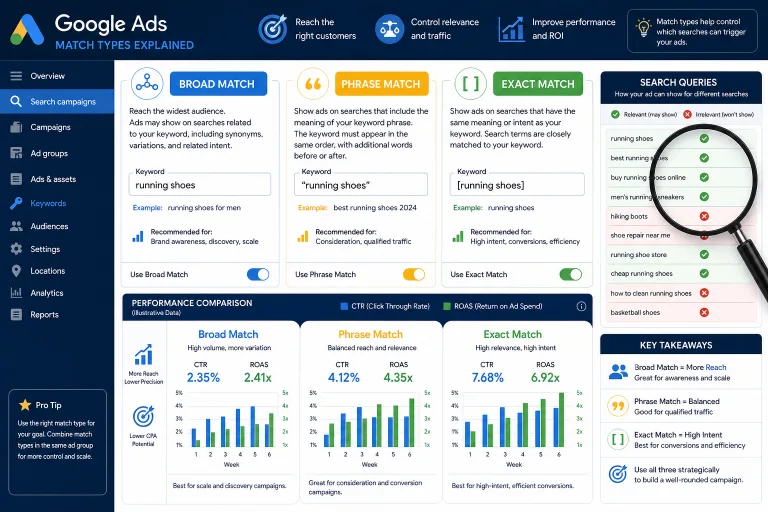
A keyword match type determines how broadly Google matches your keyword with users’ search queries. In Google Ads, there are three main types:
- Broad Match — ads are shown for queries related to your keyword, including synonyms, variations, and related phrases. Maximum reach, minimum control.
- Phrase Match — impressions for queries containing your phrase in the specified order, with possible words before or after. A balance between reach and accuracy.
- Exact Match — impressions for queries as close as possible to your keyword, taking morphology and close variations into account. Maximum control, minimum reach.
In recent years, Google has gradually expanded the boundaries of each type, especially Broad Match, which now actively uses machine learning to select “related” queries. This has created a situation where advertisers often don’t know which actual queries their ads are showing for until they look at the search terms report.
What exactly is Google testing
According to MediaPost, Google is testing new labels in the Search Ads interface that should visually indicate which match type triggered a specific impression. The goal is to give advertisers a tool for filtering and analysis: which match types bring better traffic, and which waste the budget.
Justin Wendschitl, a strategist at Variable agency, noted that the labeling criteria are still unclear: “If everything is set up carefully, this could be very useful for filtering the best matches and spending the budget more efficiently. But if there are flaws in the labeling, it could harm businesses.”
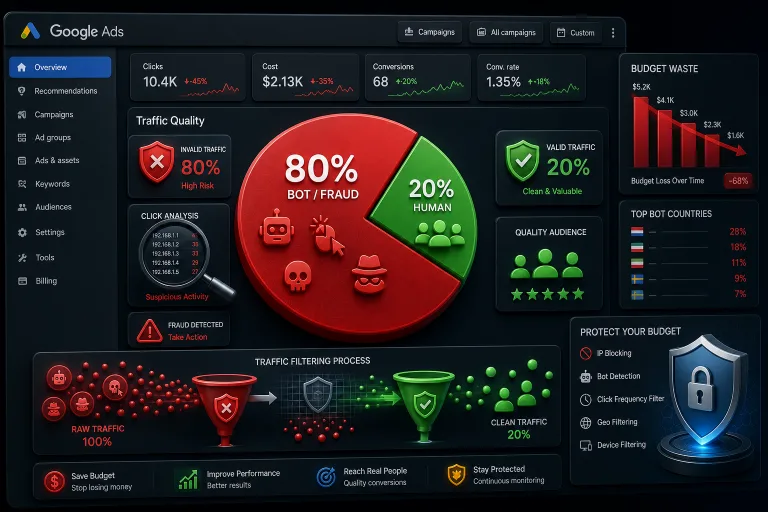
For affiliates, this is especially critical: when working with thin margin combinations, even a slight inaccuracy in traffic filtering can lead to wasting the budget on irrelevant impressions.
Why this is important for traffic arbitrage
Traffic arbitrage in Google Ads is built on precision. You select keywords, landing pages, and offers so that every click has the maximum probability of conversion. Match types are one of the main levers for controlling traffic quality.
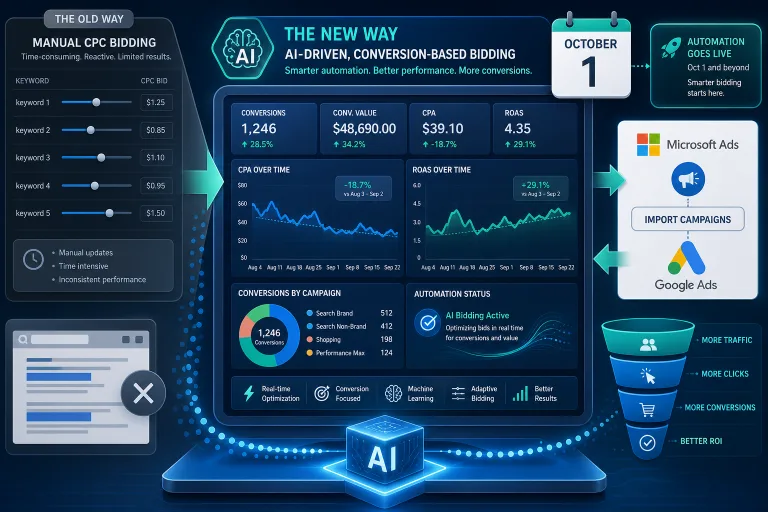
The problem is that Google increasingly relies on automated strategies and machine learning. Smart Bidding, Performance Max, and expanded Broad Match reduce manual control. New labels, if they work correctly, can partially restore transparency: you will see which match type actually brought a conversion, and which only brought clicks without results.
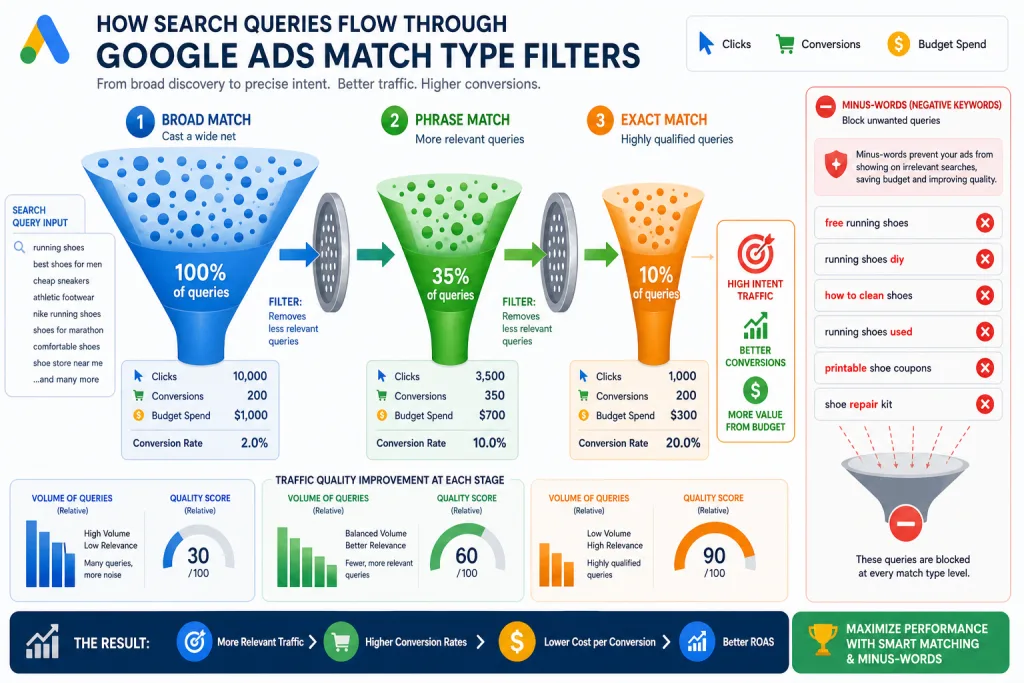
Let’s look at a practical example. An affiliate launches a campaign for an offer in the mVAS vertical with the keyword “download ringtone” in Broad Match. The system can show ads for queries like “free ringtones”, “phone melodies”, “iPhone ringtone”, and even “how to make a ringtone yourself”. Without clear match type labeling, it’s hard to tell which of these queries brings conversions and which brings junk traffic. The new labels could highlight exactly what worked and by which match type.
Potential benefits of the new labels
If Google’s experiment proves successful, match type labels could bring several specific benefits:
1. Quick filtering of junk traffic
You will be able to identify faster which match types generate irrelevant impressions and disable them or add negative keywords.
2. More precise bid adjustments
By understanding which match type brings more conversions, you can reallocate bids in favor of the most effective combinations.
3. Reduced analysis time
Instead of manually parsing search term reports, you will get visual labeling right in the interface, which speeds up decision-making.
4. Improved ROAS
By using the labels correctly, you can reduce the share of irrelevant clicks and increase your return on ad spend—a key metric for arbitrage.
Risks and pitfalls
Despite the potential benefits, the update carries risks, especially for affiliates:
Labeling errors. If Google incorrectly determines the match type for an impression, you may get distorted statistics. For example, a Broad Match impression might be mistakenly labeled as Phrase Match, and you will draw the wrong conclusions about the combination’s effectiveness.
Over-reliance on automation. The new labels might create an illusion of transparency, pushing advertisers to use Broad Match and Smart Bidding even more. But Google’s automation doesn’t always act in the affiliate’s best interests—its goal is to maximize the platform’s revenue, not your ROAS.
Test limitations. The experiment is currently only being conducted in the US and may not cover all verticals and geos. For affiliates working in other markets, the labels might not be available for a long time.
Compatibility with third-party tools. If you use third-party trackers and arbitrage platforms, the new labels might not integrate with them automatically, creating a data gap.
How to prepare for the update right now
Even if match type labels aren’t available in your campaigns yet, there are specific steps you can take to be ready for their implementation.
Audit current match types
Review all active campaigns and write down which match types you use for each keyword. If everything is on Broad Match—that’s a red flag. Add Phrase Match and Exact Match for the most converting keywords to get more granular data.
Set up search term reports
The search terms report is your main tool for understanding which queries your ads are actually showing for. Set up regular exports and analysis of this report to identify irrelevant traffic patterns in advance.
Expand your negative keyword list
Negative keywords are the cheapest way to improve traffic quality. Compile a list of all the irrelevant queries you found in the report and add them to the campaign or account level.
Test on a small budget
When the labels become available in your account, don’t change all campaigns at once. Select one or two campaigns with a small budget and test how the labels work in practice. Compare the results with your regular reports.
Impact on different arbitrage verticals
The innovation will affect different verticals in different ways:
mVAS and mobile subscriptions. Keyword precision is critical here, as conversions depend on specific intents. Labels will help filter informational queries from transactional ones.
Nutra and physical goods. Broad Match is often used in this vertical for maximum reach. Labels will allow you to see which expanded matches actually bring sales, and which only bring clicks.
Finance and insurance. High CPCs mean that every irrelevant impression is a serious loss. Labels are especially useful for optimization in this vertical.
Gaming and apps. App installation is a long funnel, and labels will help understand at which stage traffic is being lost.
Comparison with previous Google Ads changes
Google regularly changes how match types work. In 2021, Phrase Match was expanded and effectively absorbed part of the Broad Match Modifier functionality. In 2022–2023, Exact Match was weakened—the system started showing ads for queries with the same meaning but different words.
Each of these changes reduced manual control and increased reliance on Google’s algorithms. The new labels are, in essence, an attempt by Google to partially compensate for the loss of transparency that previous updates themselves created. For affiliates, this means you shouldn’t relax, but rather use the new tools to regain control without abandoning your own checks.
Strategy for media buyers: what to do in the coming weeks
While the labels are in testing, focus on preparing your infrastructure. Here is a concrete action plan:
- Do a full match types audit across all active campaigns. Write down the share of Broad, Phrase, and Exact Match in the total volume of impressions and conversions.
- Set up automated rules for adding negative keywords based on the search terms report. Use Google Ads scripts or third-party tools.
- Segment campaigns by match type. Don’t mix Broad and Exact Match in the same ad group—this will make analysis difficult.
- Prepare report templates that will account for the new labels when they appear. Think in advance about which metrics you will compare.
- Follow updates from Google Ads and industry resources. When the labels leave the testing phase, those who prepared in advance will be the first to master them.
Checklist: preparing for the new match type labels
- Audit all active campaigns: write down the share of Broad, Phrase, and Exact Match
- Set up regular exports of the search terms report
- Compile and expand the negative keyword list at the account level
- Separate ad groups by match type — don’t mix Broad and Exact
- Prepare report templates accounting for future labels
- Allocate a test budget to check the labels upon launch
What practitioners say
Opinions in the industry are divided. Supporters of the update point out that Google has been reducing match type transparency for too long, and any steps toward restoring it are a plus. Skeptics remind us that Google has introduced “improvements” before that in practice worked in the platform’s interests, not the advertiser’s.
For the affiliate community, the key question is: “Can Google’s labels be trusted?”. The answer: trust but verify. Use the labels as an additional signal, but don’t replace your own analysis of search terms and conversions with them. Your tracker and your data are the primary source of truth, and the Google interface is just one of the tools.
FAQ
When will the new match type labels be available to all advertisers?
So far, Google is only running the test in the US. There are no exact timelines for a global rollout. It is expected that after collecting feedback, the labels will gradually expand to other markets, but this could take several months.
Will the labels affect the cost per click?
There is no direct impact on CPC—labels are a display tool, not an auction change. However, indirectly they can have an effect: if advertisers start filtering traffic more actively, competition for irrelevant queries will decrease, which might slightly change prices in certain niches.
Do I need to change current campaigns before the labels launch?
You don’t necessarily need to change them, but you should audit your match types and prepare your reports. When the labels appear, you can use them immediately without restructuring your campaigns.
Will the labels work with Smart Bidding and Performance Max?
Most likely, the labels will be available in standard Search campaigns. Integration with Performance Max is questionable, as this format uses automatic distribution without detailed match type control.
What to do if the labels show incorrect data?
Compare the label data with the search terms report. If there are discrepancies, contact Google Ads support and continue relying on your own tracking. Don’t make decisions based solely on the labels.
Summary
The new match type labels in Google Search Ads are a step toward greater transparency that advertisers have been waiting for a long time. For affiliates and media buyers, this is a potentially useful tool, but not a panacea. Success will depend on how accurately Google implements the labeling and how quickly you adapt your processes. Prepare your infrastructure now, and when the labels become available—you will be among the first to benefit from them.