What Happened: Google Launches Mandatory AI Ad Labeling
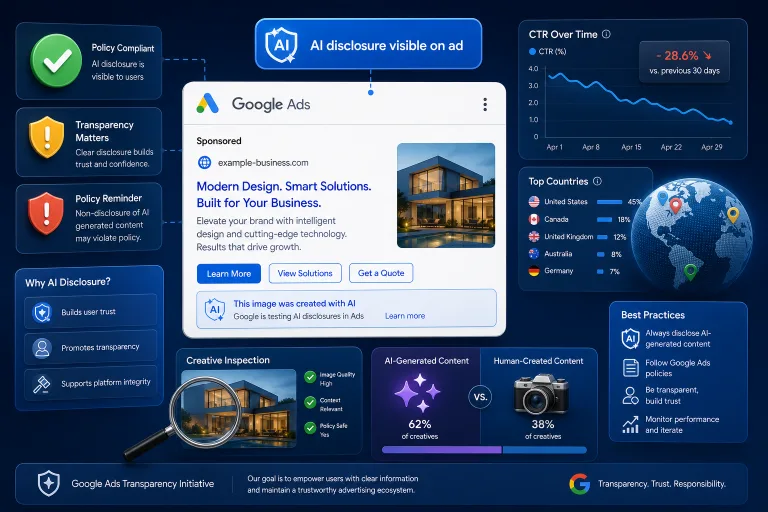
Starting July 9, 2026, Google will gradually roll out a new label in the ad information panel — “How this ad was made.” Now, users who click the information icon next to a Google Ads ad will see a specific item indicating whether the creative was created or edited using generative AI. This applies to both Performance Max with Google’s generative tools and third-party creatives uploaded by the advertiser.
For arbitrageurs and media buyers, this is not a cosmetic change. The label directly affects user trust in the ad, potentially lowers CTR on sensitive verticals, and creates a new layer of compliance that must be considered when scaling campaigns. This is especially impactful in niches where creative “authenticity” is part of the value proposition: nutra, fintech, crypto, and whitehat e-commerce with live product photos.
How the Labeling Mechanism Works
Google is implementing two labeling paths:
Automatic labeling. When an advertiser uses Google Ads’ native generative tools (e.g., image generation in Performance Max, AI text for Search ads, editing via Magic Editor), the label is enabled automatically. It cannot be disabled — it’s part of Google’s platform policy.
Manual labeling. If a creative is made in an external tool — Midjourney, DALL-E, Stable Diffusion, Canva AI, Adobe Firefly — and uploaded to Google Ads as a standard asset, the responsibility for disclosing AI origin falls on the advertiser. Google does not perform its own verification of generative origin for uploaded assets. However, if concealing AI generation is discovered in violation of policy, the account receives a warning or ban.
This means: Google delegates compliance to the advertiser but retains the right to impose sanctions. For arbitrageurs working through agency MCC accounts, this creates an additional risk — one hidden AI creative can cost access to an entire MCC.
Which Creatives Fall Under Labeling
Not every AI tool = labeling. Google distinguishes:
- Generative AI creation — labeling is mandatory. This includes images generated from text prompts, AI background expansion, object replacement in photos, and text variation generation.
- AI optimization — no label required. Automated bidding, Smart Bidding, Response Searcher Experience, dynamic headlines — this is algorithmic optimization, not content generation.
- AI assistance — a gray area. If a designer used AI for retouching, background removal, or color correction, but the base image is a real photograph, a label may not be required. Google has not yet provided clear boundaries for this category.
The problem for arbitrageurs: there is no clear boundary between “retouch” and “generation.” If you replaced the background on a product photo via AI, that’s generation. If you just removed a pimple, it’s not. But where is the line between “removed bags under the model’s eyes” and “generated a new person”? Google leaves this to the advertiser’s discretion, which in reality means — to the algorithm’s discretion during manual review.
Impact on CTR and Conversions: What to Expect
There is no direct A/B data from Google yet — the feature is just launching. But there are several factors that allow us to forecast the impact:
Negative scenario for sensitive verticals. In nutra and fintech, where trust is a critical factor, an open “created with AI” label can reduce CTR by 5–15%. Users who see “improve your credit score” next to an “made with AI” label naturally wonder: how real is the offer if even the image is generated?
Neutral scenario for e-commerce. In Performance Max for online stores, AI backgrounds and product placement are the norm. The label is unlikely to hit CTR hard because users are accustomed to “studio” product photos.
Positive scenario for broad targeting. For some audiences, an “AI-enhanced” label may be perceived as technological sophistication and brand modernity. Especially for Gen Z and tech-savvy audiences.
Practical takeaway: the effect depends on the vertical, audience, and how “artificial” the creative looks. If an AI photo is clearly unrealistic — the label amplifies negative perception. If AI was used for polishing — the label can be neutral.
Risks for Arbitrage Campaigns
Risk 1: Hiding AI Generation → Account Ban
The main risk is not lower CTR, but compliance. If you upload an AI-generated creative and don’t label it as AI, and Google discovers this (via a user complaint, auto-moderation, or manual review), the consequences are:
- Warning and a demand to fix it
- Ad disapproval
- For repeated violations — account suspension
- In an agency MCC — escalation to the entire MCC
For arbitrageurs running traffic through white agencies with postpay budgets, an MCC ban = frozen turnover for weeks.
Risk 2: GEO Mismatch
Google noted that in some markets, the AI label may be mandatory under local law. This means the same creative may be shown without a label in one country, and with a mandatory label in another. For arbitrageurs running traffic to multiple GEOs through a single campaign, this creates:
- Unpredictable CTR across countries
- Risk of violating local legislation
- Difficulties with A/B testing — results from different GEOs are incomparable
Risk 3: Leaking Operational Methods
For arbitrageurs, a “made with AI” label is a disclosure of part of their methodology. Competitors see which ads are generated and can copy the approach. In verticals with rapid creative copying (nutra, gambling), this accelerates bundle burnout.
Regulatory Context: Why Google Is Doing This Now
The launch of AI-labeling is not a Google initiative, but a reaction to regulatory pressure. The EU, through the AI Act, requires labeling of AI-generated content. In the US, the FTC has already fined several companies for misleading AI claims in advertising. Brazil, India, and Southeast Asia are developing their own rules.
Google is choosing a proactive strategy: implement the label globally before fragmented regulators start dictating formats. For advertisers, this means the label will evolve — today’s simple “how this ad was made” phrasing may turn into detailed disclosure specifying the model, prompt, and degree of editing within a year.
For arbitrageurs working on EU and US GEOs, this means: you need to build processes now, not wait for stricter rules.
Adaptation Strategies: What Media Buyers Should Do
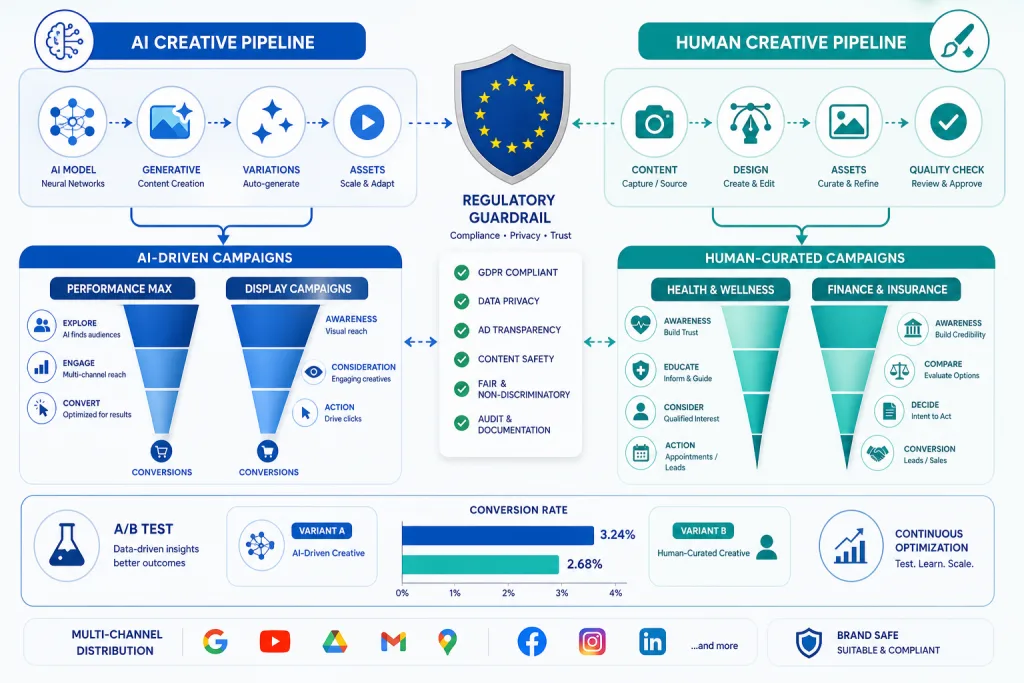
Strategy 1: Split Creative Pipelines
Create two creative pipelines:
- AI-pipeline — for Performance Max, broad targeting, Google Display, where the label is neutral or positive. Use Google’s generative tools so the label is enabled automatically and you don’t risk manual labeling issues.
- Human-pipeline — for sensitive verticals (nutra, fintech, crypto, legal services). Real photos, manual shooting, stock images with proper licenses. No AI editing — or minimal editing that doesn’t require labeling.
This is more expensive, but reduces the risk of bans and CTR drops on key campaigns.
Strategy 2: Local Labeling Instead of Global Hiding
If you run traffic to multiple GEOs, split campaigns by country with different AI labeling requirements. For EU campaigns, use only clean or correctly labeled creatives. For GEOs with soft regulation (Latin America, parts of Asia), you can be bolder with AI generation.
Strategy 3: Test the Label’s Impact on CTR
Launch parallel A/B tests:
- Creative A: AI-generated, labeled
- Creative B: similar in composition, but from stock or manual shooting, without a label
Compare CTR, CPC, and conversions. After 7–14 days, you’ll get data on the label’s real impact on your vertical. Don’t rely on general forecasts — the effect heavily depends on the specific offer and audience.
What Not to Do
- Don’t ignore the label. “Let’s wait until Google figures it out” is a bad strategy. The first fines and ad disapprovals are happening now.
- Don’t label everything as AI. Over-labeling is also harmful. If a creative is a designer’s manual work, an “AI” label lowers trust unnecessarily.
- Don’t rely on “Google doesn’t check.” Yes, Google doesn’t scan uploaded assets for AI origin. But user complaints and competitor reports trigger manual reviews.
- Don’t use one creative pipeline for all verticals. An AI creative that works in e-commerce can kill conversions in nutra.
Checklist: Preparing Campaigns for AI-Labeling
- Audit all active creatives: identify where a generative AI tool was used
- Split creative pipelines into AI and human for different verticals
- Set up manual labeling for creatives made in external AI tools
- A/B test: AI creative with a label vs. human creative without a label on the same audience
- Check GEO campaigns for compliance with local AI disclosure requirements
- Team guidelines: criteria for when AI editing requires labeling and when it doesn’t
How This Relates to Performance Max
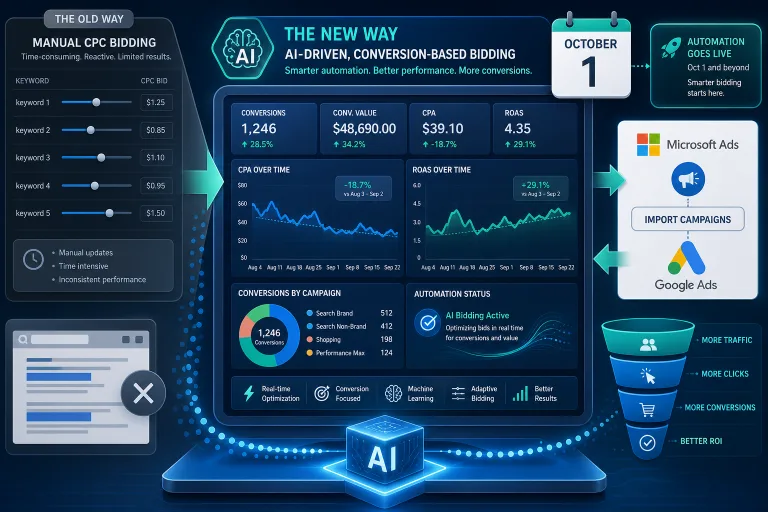
Performance Max is the main case where arbitrageurs encounter AI-labeling. Google is actively promoting generative tools within PMax: image generation, text headlines, background expansion for product photos. All of them are automatically labeled.
The question: does this reduce PMax campaign efficiency? There is no mass data yet, but logic suggests:
- For e-commerce PMax with AI-generated backgrounds — neutral, users are used to it
- For lead-gen PMax (nutra, fintech) — potentially negative, the label lowers trust
- For brand-awareness PMax — depends on the brand, well-known brands suffer less
Recommendation: for lead-gen PMax on sensitive verticals, disable generative assets and use only uploaded human creatives. Yes, this reduces variability — but lowers the risk of CTR and trust drops.
Forecast: What Happens Next
Over the next 6–12 months, expect:
- Label expansion to YouTube Ads. Video creatives with AI generation will receive similar labeling.
- Disclosure detail. Instead of just “AI” — specifying the type of generation: “background generated,” “text written by AI,” “model created by AI.”
- Integration with the Content Authenticity Initiative. Google may use C2PA metadata to automatically determine the AI origin of uploaded assets — making manual labeling verifiable.
- Penalties for hiding. As regulatory requirements mature, Google will tighten sanctions for non-disclosure of AI.
For arbitrageurs, this means: investing in labeling processes and splitting creative pipelines now is cheaper than dealing with the consequences in six months.
FAQ
Will Google check if a creative was actually made by AI?
No, Google does not scan uploaded assets for AI origin. But upon a user or competitor complaint, a manual review is triggered, and hiding AI generation can lead to an account ban.
What happens if I don’t label an AI creative as generated?
First violation — warning and ad disapproval. Repeated violations — account suspension. In agency MCC accounts, escalation may affect the entire MCC.
Does the AI label affect ad rating or the auction?
Google states that the label does not affect Quality Score or the auction directly. But indirectly — through CTR — the effect can be significant if users click less often on labeled ads.
Do I need to label AI text in Search Ads?
Yes, if the text is generated via Google Ads generative tools — the label is enabled automatically. If you wrote the text in ChatGPT and copied it to Google Ads — manual labeling is required, but in practice, this is almost impossible to track.
How does the label work in different countries?
Google applies the label globally, but in some markets (e.g., the EU), labeling may be mandatory under local law. In these cases, the format and content of the label may differ. For multi-GEO campaigns, split campaigns by country.