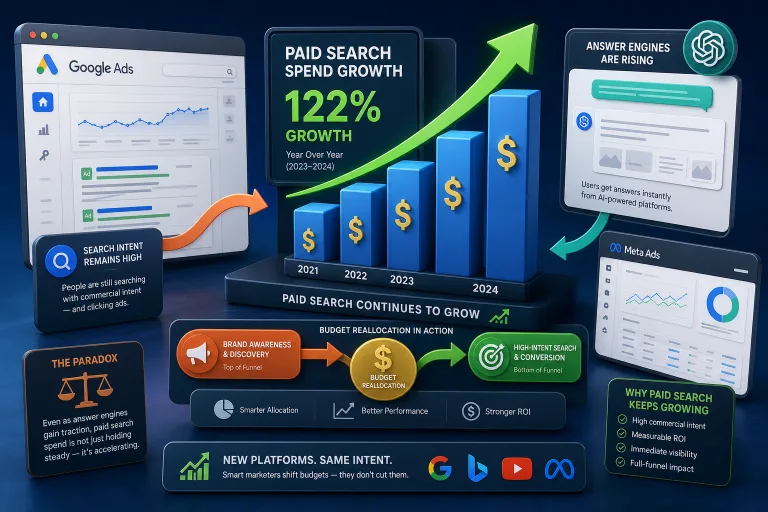
The paradox of 2026: Answer Engine Optimization (AEO) is actively eating into organic traffic, zero-click searches have become the norm, yet paid search has grown by 122% over 15 months. According to a report analyzing the spending of over 5,000 companies, aggregate paid search in the US grew from $45 million to $100 million. Google Ads in EMEA showed a 112% year-over-year growth to $110 million, and 41% in the US to $99 million. Facebook Ads grew even faster: 148% in EMEA and 211% in the US.
For affiliates, this means one thing: it’s too early to write off Google Ads. But running campaigns the old way is dangerous. Traffic quality is changing, CPC in certain verticals is rising, and a new threat is looming on the horizon—OpenAI, which plans to build a $100 billion advertising business. Let’s break down why paid search continues to grow, how AEO is changing click economics, and what media buyers should do right now.
Market Data: What the Spending of 5,000+ Companies Shows
The report, covering over 5,000 companies, highlights several key trends:
- Paid search maintains its lead as the largest channel in the digital marketing ecosystem across all regions.
- Growth is concentrated among two players: Alphabet (Google) and Meta (Facebook). Alternative networks are not capturing a significant share of the increase.
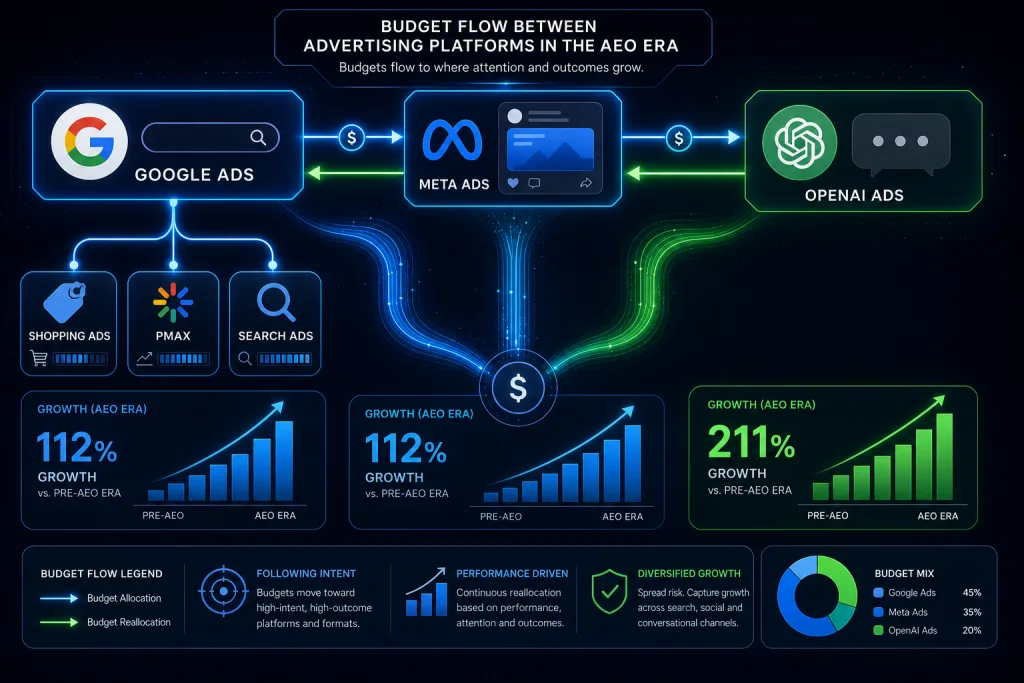
- Google Ads in EMEA grew by 112% year-over-year—up to $110 million in the analyzed sample.
- Facebook Ads in the US showed explosive growth of 211%—up to $84 million.
- Aggregate paid search in the US grew from $45 million to $100 million over the 15 months preceding April 2026.
These numbers indicate that advertisers are not abandoning paid search—on the contrary, they are increasing budgets. But the spending structure is changing: brand queries are getting more expensive, informational queries are partially intercepted by AI answers, and high-intent conversion queries are becoming the main battleground for affiliates.
Why Google Ads Continues to Grow Despite AEO
Logic suggests: if AI answers from Google and ChatGPT give the user a result without a click, paid search should suffer. But the data says otherwise. There are several reasons for this.
First—brands’ compensatory strategy. When organic results lose clicks due to AI Overviews and zero-click searches, brands increase their paid budgets to maintain visibility. This is especially noticeable in e-commerce and financial verticals, where losing a position in the SERP directly hits revenue.
Second—growth of commercial intent in paid formats. Google is actively expanding Shopping Ads, Performance Max, and generative ad formats that are shown directly within AI Overviews. Advertising is being integrated into the answer, not displaced by it.
Third—the “last click” effect. Even if a user gets some information from AI, the final transaction often occurs through a paid click. AI answers the question “what is best,” but the purchase goes through an ad link.
For affiliates, this means that Google Ads remains a working channel, but the click economics are shifting: you need to target the transactional stage of the funnel more precisely, rather than the informational one.
How AEO is Changing the Quality of Paid Traffic
Answer Engine Optimization is the optimization of content for answer engines: ChatGPT, Perplexity, Google AI Overviews. The user asks a question and gets a ready-made answer without navigating to a website. For organic traffic, this is a disaster. For paid traffic, it’s a complex but manageable shift.
Here is what is changing in the quality of paid traffic:
- Informational queries are losing value. Queries like “how to choose a VPN” or “what is mVAS” are increasingly closed by an AI answer. A paid click on such queries yields cold traffic with low conversion.
- Commercial queries are getting more expensive. Queries with explicit buying intent (“buy,” “price,” “order”) concentrate ad budgets. CPC is rising, competition is intensifying.
- Niche and long-tail queries remain effective. AI currently handles highly specialized commercial queries poorly. Long-tail with clear transactional intent is the sweet spot for affiliates.
- Local queries are strengthening. Google AI Overviews often don’t fully satisfy local needs. Ads with geo-targeting maintain high conversion rates.
Practical takeaway: redistribute budgets from broad informational campaigns to narrow commercial and local ones. Use negative keywords more aggressively to filter out informational noise.
The OpenAI Threat: A $100 Billion Ad Business
The main long-term risk for paid search is not AEO itself, but the monetization of AI answers. According to The Drum, OpenAI is planning an IPO and building a $100 billion advertising business. This means that budgets currently going to Google Ads and Meta will partially flow into advertising within ChatGPT and other AI products.
This creates three scenarios for affiliates:
Scenario 1—brand budget outflow. Large advertisers will start testing ads in ChatGPT. This could temporarily reduce competition in Google Ads and lower CPC in certain verticals. The window of opportunity for affiliates is 6–12 months after the launch of OpenAI Ads.
Scenario 2—a new platform for arbitrage. If OpenAI opens an ad API for third-party buyers, affiliates will get a new channel with potentially low CPC at the start. Risks: opaque attribution, strict compliance, possible restrictions on verticals.
Scenario 3—fragmentation of attention. Users will receive answers in the AI environment without visiting landing pages. Affiliates will have to adapt funnels for conversions within AI interfaces—a new format that currently lacks proven models.
Until OpenAI launches ads at full scale, affiliates should monitor API availability, ad formats, and content policies. Early tests could provide an advantage, but prepare for strict compliance—OpenAI is unlikely to allow grey offers.
Budget Redistribution Strategy for Affiliates
Based on the data on paid search growth and the threat from OpenAI, here is how affiliates should revise their budget allocation in 2026.
Retaining Google Ads—But With Filtering
Don’t abandon Google Ads, but review your campaign structure:
- Reduce the share of informational queries in your portfolio by 20–30%.
- Increase the share of Shopping Ads and Performance Max for e-commerce offers.
- Review search terms reports weekly to cut off AI-intercepted queries.
- Test generative ad formats in AI Overviews—they give direct access to the user within the answer.
Scaling Meta—For Funnels With Emotional Triggers
Facebook Ads is growing faster than Google in the US (211% vs. 41%). This is a signal: Meta is more effective for verticals where the decision is made on an emotional trigger rather than search intent. Gambling, dating, nutra, mVAS—verticals where Meta funnels with creative testing yield better ROAS than search campaigns.
Reserve 5–10% of Budget for Testing New Channels
Set aside a portion of your budget for experiments with ads in ChatGPT (via StackAdapt or directly, once access is available), TikTok Search Ads, and alternative networks. Early entry into a new channel usually provides the cheapest traffic.
Which Verticals Benefit from Paid Search Growth
Not all verticals benefit equally from the current dynamics. Based on the report data and arbitrage practice:
- E-commerce and DTC—the main beneficiary. Shopping Ads and PMax provide stable ROAS; AI answers don’t fully satisfy the purchasing need.
- Financial services and insurance—high CPC, but high payout. AI provides comparative information, but the final application goes through a paid click.
- mVAS and subscriptions—medium risk. Informational queries are intercepted by AI, but transactional long-tail works.
- Gambling and betting—Google Ads remains a complex channel due to compliance, but Meta’s growth compensates.
- Nutra and health—under pressure from AI answers on informational queries. Shifting budgets to Meta and TikTok is justified.
Risks and Compliance: What’s New
The growth of paid search and the emergence of new AI ad platforms bring several risks for affiliates:
- Rising CPC on commercial queries. The concentration of budgets at Google and Meta means the auction will only get more expensive. Factor in a 15–25% YoY CPC increase in your financial models.
- Attribution in the AI environment. If a user gets an answer in ChatGPT and makes a purchase without clicking your landing page, how do you attribute the conversion? Prepare for new attribution models—server-side tracking, conversion API, integration with AI platforms.
- OpenAI compliance. Advertising in ChatGPT will have strict content restrictions. Gambling, adult, grey-nutra are unlikely to pass moderation. White verticals are a priority for testing.
- Regulatory pressure. The ban on surveillance pricing in New Jersey is a precedent. Personalized pricing and targeting based on sensitive data will be restricted. Affiliates need to prepare funnels that don’t depend on price personalization.
Checklist: How to Redistribute Budgets for Paid Search Growth and the AEO Threat
- Audit search terms for the last 30 days: mark queries where CTR dropped by more than 20%—they are likely being intercepted by AI Overviews
- Reduce the share of informational campaigns in Google Ads by 20–30%, redirect the budget to Shopping Ads and PMax
- Check long-tail commercial queries in your niche—they offer better ROAS in the AEO era
- Increase the share of Meta Ads by 10–15% for verticals with emotional triggers (gambling, dating, nutra)
- Reserve 5–10% of the budget to test ads in ChatGPT when OpenAI opens the API
- Set up server-side tracking and conversion API to attribute conversions from the AI environment
- Recalculate your financial model factoring in a 15–25% YoY CPC increase
Forecast: What Will Happen to Paid Search by the End of 2026
Paid search won’t die from AEO—it will transform. By the end of 2026, we expect:
- Further integration of ads into AI Overviews. Google will embed paid results directly into AI answers, creating a hybrid format. Affiliates need to test these formats first.
- Full-scale launch of OpenAI Ads. The first 6 months after launch are a window for cheap traffic. Prepare white offers and clean landing pages.
- Increased concentration at Google and Meta. Alternative networks will lose share. Affiliates should focus on the two main platforms rather than spreading budgets thin.
- Growing importance of creatives. In an environment where AI provides a text answer, the creative and visual trigger become the main differentiator. Invest in creative testing.
FAQ
Is paid search really growing, or is it just CPC inflation?
The growth is real: the report records an increase in aggregate spending from $45 million to $100 million in the US over 15 months. Part of the growth is CPC inflation, but the main driver is companies increasing ad budgets to compensate for the loss of organic traffic.
Should affiliates switch to advertising in ChatGPT instead of Google Ads?
No, a full switch is impractical. Google Ads remains the main channel with established infrastructure. Ads in ChatGPT should be tested as an additional channel once OpenAI opens access. Reserve 5–10% of your budget for experiments.
Which verticals will suffer the most from AEO?
Informational verticals—nutra, health, education—where the user is looking for an answer, not a product. Transactional verticals—e-commerce, finance, insurance—are less vulnerable because AI provides information, but the purchase goes through a paid click.
How to prepare for the launch of OpenAI Ads?
Prepare white offers with clean landing pages, set up server-side tracking, and explore access via StackAdapt or directly. Monitor OpenAI’s content policy—grey verticals are unlikely to pass moderation.
Why is Meta growing faster than Google in the US?
Meta showed 211% growth in the US versus 41% for Google. The reason is Meta’s effectiveness for verticals with emotional triggers and improved Reels targeting. Affiliates should scale up Meta funnels, especially for gambling, dating, and nutra.